What does Genesis 36:37 mean?
"And Samlah died, and Saul of Rehoboth by the river reigned in his stead." - Genesis 36:37

Genesis 36:37 (KJV) reads, "And Samlah died, and Saul of Rehoboth by the river reigned in his stead." This verse comes from the book of Genesis, which is the first book of the Bible and is attributed to Moses. Genesis is a foundational text for Judaism, Christianity, and Islam, and is considered by many to be the literal word of God.
The context of Genesis 36:37 is in the genealogy of Esau, the older twin brother of Jacob and the grandson of Abraham. This chapter details the lineages of the Edomites, the descendants of Esau. Throughout the chapter, we are given the names of Esau's sons, the names of their chiefs, and the lands they inhabited. The verse in question specifically mentions the death of Samlah and the ascension of Saul of Rehoboth as his successor.
One of the central themes of this verse is the continuity of lineage and the passing of leadership from one generation to the next. In the biblical narrative, the succession of rulers is often of great significance, as it determines the fate and prosperity of the people. In this case, the death of Samlah and the ascension of Saul of Rehoboth represent the natural order of rulership and the transfer of authority within the Edomite community.
The symbolism of the river mentioned in the verse may also hold significance. In biblical literature, rivers are often used as symbols of life, fertility, and abundance. The mention of Saul of Rehoboth reigning "by the river" could be seen as a symbol of his governance being connected to the life-giving and sustaining properties of water. It could also symbolize the flow of time and the continuity of life, as rivers are constantly moving and changing.
Furthermore, the mention of Rehoboth itself could be symbolic. Rehoboth was a city mentioned in the book of Genesis, and its name means "broad places." This could symbolize the expansiveness and abundance of the territory that Saul was now reigning over, suggesting that he had inherited a prosperous and fertile land.
In a broader theological context, this verse can be seen as part of the larger narrative of God's sovereignty and control over the affairs of humanity. The deaths and successions of rulers are ultimately determined by God, who is the ultimate authority over all earthly kingdoms. This verse, therefore, serves as a reminder of the divine order of things and the ultimate sovereignty of God over human affairs.
In summary, Genesis 36:37 is a verse that may seem simple on the surface, but it carries deep themes of lineage, succession, and the divine sovereignty of God. The passing of leadership from Samlah to Saul of Rehoboth is a part of the broader narrative of the biblical text, and it serves as a reminder of the ultimate authority of God over all earthly rulers. The symbolism of the river and the mention of Rehoboth further enrich the meaning of this verse, adding layers of metaphor and significance to the narrative. Overall, this verse serves as a small yet significant piece of the larger tapestry of biblical theology and narrative.
Have questions about Genesis 36:37?
Dive deeper into this scripture with Bible Chat — an AI-powered tool for exploring God's Word through conversation. Ask questions, get context, and grow in your understanding of the Bible.
Get Our Apps


Genesis 36:37 Artwork
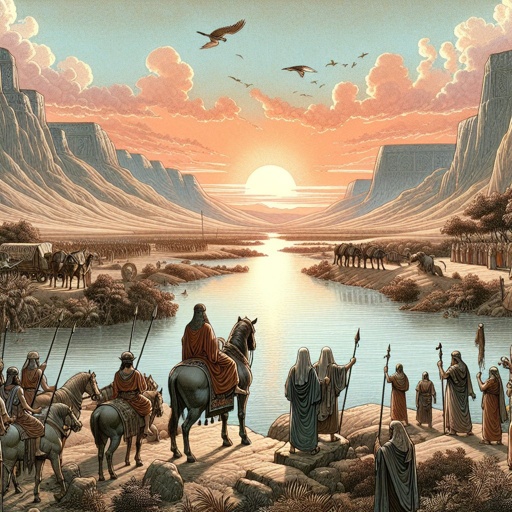
Genesis 36:37 - "And Samlah died, and Saul of Rehoboth by the river reigned in his stead."

"And Samlah died, and Saul of Rehoboth by the river reigned in his stead." - Genesis 36:37

Genesis 37:36 - "And the Midianites sold him into Egypt unto Potiphar, an officer of Pharaoh's, and captain of the guard."

"And the Midianites sold him into Egypt unto Potiphar, an officer of Pharaoh's, and captain of the guard." - Genesis 37:36

Matthew 12:36-37

matthew 12:36-37

Mark 4:36-37

Mark 9:36-37

Mark 4:36-37

Matthew 12:36-37

1 Corinthians 14:36-37

Genesis 36:36 - "And Hadad died, and Samlah of Masrekah reigned in his stead."

genesis 37

Exodus 36:37 - "¶ And he made an hanging for the tabernacle door of blue, and purple, and scarlet, and fine twined linen, of needlework;"

Genesis 24:36

Genesis 19-37

Genesis 24-37

Genesis 37:2

Psalms 37:36 - "Yet he passed away, and, lo, he was not: yea, I sought him, but he could not be found."

Genesis 19-36

Genesis 36:28 - "The children of Dishan are these; Uz, and Aran."

"And Hadad died, and Samlah of Masrekah reigned in his stead." - Genesis 36:36

Ezekiel 36:37 - "Thus saith the Lord GOD; I will yet for this be enquired of by the house of Israel, to do it for them; I will increase them with men like a flock."

Genesis 36:27 - "The children of Ezer are these; Bilhan, and Zaavan, and Akan."

Genesis 36:3 - "And Bashemath Ishmael's daughter, sister of Nebajoth."

Genesis 36:19 - "These are the sons of Esau, who is Edom, and these are their dukes."

Genesis 36:1 - "Now these are the generations of Esau, who is Edom."

Genesis 36:26 - "And these are the children of Dishon; Hemdan, and Eshban, and Ithran, and Cheran."

Genesis 36:42 - "Duke Kenaz, duke Teman, duke Mibzar,"

Genesis 36:9 - "¶ And these are the generations of Esau the father of the Edomites in mount Seir:"