The Weight of Change: Trusting God in Transitions
"And Samlah died, and Saul of Rehoboth by the river reigned in his stead." - Genesis 36:37

Genesis 36:37 reads, "And Samlah died, and Saul of Rehoboth by the river reigned in his stead." Though this line appears innocuous at first glance, it unveils layers of profound meaning regarding leadership, succession, and the faithfulness of God amidst change.
Change is an inevitable part of life, and yet, it can be one of the most challenging aspects we face. The transition from one leadership to another often stirs uncertainty and fear, especially when we're accustomed to the status quo. In this passage, we witness how the death of Samlah sets the stage for Saul of Rehoboth by the river to take over. Samlah, whose name means "the hearer of God," had led the Edomite people before his demise. With his passing, Saul’s ascent denotes a significant shift for the community.
Samlah’s death symbolizes the end of an era. Every leader, whether in public office or within private spheres, brings unique contributions to the table. Sometimes, the transition is smooth, and at other times, it may leave a void that feels insurmountable. The reign of Saul signifies that new leadership—regardless of its potential for good—brings with it the requirement for adjustment, trust, and faith. Each new ruler inherits both the history of their predecessor and the expectations of their followers. How often do we find ourselves grappling with change, struggling in a spiritual and emotional tug-of-war between nostalgia for what was and hope for what can be?
The KJV Bible offers profound wisdom on the subject of transitions. In Isaiah 43:18-19, God reassures us, "Remember ye not the former things, neither consider the things of old. Behold, I will do a new thing; now it shall spring forth; shall ye not know it?" This is an invitation to let go of our grip on the past. It compels us to trust in the Lord's sovereign plan, knowing that every situation—even death—can be a prelude to transformation and renewal.
As believers, it is essential to remind ourselves that God remains constant, irrespective of the changes occurring around us. Just as the river flows onward, persistent yet ever-changing, so too does God’s purpose in our lives. The mention of "Rehoboth by the river" carries rich symbolism; rivers often represent life, sustenance, and continuity. The new leadership of Saul represents hope as it flows from the need for guidance and direction in uncertain times. In the midst of change, God's intention may be to redirect us towards a flourishing future. We may find peace knowing that our lives, like the currents of a river, are under God’s miraculous sovereignty.
Let’s not overlook the spiritual connotation behind names in Scripture. Saul, whose name means "asked for, prayed for," reminds us of the importance of prayer in all transitions. We must seek God's guidance just as those in leadership do. In times when we are challenged with the changes in our lives—whether personal, professional, or spiritual—prayer becomes our lifeline to understanding God’s vision for us and hope for renewal.
In our personal transitions, let us engage in prayer, putting aside any murmurings of doubt or fear, allowing God to fill us with assurance. Through prayer, we invite the Holy Spirit into our process of adjustment, creating space for God's new ways of moving within us. We can reclaim our peace in knowing that, just as Saul took up the reigns after Samlah, all transitions are not marked by loss but by the continuous unfolding of God’s perfect plan.
In conclusion, let us hold onto the truth that, as changes arise in our midst—just as the leaders came and went—the everlasting God remains our foundation. In Him, we can face the unknown with courage, recognizing that there is always a purpose and a blessing when we trust in His divine arrangement. May we take solace and inspiration from Genesis 36:37, reminding ourselves that life will bring change, but God will always guide us through.
Want to reflect more on Genesis 36:37?
Continue your spiritual journey with Bible Chat — an AI-powered tool for exploring God's Word through conversation. Ask questions, discover connections, and deepen your understanding.
Get Our Apps


Genesis 36:37 Artwork
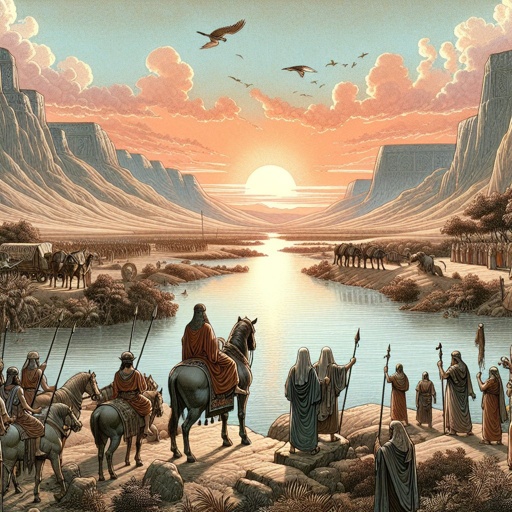
Genesis 36:37 - "And Samlah died, and Saul of Rehoboth by the river reigned in his stead."

"And Samlah died, and Saul of Rehoboth by the river reigned in his stead." - Genesis 36:37

Genesis 37:36 - "And the Midianites sold him into Egypt unto Potiphar, an officer of Pharaoh's, and captain of the guard."

"And the Midianites sold him into Egypt unto Potiphar, an officer of Pharaoh's, and captain of the guard." - Genesis 37:36

Matthew 12:36-37

matthew 12:36-37

Mark 4:36-37

Mark 9:36-37

Mark 4:36-37

Matthew 12:36-37

1 Corinthians 14:36-37

Genesis 36:36 - "And Hadad died, and Samlah of Masrekah reigned in his stead."

genesis 37

Exodus 36:37 - "¶ And he made an hanging for the tabernacle door of blue, and purple, and scarlet, and fine twined linen, of needlework;"

Genesis 24:36

Genesis 19-37

Genesis 24-37

Genesis 37:2

Psalms 37:36 - "Yet he passed away, and, lo, he was not: yea, I sought him, but he could not be found."

Genesis 19-36

Genesis 36:28 - "The children of Dishan are these; Uz, and Aran."

"And Hadad died, and Samlah of Masrekah reigned in his stead." - Genesis 36:36

Ezekiel 36:37 - "Thus saith the Lord GOD; I will yet for this be enquired of by the house of Israel, to do it for them; I will increase them with men like a flock."

Genesis 36:27 - "The children of Ezer are these; Bilhan, and Zaavan, and Akan."

Genesis 36:3 - "And Bashemath Ishmael's daughter, sister of Nebajoth."

Genesis 36:19 - "These are the sons of Esau, who is Edom, and these are their dukes."

Genesis 36:1 - "Now these are the generations of Esau, who is Edom."

Genesis 36:26 - "And these are the children of Dishon; Hemdan, and Eshban, and Ithran, and Cheran."

Genesis 36:42 - "Duke Kenaz, duke Teman, duke Mibzar,"

Genesis 36:9 - "¶ And these are the generations of Esau the father of the Edomites in mount Seir:"