What does Romans 8:15 mean?
"For ye have not received the spirit of bondage again to fear; but ye have received the Spirit of adoption, whereby we cry, Abba, Father." - Romans 8:15
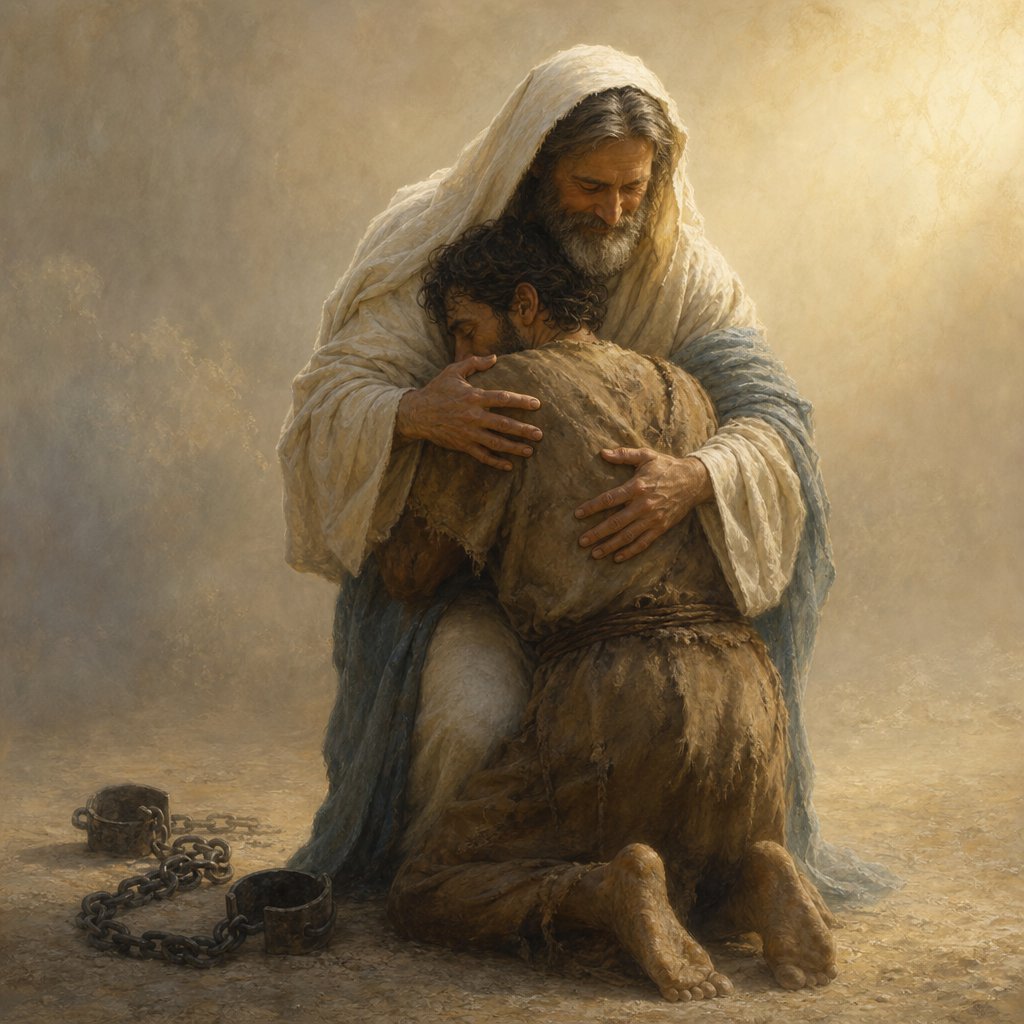
Romans 8:15 in the King James Version reads, “For ye have not received the spirit of bondage again to fear; but ye have received the Spirit of adoption, whereby we cry, Abba, Father.” In its plain sense, Paul is telling believers that what they have been given in Christ is not a return to a life dominated by slavery and fear, but a new relationship with God marked by sonship, confidence, and intimate access. The verse contrasts two “spirits,” not as two competing ghostly forces floating around a person, but as two governing realities and dispositions that characterize two different ways of standing before God: bondage that produces fear, and adoption that produces a child’s cry to a father.
The immediate context of Romans 8 is Paul’s unfolding of what it means to live under grace in Christ after the struggle described in Romans 7. Romans 8 opens with the declaration that there is “now no condemnation to them which are in Christ Jesus,” and then moves to the work of “the Spirit” in liberating believers from “the law of sin and death.” This matters for Romans 8:15 because Paul is not describing a mere change of mood; he is describing a change of status and master. The believer’s life is no longer defined by condemnation, captivity, and dread of judgment, but by the indwelling Holy Ghost, who leads the believer into a new way of relating to God. A few verses later Paul speaks of being “led by the Spirit of God” and calls such people “the sons of God,” and then he speaks of the Spirit “bearing witness with our spirit, that we are the children of God.” Romans 8:15 sits in the middle of that argument and functions like a doorway: it explains why believers can live as sons and not as slaves.
The phrase “the spirit of bondage again to fear” draws on the imagery of slavery. Bondage is not merely difficult circumstances; it is the condition of being under a master that compels and threatens. Within Romans, bondage is closely tied to sin’s tyranny and to the condemning power of the law upon the guilty conscience. Fear, in this setting, is not the reverent “fear of the LORD” that Scripture elsewhere commends; it is the dread that arises when a person knows he stands exposed and unaccepted, expecting punishment. Paul’s “again” hints at a return to an old condition, as though the gospel were merely another version of servitude. He rejects that entirely. Christianity, as Paul preaches it, is not a new system of terror meant to keep people in line; it is deliverance from the old prison-house where fear is the atmosphere.
Against that, Paul sets “the Spirit of adoption.” Adoption is a legal and relational word: it speaks of being placed as a son in a household, given a name, a standing, an inheritance, and the rights of family. Paul does not say believers have achieved adoption by their performance; he says they have “received” the Spirit of adoption. The significance is that this new standing before God is given, not earned, and it is inwardly sealed by the Holy Ghost. The Spirit is not simply providing information that adoption has happened; he is producing the lived reality of it in the believer, forming a filial disposition—an inclination to approach God as Father rather than to hide from him as Judge.
The climax of the verse is the cry, “whereby we cry, Abba, Father.” “Abba” is an intimate address used in the family circle, and “Father” interprets it for Paul’s readers. By placing the two together, the verse conveys both nearness and clarity: the believer’s approach to God is not vague sentimentality, nor is it cold formality. It is the warmth of a child’s confidence joined to the sober truth of who God is. The word “cry” is also important. Paul does not say, “whereby we reason,” or “whereby we recite,” but “whereby we cry.” It suggests something spontaneous and heartfelt, especially in need and dependence. When the Spirit of adoption is operative, prayer becomes less like pleading for acceptance and more like the instinctive turning of a child toward a father—still humble, still dependent, but not paralyzed by terror.
Symbolically, the verse depicts a transfer of households. Bondage evokes the house of slavery where fear polices the heart; adoption evokes the Father’s house where love grants access. In bondage, the voice within says, in effect, “You do not belong, and you must dread the lash.” In adoption, the Spirit moves the believer to say, “I belong, and I may draw near.” This does not mean the believer becomes careless about sin or indifferent to God’s holiness. Romans 8 has already spoken of mortifying “the deeds of the body,” and later it speaks of suffering with Christ. The difference is the motive and the posture: holiness is not pursued to escape rejection, but because rejection has been removed in Christ and a new family life has begun.
The theological weight of Romans 8:15 is that it ties assurance, prayer, and identity directly to the Holy Ghost. The believer’s freedom from fear is not grounded in self-confidence but in the gift of the Spirit, and the believer’s sense of sonship is not merely an abstract doctrine but something that expresses itself in the most basic act of religion: calling upon God. The verse therefore teaches that the gospel changes the believer’s relationship to God at its root. Instead of standing at a distance under the shadow of bondage, the believer is brought near under the banner of adoption, and the Spirit given by God becomes the inward witness and living impulse by which the believer says, with real personal trust, “Abba, Father.”
Have questions about Romans 8:15?
Dive deeper into this scripture with Bible Chat — an AI-powered tool for exploring God's Word through conversation. Ask questions, get context, and grow in your understanding of the Bible.
Get Our Apps


Romans 8:15 Artwork

Romans 8:15-16

Romans 8:15 - "For ye have not received the spirit of bondage again to fear; but ye have received the Spirit of adoption, whereby we cry, Abba, Father."
"For ye have not received the spirit of bondage again to fear; but ye have received the Spirit of adoption, whereby we cry, Abba, Father." - Romans 8:15

Romas 8:15-16

Romans 15:8 - "Now I say that Jesus Christ was a minister of the circumcision for the truth of God, to confirm the promises made unto the fathers:"

Romans 8

romans 8

Romans 8:8 - "So then they that are in the flesh cannot please God."

Romans 8:31

Romans 8:28

Romans 8:19

Romans 13:8

Romans 8:28

Romans chapter 8

Romans 8:14

romans 8:38

Romans 5:8

Romans 8:35

Romans 10:13-15

Romans 5:8

Romans 8:28

Romans 13:8

Romans 5:8

Romans 8:6

Romans 8:16

Romans 8:28

Romans 8:19

Romans 8:31

Romans 8:1

Romans 8:29