What does Romans 16:20 mean?
"And the God of peace shall bruise Satan under your feet shortly. The grace of our Lord Jesus Christ be with you. Amen." - Romans 16:20
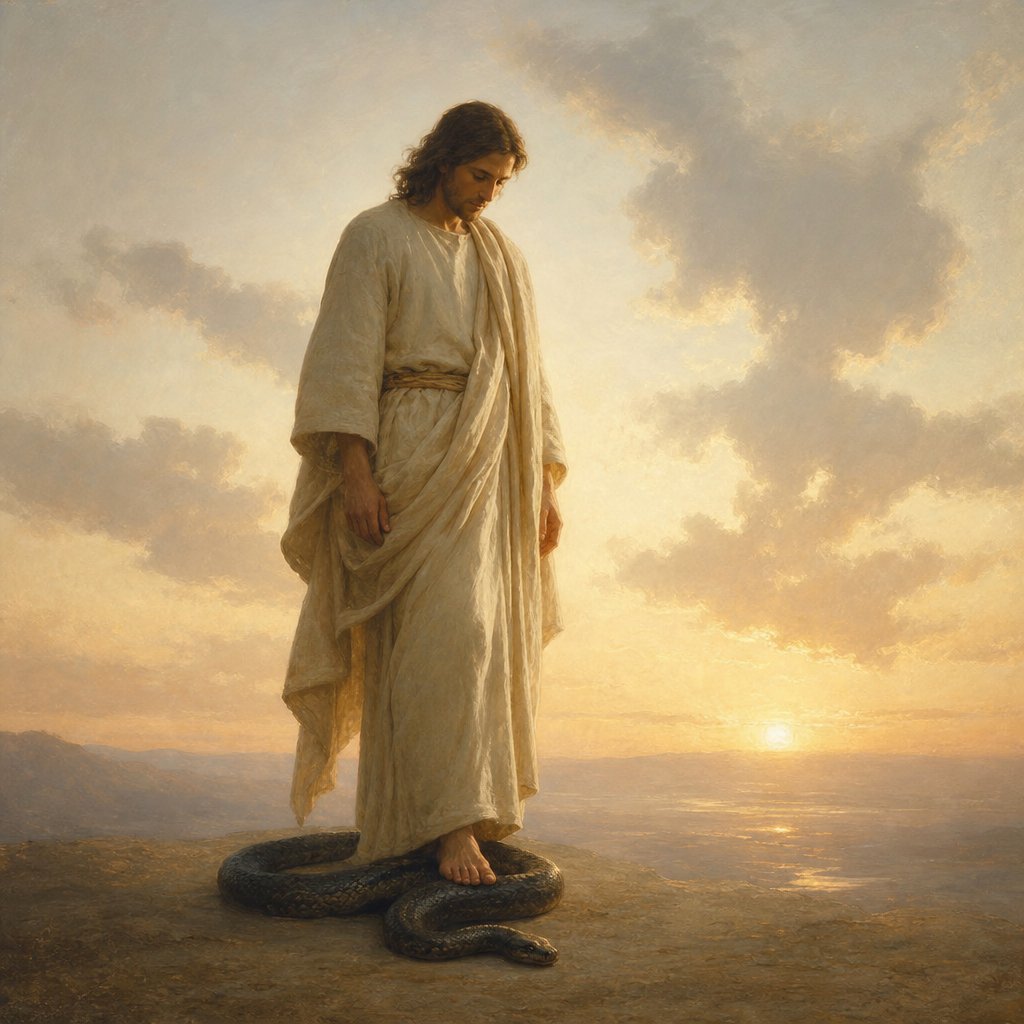
Romans 16:20 in the KJV reads, “And the God of peace shall bruise Satan under your feet shortly. The grace of our Lord Jesus Christ be with you. Amen.” It stands near the close of Paul’s epistle, in the middle of final exhortations and greetings, and it functions like a concluding assurance: the conflicts, divisions, and spiritual dangers Paul has been warning about are real, but they are not ultimate. The verse gathers up the letter’s themes of God’s saving rule, the believer’s new standing in Christ, and the certainty of God’s victory, and it presses them into a single promise framed by peace and grace.
Its immediate context is Paul’s warning a few verses earlier about those who “cause divisions and offences contrary to the doctrine which ye have learned,” and his call to the Roman believers to “mark” and “avoid” them, to be “wise unto that which is good, and simple concerning evil” (Romans 16:17–19, KJV). Against that backdrop, “Satan” is not introduced as an abstract idea but as the deeper spiritual power that works through deception, false doctrine, and the disruption of the church’s unity. The Roman congregation is being asked to exercise discernment and obedience, yet the decisive outcome is attributed to God: “the God of peace shall bruise Satan.” Human watchfulness matters, but the victory belongs to God and comes from God.
The title “the God of peace” is itself significant. Peace in Romans is not merely the absence of trouble; it is the reconciled relationship established by God through Christ: “Therefore being justified by faith, we have peace with God through our Lord Jesus Christ” (Romans 5:1, KJV). That reconciled peace becomes the atmosphere in which the church is meant to live, and the standard by which divisive teaching is exposed as alien to the gospel. Paul’s wording is almost paradoxical: the God characterized by peace is the One who crushes the great disturber of peace. The point is not that God is both peaceful and violent in the same way, but that true peace is not sentimental tolerance of evil; it is the settled wholeness God creates by defeating what destroys communion with God and with one another.
“Shall bruise Satan” carries a strong note of biblical symbolism. The language of bruising evokes the earliest promise of deliverance in Scripture, where the serpent is put under judgment: “it shall bruise thy head, and thou shalt bruise his heel” (Genesis 3:15, KJV). By choosing this verb, Paul connects the church’s present struggle to the long arc of God’s redemptive plan. Satan appears as “the serpent,” the deceiver from the beginning, and the “bruising” indicates a decisive defeat. In Genesis the serpent’s head is the target, the place of mortal blow; Romans echoes the same imagery of overthrow. Paul is not saying that believers, by their own strength, crush Satan; he is saying that God will do it, and that He will do it “under your feet,” meaning in such a way that the saints share in the triumph and publicly stand in the position of victory.
The phrase “under your feet” also resonates with the Bible’s broader symbolism of subjugation. To be placed under someone’s feet is to be put in a posture of defeat and humiliation, to have one’s authority broken. In the life of the church, this means that the enemy’s power to dominate, accuse, and fracture is destined to be put down in the very arena where he tried to work: among the people of God. It also fits Romans’ theology of union with Christ. The New Testament repeatedly teaches that Christ has triumphed and that believers participate in His triumph; the church’s victory is derivative and shared, not independent. Romans 16:20 compresses that reality into a promise that the God who reconciles will also conquer.
“Shortly” adds both comfort and tension. Comfort, because it tells the Romans that God is not indifferent and that the struggle is not endless; the defeat of Satan is not a distant wish but an appointed certainty. Tension, because “shortly” can function in Scripture as the language of nearness from God’s perspective and in God’s timing, not necessarily as a calendar measure the reader can control. In the immediate sense, Paul may be encouraging them that the present threats—divisive influences and the turmoil they stir—will not be allowed to prevail for long if they remain obedient to the doctrine they have learned. In the larger sense, the final overthrow of Satan belongs to God’s consummation, yet it is so assured that it can be spoken of as near, pressing upon the present. The Christian life, in Romans, is lived between what God has already done in Christ and what He will yet bring to completion; “shortly” holds those two horizons together.
The verse ends with, “The grace of our Lord Jesus Christ be with you. Amen.” This closing is not a mere polite farewell; it is the theological ground of everything just said. If peace is God’s gift and Satan’s defeat is God’s work, then the sustaining power for the church in the meantime is grace—God’s unmerited favor and enabling presence through Jesus Christ. Romans began by announcing “grace” and the gospel of God (Romans 1:1, 1:7, KJV), unfolded justification and new life as gifts, and now ends by blessing the believers with the very thing they need to stand, discern, and persevere. The promise of Satan’s bruising is therefore not detached from daily Christian dependence; it is wrapped in grace, meaning that the church’s hope is not in its own cleverness or strength, but in the continued favor and help of Christ.
Taken as a whole, Romans 16:20 is a compact statement of assurance for a community being urged to guard its unity and doctrine. It sets the church’s immediate challenges within the cosmic conflict that began in Genesis, it declares that God’s peace is not fragile but victorious, it portrays Satan’s defeat in the vivid symbolism of being crushed beneath the feet of God’s people, and it anchors the entire hope in the abiding grace of “our Lord Jesus Christ.” In one sentence, Paul both sobers the believer about the reality of the enemy and steadies the believer with the certainty that the God who gives peace will also finish the war.
Have questions about Romans 16:20?
Dive deeper into this scripture with Bible Chat — an AI-powered tool for exploring God's Word through conversation. Ask questions, get context, and grow in your understanding of the Bible.
Get Our Apps


Romans 16:20 Artwork

Romans 16:20 - "And the God of peace shall bruise Satan under your feet shortly. The grace of our Lord Jesus Christ be with you. Amen."
"And the God of peace shall bruise Satan under your feet shortly. The grace of our Lord Jesus Christ be with you. Amen." - Romans 16:20

Romans 8:16

Romans 16:17

Romans 16:17

Romans 16:17

Romans 16:16 - "Salute one another with an holy kiss. The churches of Christ salute you."

Romans 8:15-16

Romans 3:16 - "Destruction and misery are in their ways:"

Romans 16:8 - "Greet Amplias my beloved in the Lord."

Romans 14:16 - "Let not then your good be evil spoken of:"

Romans 1:16 to the Jew first

Romans 16:6 - "Greet Mary, who bestowed much labour on us."

Romans 16:3 - "Greet Priscilla and Aquila my helpers in Christ Jesus:"

Romans 16:13 - "Salute Rufus chosen in the Lord, and his mother and mine."

"Destruction and misery are in their ways:" - Romans 3:16

Romans 6:20 - "For when ye were the servants of sin, ye were free from righteousness."

Romans 2:20 - "An instructor of the foolish, a teacher of babes, which hast the form of knowledge and of the truth in the law."

Romans 16:24 - "The grace of our Lord Jesus Christ be with you all. Amen."

Romans 16:9 - "Salute Urbane, our helper in Christ, and Stachys my beloved."

Romans 16:22 - "I Tertius, who wrote this epistle, salute you in the Lord."

Romans 7:20 - "Now if I do that I would not, it is no more I that do it, but sin that dwelleth in me."

Romans 16:14 - "Salute Asyncritus, Phlegon, Hermas, Patrobas, Hermes, and the brethren which are with them."

Romans 16:27 - "To God only wise, be glory through Jesus Christ for ever. Amen."

Romans 9:16 - "So then it is not of him that willeth, nor of him that runneth, but of God that sheweth mercy."

Romans 11:16 - "For if the firstfruit be holy, the lump is also holy: and if the root be holy, so are the branches."

Romans 8:16 - "The Spirit itself beareth witness with our spirit, that we are the children of God:"

Romans 16:10 - "Salute Apelles approved in Christ. Salute them which are of Aristobulus' household."

"And brought them to the magistrates, saying, These men, being Jews, do exceedingly trouble our city," - Acts 16:20

Romans 3:20 - "Therefore by the deeds of the law there shall no flesh be justified in his sight: for by the law is the knowledge of sin."