What does Romans 15:1 mean?
"We then that are strong ought to bear the infirmities of the weak, and not to please ourselves." - Romans 15:1

Romans 15:1 from the King James Version of the Bible states, "We then that are strong ought to bear the infirmities of the weak, and not to please ourselves." This verse is part of the larger context of the book of Romans, a letter written by the apostle Paul to the Christians in Rome.
The overarching theme of the book of Romans is the righteousness of God and the importance of faith in Jesus Christ. In this particular verse, Paul is addressing the way in which Christians should treat one another, particularly in the context of differing levels of spiritual maturity and strength.
When Paul speaks of "the strong," he is likely referring to those Christians who are spiritually mature and grounded in their faith. These are the believers who have a firm understanding of Christian doctrine, are able to resist temptation, and are not easily swayed by false teachings or worldly influences. On the other hand, "the weak" refers to those who are new in their faith, easily led astray, or struggling with doubts and fears.
Paul encourages the strong to "bear the infirmities of the weak," which means that they should be patient, understanding, and supportive of their fellow believers who may be struggling. This is in line with the teachings of Jesus, who emphasized the importance of loving and caring for one another, especially in times of need. The strong are called to be compassionate and empathetic, to assist and uplift their weaker brothers and sisters in Christ.
Furthermore, Paul exhorts the strong not to "please ourselves." This serves as a reminder that the Christian life is not meant to be self-centered or focused solely on personal satisfaction and comfort. Instead, believers are called to sacrificially love and serve one another, putting the needs of others above their own desires.
The verse also echoes the teachings of Jesus, who said, "It is more blessed to give than to receive" (Acts 20:35). The act of bearing the infirmities of the weak is a demonstration of selflessness and humility, reflecting the love and compassion of Christ. It is an opportunity for the strong to imitate Jesus, who came not to be served, but to serve and give His life as a ransom for many (Mark 10:45).
In a broader context, this verse speaks to the unity and community of the body of Christ. The church is meant to be a place of mutual support, encouragement, and edification. It is a place where believers can come together to share their burdens, joys, and struggles, and to experience the love and grace of God through one another.
The deeper symbolism of this verse lies in the understanding of the Christian life as a journey of growth and transformation. As believers grow in their faith and spiritual maturity, they are called to help and strengthen their fellow travelers who may be struggling along the way. This is the essence of true Christian fellowship – to walk alongside one another, bearing each other's burdens, and spurring one another on toward love and good deeds (Hebrews 10:24).
In conclusion, Romans 15:1 serves as a powerful reminder of the importance of selfless love and support within the body of Christ. It challenges believers to consider how they can help and encourage their weaker brothers and sisters, and to live in a manner that reflects the sacrificial love of Jesus. By embodying this principle, Christians can build a community of faith that is characterized by unity, love, and mutual edification.
Have questions about Romans 15:1?
Dive deeper into this scripture with Bible Chat — an AI-powered tool for exploring God's Word through conversation. Ask questions, get context, and grow in your understanding of the Bible.
Get Our Apps


Romans 15:1 Artwork

Romans 15:1 - "We then that are strong ought to bear the infirmities of the weak, and not to please ourselves."

Romans 15:1-2 - "We who are strong ought to bear with the failings of the weak and not to please ourselves. Each of us should please our neighbors for their good, to build them up."

"We then that are strong ought to bear the infirmities of the weak, and not to please ourselves." - Romans 15:1
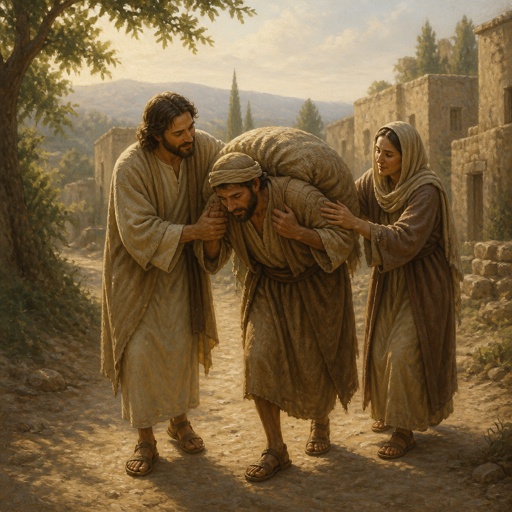
"We who are strong ought to bear with the failings of the weak and not to please ourselves. Each of us should please our neighbors for their good, to build them up." - Romans 15:1-2

Romans 1:15 - "So, as much as in me is, I am ready to preach the gospel to you that are at Rome also."

Romans 10:13-15

Romans 8:15-16

Romans 3:15 - "Their feet are swift to shed blood:"

"So, as much as in me is, I am ready to preach the gospel to you that are at Rome also." - Romans 1:15

Romans 15:33 - "Now the God of peace be with you all. Amen."

Romans 12:15 - "Rejoice with them that do rejoice, and weep with them that weep."

Romans 4:15 - "Because the law worketh wrath: for where no law is, there is no transgression."

Romans 15:25 - "But now I go unto Jerusalem to minister unto the saints."

Romans 15:10 - "And again he saith, Rejoice, ye Gentiles, with his people."

Romans 15:32 - "That I may come unto you with joy by the will of God, and may with you be refreshed."

Romans 15:2 - "Let every one of us please his neighbour for his good to edification."

Romans 15:15 - "Nevertheless, brethren, I have written the more boldly unto you in some sort, as putting you in mind, because of the grace that is given to me of God,"

"Their feet are swift to shed blood:" - Romans 3:15

Romans 15:21 - "But as it is written, To whom he was not spoken of, they shall see: and they that have not heard shall understand."

Romans 15:7 - "Wherefore receive ye one another, as Christ also received us to the glory of God."

Romans 16:15 - "Salute Philologus, and Julia, Nereus, and his sister, and Olympas, and all the saints which are with them."

Romans 15:3 - "For even Christ pleased not himself; but, as it is written, The reproaches of them that reproached thee fell on me."

Romans 15:11 - "And again, Praise the Lord, all ye Gentiles; and laud him, all ye people."

Romans 15:22 - "For which cause also I have been much hindered from coming to you."

Romans 15:26 - "For it hath pleased them of Macedonia and Achaia to make a certain contribution for the poor saints which are at Jerusalem."

Romans 1

Romans 11:15 - "For if the casting away of them be the reconciling of the world, what shall the receiving of them be, but life from the dead?"

Romans 6:15 - "What then? shall we sin, because we are not under the law, but under grace? God forbid."

Romans 15:5 - "Now the God of patience and consolation grant you to be likeminded one toward another according to Christ Jesus:"

Romans 15:28 - "When therefore I have performed this, and have sealed to them this fruit, I will come by you into Spain."