What does Revelation 12:11 mean?
"And they overcame him by the blood of the Lamb, and by the word of their testimony; and they loved not their lives unto the death." - Revelation 12:11
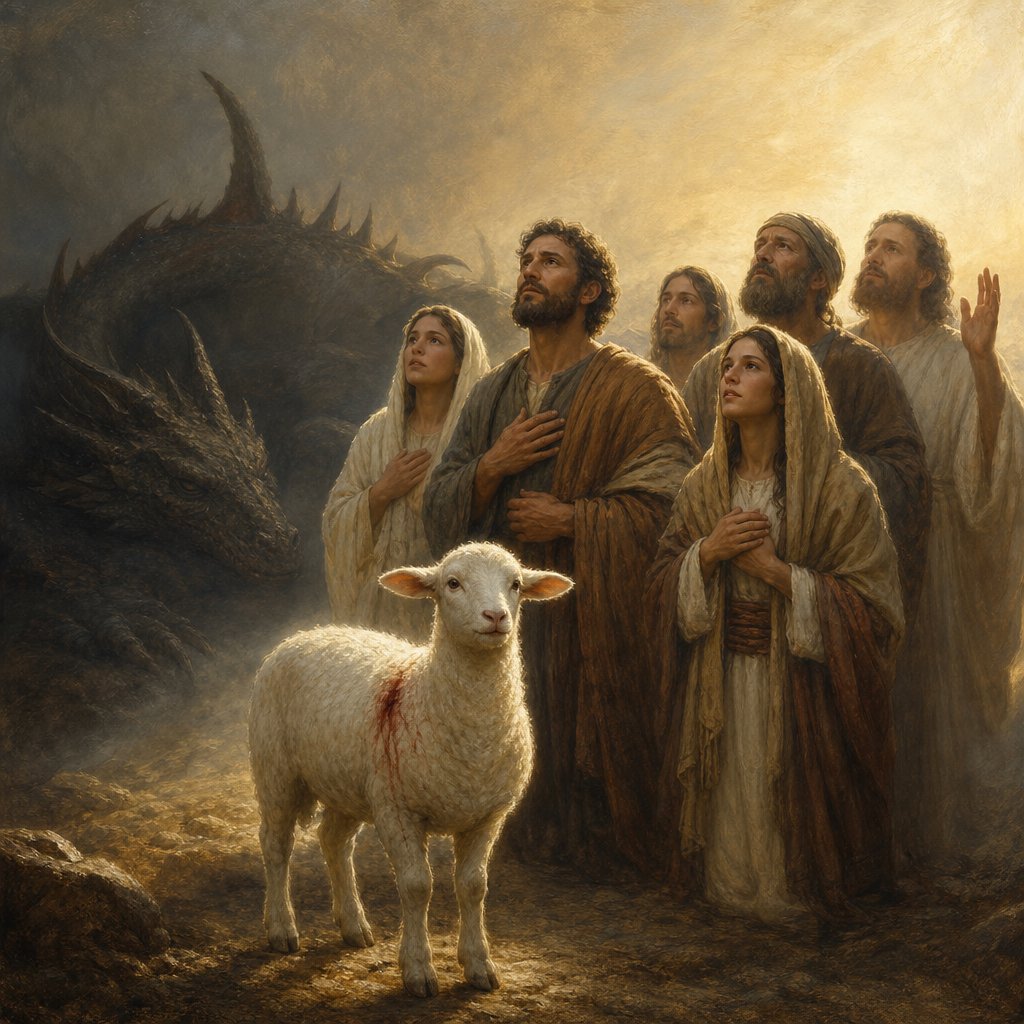
Revelation 12:11 in the King James Version reads, “And they overcame him by the blood of the Lamb, and by the word of their testimony; and they loved not their lives unto the death.” In its own setting this sentence stands inside a dramatic heavenly conflict, and its meaning comes into focus when it is heard as part of the larger vision: Satan is portrayed as the great adversary, the accuser, and the dragon who wars against the people of God, while God’s purpose in Christ triumphs over him. The verse explains how that triumph is shared in by “they,” a people who belong to God and who are caught up in the same conflict.
The immediate context is the war in heaven described earlier in Revelation 12, where “the great dragon… that old serpent, called the Devil, and Satan” is cast down. The vision then calls him “the accuser of our brethren… which accused them before our God day and night.” Revelation 12:11 answers the question of what defeats such an accuser. The enemy’s weapon is accusation, condemnation, and intimidation, but the victory described here is not achieved by earthly power or by the saints’ natural strength; it is achieved in a way that matches the spiritual nature of the battle. It is a victory over Satan’s claim, over his right to condemn, and over his power to terrify.
The first and controlling theme is redemption and atonement: “they overcame him by the blood of the Lamb.” In Revelation, “the Lamb” is Jesus Christ, presented throughout the book as the One who was slain and yet lives and reigns. “Blood” in Scripture is life given, sacrifice offered, and covenant established; in the language of Revelation it marks the decisive act by which Christ purchases, cleanses, and secures His people. The accuser’s fundamental charge against God’s people is that they are guilty and therefore belong to judgment; the answer given here is not self-defense but Christ’s sacrifice. The blood of the Lamb speaks to God’s justice satisfied and to the believer’s standing changed. In other words, Satan is overcome because his accusations are rendered powerless where God has accepted the Lamb’s blood on behalf of His people.
The second theme is faithful witness: “and by the word of their testimony.” Revelation repeatedly emphasizes testimony, witness, and confession of Jesus in the face of pressure to deny Him. The “word” here is not mere speech in the abstract; it is the public and personal confession of what God has done in Christ and the believer’s allegiance to Him. In the structure of the verse, the blood of the Lamb is the ground of victory, and the saints’ testimony is the manner in which that victory is held and displayed. Their testimony does not add to the Lamb’s work, but it is the faithful declaration and endurance that refuses to surrender to the dragon’s lies. The enemy is “the accuser,” and testimony functions as the opposite of accusation: it is truth spoken in loyalty to God, even when that truth is costly.
The third theme is sacrificial perseverance: “and they loved not their lives unto the death.” This line makes plain that the victory of Revelation 12:11 is often experienced under persecution. The saints “overcome” not by preserving earthly life at all costs, but by valuing Christ above life itself. The phrase does not glorify death for its own sake; it describes a settled priority in which fear of death no longer rules the conscience. In Revelation, the dragon makes war with the faithful, and the pressure is to compromise, to worship what is false, or to silence witness. The saints’ refusal to “love” their lives “unto the death” means that even the ultimate threat cannot make them abandon the Lamb. Satan’s power to dominate is tied to fear and accusation; when a believer stands in the Lamb’s blood and continues in testimony even under threat, the enemy’s leverage breaks.
Symbolically, the verse gathers several of Revelation’s central images into one statement. The “Lamb” is a paradoxical figure: gentle, slain, yet victorious. That symbolism teaches that God’s triumph comes through what appears weak to the world, through suffering obedience and sacrificial love rather than coercion. “Blood” symbolizes both cost and cleansing; it implies that victory is purchased, not earned, and that it involves real suffering, not mere ideas. “Testimony” symbolizes prophetic truth and covenant loyalty; it is the voice of the church in a hostile world, echoing heaven’s verdict rather than the accuser’s. “Unto the death” symbolizes the limit of earthly power; the dragon can threaten the body, but he cannot overturn the Lamb’s saving work or silence the testimony that is willing to suffer.
The significance of Revelation 12:11, then, is that it describes a distinctively Christian kind of conquering. In Revelation, to “overcome” is not primarily to dominate opponents but to remain faithful to God in the face of spiritual assault and earthly persecution. The verse ties overcoming to three inseparable realities: Christ’s finished sacrifice, the believer’s confession and witness, and steadfast endurance that refuses to be ruled by fear. It is a portrait of how God’s people share in Christ’s victory in the midst of an ongoing war. Satan is cast down, yet still rages; the saints are attacked, yet are called “overcomers.” Their triumph is not that they never suffer, but that suffering and even death cannot separate them from the Lamb or silence their allegiance. Revelation 12:11 thus serves as a theological summary of how the kingdom of God advances in Revelation’s vision: the Lamb’s blood secures God’s people, their testimony proclaims the truth, and their steadfastness unto death demonstrates that the accuser has lost his claim and his control.
Have questions about Revelation 12:11?
Dive deeper into this scripture with Bible Chat — an AI-powered tool for exploring God's Word through conversation. Ask questions, get context, and grow in your understanding of the Bible.
Get Our Apps


Revelation 12:11 Artwork

Revelation 12:11 - "And they overcame him by the blood of the Lamb, and by the word of their testimony; and they loved not their lives unto the death."
"And they overcame him by the blood of the Lamb, and by the word of their testimony; and they loved not their lives unto the death." - Revelation 12:11

Revelation 11:12 - "And they heard a great voice from heaven saying unto them, Come up hither. And they ascended up to heaven in a cloud; and their enemies beheld them."

Revelation 12:3

Revelation 12:3-9

Revelation 1:11

Revelation 21:11

Revelation 11:9

Revelation 21:11

Revelation 1:11

Revelation 21:12

Revelation 12:1

Revelation 12:7

Revelation 1:11

Revelation 9:11

Revelation 1:12-16

revelation 12:1-3

Revelation 1:12-16

Revelations 7:11

Revelations 8:11-13

John 1:1-2

John 1:1-2

John 1:1-2

John 1:1-2

John 1:1-2

Revelation 12:8 - "And prevailed not; neither was their place found any more in heaven."

REVELATION 11:6. WATERS TURNING TO BLOOD

Revelation 16:11 - "And blasphemed the God of heaven because of their pains and their sores, and repented not of their deeds."

Revelation 12:2 - "And she being with child cried, travailing in birth, and pained to be delivered."

Revelation 11:14 - "The second woe is past; and, behold, the third woe cometh quickly."