What does Psalms 119:105 mean?
"Thy word is a lamp unto my feet, and a light unto my path." - Psalms 119:105
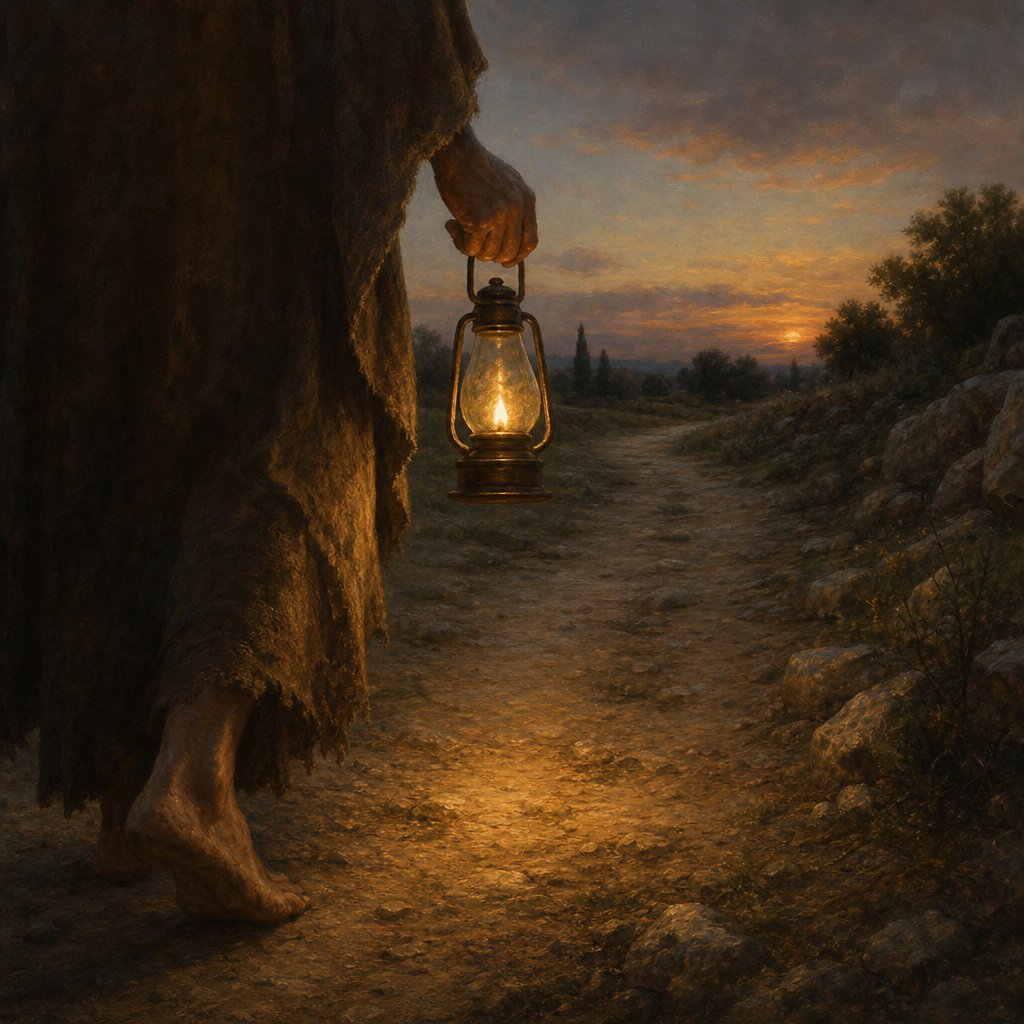
“Thy word is a lamp unto my feet, and a light unto my path.” Psalm 119:105 (KJV) gathers into one sentence the central burden of Psalm 119 as a whole: the life of faith is meant to be lived under the guidance of the LORD’s revealed word. In the KJV, “thy word” is spoken directly to God, so the verse is not an abstract proverb but a confession of dependence and devotion. The speaker is not merely admiring Scripture; he is declaring that God’s own utterance governs his movement, his choices, his direction, and his safety as he walks through a world where the way is not naturally clear.
The immediate context is Psalm 119’s sustained meditation on God’s law, commandments, statutes, judgments, testimonies, and precepts. Throughout the psalm, the writer repeatedly describes affliction, opposition, and the pressure of temptation, and he answers these realities not with self-confidence but with repeated returns to God’s word. Verse 105 sits within a section where the psalmist has been affirming loyalty to God in the midst of danger and sorrow, speaking of having “sworn” to keep God’s righteous judgments, and crying to be “quickened” according to God’s word. In that setting, the imagery of light is not decorative; it is survival language. The psalmist is walking through circumstances where missteps can wound, where traps can be laid, and where the heart can wander. God’s word becomes the reliable means of forward movement.
The symbolism is built from two closely related pictures: a lamp for “my feet” and a light for “my path.” “Feet” points to immediate, present steps: what to do next, how to act today, how to keep from stumbling in the next moment of moral or spiritual difficulty. A “path” points to a larger course: the direction of one’s life, the pattern of one’s conduct, the long obedience of faith. The verse holds both together. It presents God’s word as sufficient for the near decision and for the overall direction, for the small act of obedience and for the settled way of righteousness. The pairing also suggests that divine guidance is often given as needed. A lamp shows what is right at one’s feet; it does not floodlight the whole landscape at once. The believer is invited into trust, taking faithful steps in the light already given, rather than demanding certainty about every future turn before obeying.
Light in Scripture commonly signals truth, holiness, and the exposure of what is hidden. In Psalm 119:105, that light is not generated by human reasoning or instinct; it comes from “thy word.” This implies that without God’s word, the natural condition is darkness—confusion, vulnerability, and the ease of self-deception. The verse therefore speaks not only about information but about moral clarity. God’s word illuminates what is right, what is false, what is dangerous, and what leads to peace. It also suggests protection: a light reveals obstacles and threats that would otherwise trip the traveler. Spiritually, the “lamp” keeps the worshipper from being ensnared by sin, by the counsel of the wicked, or by inward drift.
The personal pronouns are part of the force: “my feet” and “my path.” The psalmist is not talking about God’s word as a distant authority for other people; he is testifying that it governs his own walk. That makes the verse both intimate and accountable. Intimate, because guidance is portrayed as God attending to the believer’s steps; accountable, because once the path is lit, the traveler can no longer claim ignorance as an excuse for wandering. The “lamp” implies responsibility to walk where the light shows, to let God’s word correct the course when it reveals a wrong direction.
As part of Psalm 119, this verse also carries the theme of delight and constancy. The psalmist is repeatedly described as loving God’s commandments and meditating on them. A lamp must be carried and attended; it must be kept near, not left behind. In the same way, the verse implies a life that stays close to the word—remembering it, considering it, and submitting to it—so that guidance is not occasional but continual. The significance is not merely that Scripture can give advice, but that God’s word is presented as the normal, God-appointed means by which a believer walks safely and steadily before Him.
In prose, Psalm 119:105 is the believer’s confession that God has not left His servant to navigate life by guesswork. The LORD speaks, and His speaking is light. It does not merely decorate the road; it makes walking possible. It steadies the next step and clarifies the long way ahead. In a world of shadows and uncertainties, the psalmist declares that the surest guidance is not found in the shifting brightness of circumstance, but in the enduring “word” of God, carried like a lamp close to the feet and trusted as the light that marks out the path.
Have questions about Psalms 119:105?
Dive deeper into this scripture with Bible Chat — an AI-powered tool for exploring God's Word through conversation. Ask questions, get context, and grow in your understanding of the Bible.
Get Our Apps


Psalms 119:105 Artwork

Psalms 119:105 - "Thy word is a lamp unto my feet, and a light unto my path."
"Thy word is a lamp unto my feet, and a light unto my path." - Psalms 119:105

Psalm 119:105

Psalm 119:105

Psalm 119:105

Psalm 119:105 Lamp & Light

Psalm 119:105 Young man walking down dark pathway carrying a torch

Psalms 105:35 - "And did eat up all the herbs in their land, and devoured the fruit of their ground."

"Thy word is a lamp unto my feet, and a light unto my path." - Psalm 119:105

"Seek the LORD, and his strength: seek his face evermore." - Psalms 105:4
Psalms 105:2 - "Sing unto him, sing psalms unto him: talk ye of all his wondrous works."

Psalms 105:34 - "He spake, and the locusts came, and caterpillers, and that without number,"

Psalms 105:18 - "Whose feet they hurt with fetters: he was laid in iron:"

Psalms 105:10 - "And confirmed the same unto Jacob for a law, and to Israel for an everlasting covenant:"

Psalms 105:29 - "He turned their waters into blood, and slew their fish."

Psalms 105:4 - "Seek the LORD, and his strength: seek his face evermore."

Psalms 105:7 - "He is the LORD our God: his judgments are in all the earth."

Psalms 105:27 - "They shewed his signs among them, and wonders in the land of Ham."

Psalms 105:15 - "Saying, Touch not mine anointed, and do my prophets no harm."

"The people asked, and he brought quails, and satisfied them with the bread of heaven." - Psalms 105:40

"He spread a cloud for a covering; and fire to give light in the night." - Psalms 105:39

"He sent darkness, and made it dark; and they rebelled not against his word." - Psalms 105:28

"And he increased his people greatly; and made them stronger than their enemies." - Psalms 105:24

Psalms 119:153 - "Consider mine affliction, and deliver me: for I do not forget thy law."

Psalms 105:44 - "And gave them the lands of the heathen: and they inherited the labour of the people;"

Psalms 105:30 - "Their land brought forth frogs in abundance, in the chambers of their kings."

"Until the time that his word came: the word of the LORD tried him." - Psalms 105:19

Psalms 119:174 - "I have longed for thy salvation, O LORD; and thy law is my delight."

"Saying, Unto thee will I give the land of Canaan, the lot of your inheritance:" - Psalms 105:11

Psalms 105:31 - "He spake, and there came divers sorts of flies, and lice in all their coasts."