What does Nehemiah 3:1 mean?
"Then Eliashib the high priest rose up with his brethren the priests, and they builded the sheep gate; they sanctified it, and set up the doors of it; even unto the tower of Meah they sanctified it, unto the tower of Hananeel." - Nehemiah 3:1
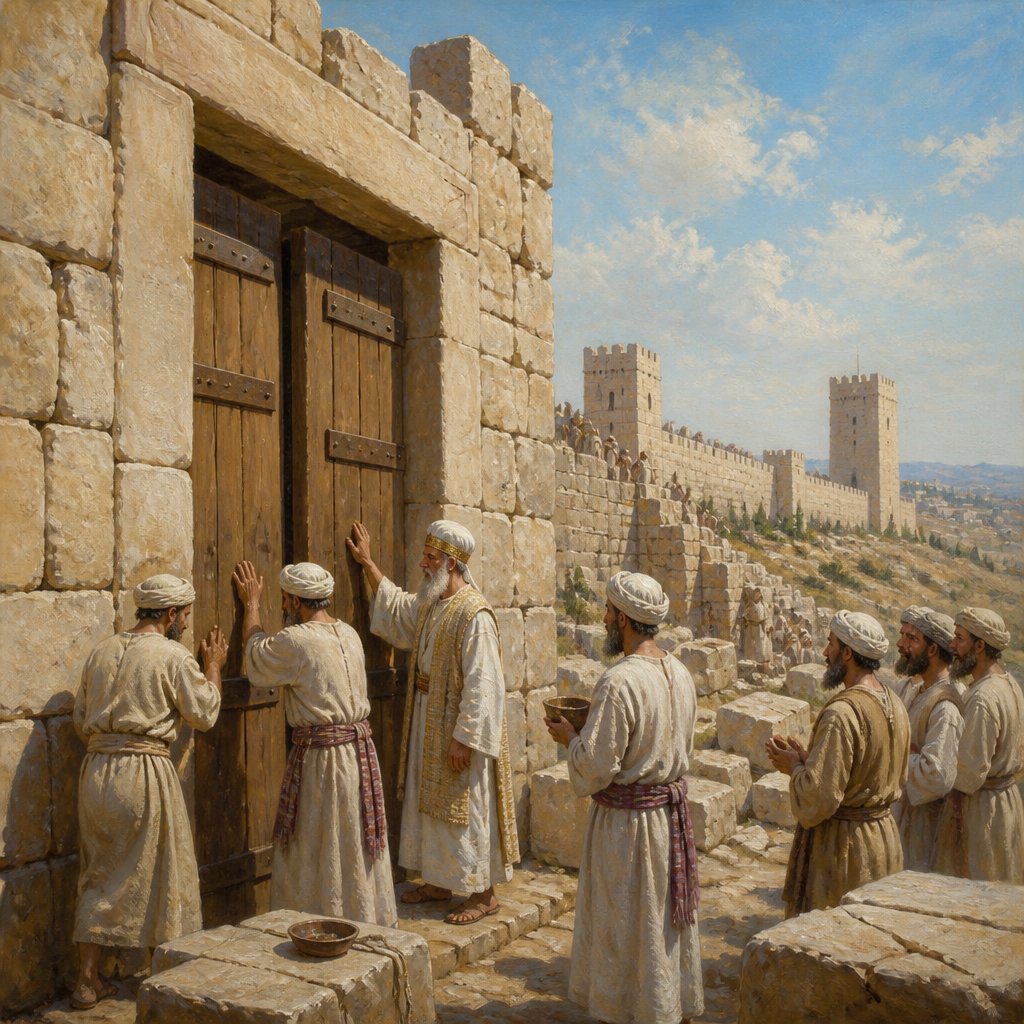
The Bible verse Nehemiah 3:1 in the King James Version reads:
"Then Eliashib the high priest rose up with his brethren the priests, and they builded the sheep gate; they sanctified it, and set up the doors of it; even unto the tower of Meah they sanctified it, unto the tower of Hananeel."
Context:
The book of Nehemiah is set in the 5th century BC, during the time when the Jewish people were exiled in Babylon. Nehemiah, a cupbearer to the Persian king Artaxerxes, hears about the distress of the people in Jerusalem and is moved to seek permission to go and rebuild the city's walls. Once in Jerusalem, Nehemiah rallies the people to join together in rebuilding the city's walls and gates, which had been destroyed by the Babylonians.
Nehemiah 3:1 is part of a section that describes the various individuals and groups of people who took part in the rebuilding of the city's walls and gates. This verse specifically mentions Eliashib, the high priest, and his fellow priests, who took on the responsibility of rebuilding the Sheep Gate.
The Sheep Gate was one of the gates leading into the city of Jerusalem, named so because it was the gate through which sheep were brought into the city for sacrifices at the Temple. The gate held great religious significance for the Jewish people, as it was closely associated with the Temple and the worship of God.
Themes:
One of the key themes in this verse is the idea of restoration and renewal. The act of rebuilding the Sheep Gate was symbolic of the Jewish people's desire to restore their city and their connection to their faith. The gate's association with the Temple also underscores the theme of religious renewal, as the people sought to re-establish their worship practices and rituals.
Another important theme is the idea of collective action and communal responsibility. Throughout the book of Nehemiah, there is a strong emphasis on the people coming together to work towards a common goal. Each individual or group had a specific task to perform in the rebuilding process, and their combined efforts contributed to the overall success of the project.
Symbolism:
The involvement of Eliashib and the priests in rebuilding the Sheep Gate carries significant symbolic value. As high priest, Eliashib held a position of great spiritual authority and leadership among the people. His participation in the physical act of rebuilding the gate speaks to the idea of religious leaders taking an active role in the restoration of their community.
The Sheep Gate itself holds symbolic meaning as well. In addition to its religious significance, the gate can be seen as a representation of the city's vulnerability and the need for protection. By rebuilding the gate, the people were demonstrating their desire to create a safe and secure environment for their community.
Overall, Nehemiah 3:1 serves as a powerful reminder of the importance of collective action, spiritual renewal, and the willingness of leaders to actively participate in the physical and spiritual restoration of their community. It also highlights the enduring relevance of the biblical narrative, as it continues to inspire and guide individuals and communities in their own quests for renewal and revival.
Have questions about Nehemiah 3:1?
Dive deeper into this scripture with Bible Chat — an AI-powered tool for exploring God's Word through conversation. Ask questions, get context, and grow in your understanding of the Bible.
Get Our Apps


Nehemiah 3:1 Artwork

Nehemiah 3:1 - "Then Eliashib the high priest rose up with his brethren the priests, and they builded the sheep gate; they sanctified it, and set up the doors of it; even unto the tower of Meah they sanctified it, unto the tower of Hananeel."
"Then Eliashib the high priest rose up with his brethren the priests, and they builded the sheep gate; they sanctified it, and set up the doors of it; even unto the tower of Meah they sanctified it, unto the tower of Hananeel." - Nehemiah 3:1

Nehemiah 1:3 - "And they said unto me, The remnant that are left of the captivity there in the province are in great affliction and reproach: the wall of Jerusalem also is broken down, and the gates thereof are burned with fire."

Nehemiah 12:3 - "Shechaniah, Rehum, Meremoth,"

Nehemiah 10:3 - "Pashur, Amariah, Malchijah,"

Nehemiah 1:1 - "The words of Nehemiah the son of Hachaliah. And it came to pass in the month Chisleu, in the twentieth year, as I was in Shushan the palace,"

Nehemiah 10:1 - "Now those that sealed were, Nehemiah, the Tirshatha, the son of Hachaliah, and Zidkijah,"

Nehemiah 3:22 - "And after him repaired the priests, the men of the plain."

Nehemiah 3:16 - "After him repaired Nehemiah the son of Azbuk, the ruler of the half part of Beth-zur, unto the place over against the sepulchres of David, and to the pool that was made, and unto the house of the mighty."

"Pashur, Amariah, Malchijah," - Nehemiah 10:3

"Shechaniah, Rehum, Meremoth," - Nehemiah 12:3

Nehemiah 11:1-19

Nehemiah 3:32 - "And between the going up of the corner unto the sheep gate repaired the goldsmiths and the merchants."

Nehemiah 3:5 - "And next unto them the Tekoites repaired; but their nobles put not their necks to the work of their Lord."

Nehemiah 11:13

Nehemiah 8:10

Nehemiah 3:3 - "But the fish gate did the sons of Hassenaah build, who also laid the beams thereof, and set up the doors thereof, the locks thereof, and the bars thereof."

Nehemiah 3:9 - "And next unto them repaired Rephaiah the son of Hur, the ruler of the half part of Jerusalem."

Nehemiah 3:18 - "After him repaired their brethren, Bavai the son of Henadad, the ruler of the half part of Keilah."

Nehemiah 3:11 - "Malchijah the son of Harim, and Hashub the son of Pahath-moab, repaired the other piece, and the tower of the furnaces."

Nehemiah 3:2 - "And next unto him builded the men of Jericho. And next to them builded Zaccur the son of Imri."

Nehemiah 3:28 - "From above the horse gate repaired the priests, every one over against his house."

Nehemiah 11:11-14

Nehemiah 13:3 - "Now it came to pass, when they had heard the law, that they separated from Israel all the mixed multitude."

"The words of Nehemiah the son of Hachaliah. And it came to pass in the month Chisleu, in the twentieth year, as I was in Shushan the palace," - Nehemiah 1:1

"And after him repaired the priests, the men of the plain." - Nehemiah 3:22

"Now those that sealed were, Nehemiah, the Tirshatha, the son of Hachaliah, and Zidkijah," - Nehemiah 10:1

Nehemiah 3:12 - "And next unto him repaired Shallum the son of Halohesh, the ruler of the half part of Jerusalem, he and his daughters."

Nehemiah book overview with element mentioned

Nehemiah 3:26 - "Moreover the Nethinims dwelt in Ophel, unto the place over against the water gate toward the east, and the tower that lieth out."