What does Nehemiah 12:38 mean?
"And the other company of them that gave thanks went over against them, and I after them, and the half of the people upon the wall, from beyond the tower of the furnaces even unto the broad wall;" - Nehemiah 12:38
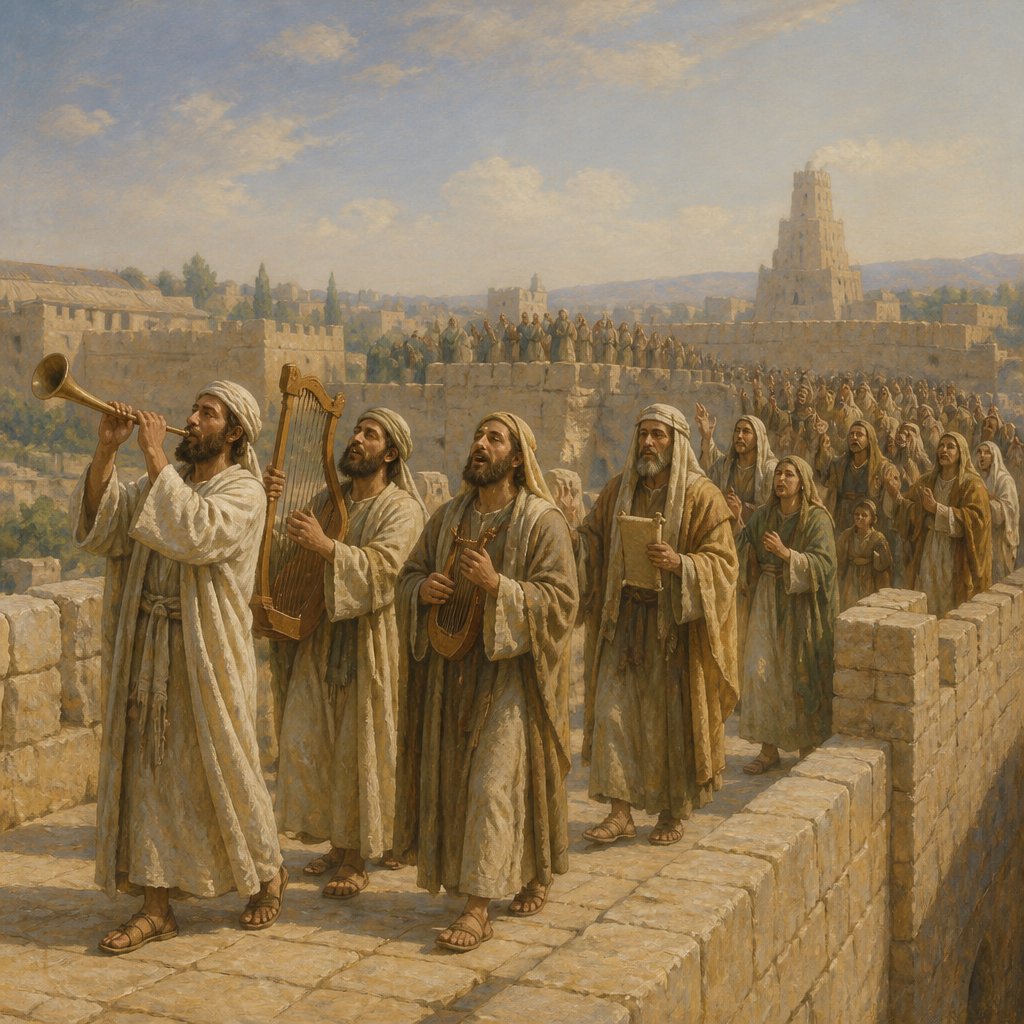
The verse Nehemiah 12:38 from the King James Version (KJV) of the Bible reads: "And the other company of them that gave thanks went over against them, and I after them, and the half of the people upon the wall, from beyond the tower of the furnaces even unto the broad wall."
This verse is part of the book of Nehemiah, which is part of the Old Testament and is named after the central character, Nehemiah, who was a Jewish leader and cupbearer to the Persian King Artaxerxes. The book of Nehemiah primarily focuses on the rebuilding of the walls of Jerusalem and the restoration of the Jewish community living there. This verse specifically describes the organization of a procession of thanksgiving that took place during the dedication of the rebuilt walls.
In this verse, the "other company of them that gave thanks" refers to a group of people who were tasked with offering thanks and praise to God. The text suggests that this was a highly organized event, with different groups of people designated to specific roles in the procession. It is noteworthy that the act of giving thanks is emphasized, showcasing the importance of gratitude in the religious life of the community.
The phrase "went over against them" could be interpreted as the other company of thanksgivers going opposite to the first company mentioned in the previous verses. This suggests that the thanksgiving procession was organized in a way that allowed the groups to meet and come together during the procession, creating a sense of unity and solidarity among the people.
The mention of Nehemiah following after them and the half of the people upon the wall indicates that he was actively involved in the event and was a part of the procession, underscoring his leadership and participation in the religious rituals of the community. The reference to "the half of the people upon the wall" further emphasizes the communal nature of this event, as the entire community, represented by "the half of the people," was involved in the dedication of the walls.
The mention of specific landmarks such as "the tower of the furnaces" and "the broad wall" serves to provide a vivid picture of the scene and adds a layer of historicity to the narrative, grounding it in a specific time and place.
Symbolically, the rebuilding of the walls of Jerusalem and the accompanying dedication ceremony represent the restoration, renewal, and protection of the community. The walls not only served as a physical barrier for the city but also held spiritual and symbolic significance for the people. The dedication ceremony, with its emphasis on thanksgiving and praise, highlights the faith and devotion of the community to God, acknowledging His role in the restoration and protection of their city.
The themes of gratitude, unity, and communal worship are central to this verse and the larger narrative of Nehemiah. The act of giving thanks is a recurring motif throughout the Bible, emphasizing the importance of acknowledging God's blessings and faithfulness. The communal nature of the event, with different groups coming together in a structured procession, underscores the theme of unity and collective worship.
In context, this verse is part of a larger passage describing the dedication of the walls of Jerusalem. The entire chapter of Nehemiah 12 provides a detailed account of the organization and execution of this event, highlighting the significance of this moment in the life of the Jewish community. The dedication of the walls symbolizes the restoration of Jerusalem and the reaffirmation of the people's faith and commitment to their God. It also serves as a testament to the leadership of Nehemiah and his role in the restoration of the city.
In conclusion, Nehemiah 12:38 from the King James Version of the Bible encapsulates the themes of gratitude, unity, and communal worship within the context of the dedication of the walls of Jerusalem. The verse offers a vivid portrayal of a highly organized thanksgiving procession and underscores the spiritual and symbolic significance of this event for the Jewish community. It serves as a reminder of the importance of gratitude and unity in the religious life of the people and the significance of communal worship in honoring and praising God.
Have questions about Nehemiah 12:38?
Dive deeper into this scripture with Bible Chat — an AI-powered tool for exploring God's Word through conversation. Ask questions, get context, and grow in your understanding of the Bible.
Get Our Apps


Nehemiah 12:38 Artwork

Nehemiah 12:38 - "And the other company of them that gave thanks went over against them, and I after them, and the half of the people upon the wall, from beyond the tower of the furnaces even unto the broad wall;"
"And the other company of them that gave thanks went over against them, and I after them, and the half of the people upon the wall, from beyond the tower of the furnaces even unto the broad wall;" - Nehemiah 12:38

Nehemiah 7:38 - "The children of Senaah, three thousand nine hundred and thirty."

Nehemiah 9:38 - "And because of all this we make a sure covenant, and write it; and our princes, Levites, and priests, seal unto it."

"The children of Senaah, three thousand nine hundred and thirty." - Nehemiah 7:38

Nehemiah 12:26 - "These were in the days of Joiakim the son of Jeshua, the son of Jozadak, and in the days of Nehemiah the governor, and of Ezra the priest, the scribe."

Nehemiah 12:5 - "Miamin, Maadiah, Bilgah,"

Nehemiah 12:33 - "And Azariah, Ezra, and Meshullam,"

Nehemiah 12:4 - "Iddo, Ginnetho, Abijah,"

Nehemiah 12:2 - "Amariah, Malluch, Hattush,"

Nehemiah 12:3 - "Shechaniah, Rehum, Meremoth,"

Nehemiah 10:12 - "Zaccur, Sherebiah, Shebaniah,"

Nehemiah 12:6 - "Shemaiah, and Joiarib, Jedaiah,"

Nehemiah 12:12 - "And in the days of Joiakim were priests, the chief of the fathers: of Seraiah, Meraiah; of Jeremiah, Hananiah;"

Nehemiah 12:13 - "Of Ezra, Meshullam; of Amariah, Jehohanan;"

Nehemiah 12:16 - "Of Iddo, Zechariah; of Ginnethon, Meshullam;"

Nehemiah 12:20 - "Of Sallai, Kallai; of Amok, Eber;"

Nehemiah 12:19 - "And of Joiarib, Mattenai; of Jedaiah, Uzzi;"

Nehemiah 12:34 - "Judah, and Benjamin, and Shemaiah, and Jeremiah,"

Nehemiah 12:15 - "Of Harim, Adna; of Meraioth, Helkai;"

Nehemiah 12:18 - "Of Bilgah, Shammua; of Shemaiah, Jehonathan;"

Nehemiah 12:21 - "Of Hilkiah, Hashabiah; of Jedaiah, Nethaneel."

Nehemiah 12:14 - "Of Melicu, Jonathan; of Shebaniah, Joseph;"

Nehemiah 12:17 - "Of Abijah, Zichri; of Miniamin, of Moadiah, Piltai;"

Nehemiah 12:11 - "And Joiada begat Jonathan, and Jonathan begat Jaddua."

Nehemiah 10:38 - "And the priest the son of Aaron shall be with the Levites, when the Levites take tithes: and the Levites shall bring up the tithe of the tithes unto the house of our God, to the chambers, into the treasure house."

Nehemiah 7:12 - "The children of Elam, a thousand two hundred fifty and four."

Nehemiah 12:32 - "And after them went Hoshaiah, and half of the princes of Judah,"

"Miamin, Maadiah, Bilgah," - Nehemiah 12:5

"Shemaiah, and Joiarib, Jedaiah," - Nehemiah 12:6