What does Nehemiah 12:36 mean?
"And his brethren, Shemaiah, and Azarael, Milalai, Gilalai, Maai, Nethaneel, and Judah, Hanani, with the musical instruments of David the man of God, and Ezra the scribe before them." - Nehemiah 12:36
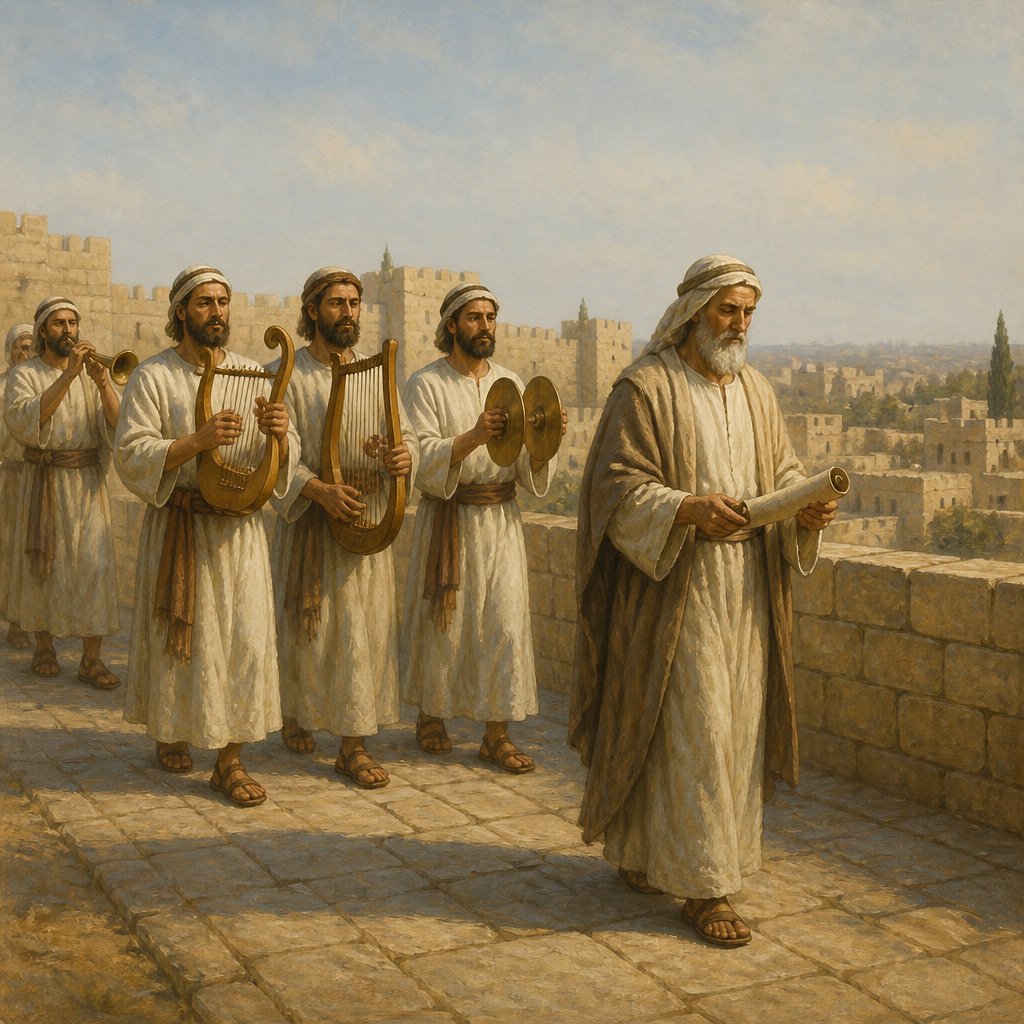
Nehemiah 12:36 (KJV) says, "And his brethren, Shemaiah, and Azarael, Milalai, Gilalai, Maai, Nethaneel, and Judah, Hanani, with the musical instruments of David the man of God, and Ezra the scribe before them."
This verse is part of the book of Nehemiah, which is the 16th book of the Old Testament and the 16th book of the Bible overall. The book of Nehemiah is set during the time when the Israelites are returning to Jerusalem after the Babylonian exile. Nehemiah, who was a cupbearer to the Persian king, returns to Jerusalem with the king's permission to rebuild the city walls and restore order and worship.
The verse falls within a section of Nehemiah that describes the dedication of the rebuilt wall of Jerusalem. The verse specifically mentions Shemaiah, Azarael, Milalai, Gilalai, Maai, Nethaneel, and Judah, Hanani, who are listed as the brethren. They are identified as being responsible for overseeing the praise and worship during the dedication of the wall. This group is described as having "the musical instruments of David the man of God, and Ezra the scribe before them." This indicates that they were leading the musical aspect of the dedication, using instruments that were historically associated with David, a well-known musician and king of Israel, and Ezra, a scribe who played an important role in the restoration of the Jewish community.
It is important to note that the dedication of the wall in Nehemiah was an act of consecration and thanksgiving, a celebration of God's faithfulness and the completion of a significant project. The use of music and musical instruments during the dedication serves to elevate the spiritual significance of the event and to honor God through joyful praise and worship.
The theme of worship and praise is central to this verse. Throughout the Bible, worship is seen as a crucial aspect of the relationship between God and his people. It is a way for believers to express reverence, adoration, and gratitude to God. In this verse, the inclusion of "the musical instruments of David the man of God" emphasizes the practice of using music as a way to glorify God. It indicates that music was an integral part of the Israelites' worship and that it played a significant role in their spiritual lives.
Furthermore, the verse underscores the importance of collaboration and teamwork in the context of worship. Shemaiah, Azarael, Milalai, Gilalai, Maai, Nethaneel, and Judah, Hanani are described as working together to lead the musical aspect of the dedication. This cooperation reflects the idea that worship is not just an individual practice but a communal one, requiring the participation and contribution of multiple individuals united in their devotion to God.
Symbolism can also be found in this verse, with the mention of "the musical instruments of David the man of God, and Ezra the scribe before them." The use of David's instruments symbolizes the continuity of worship and praise within the Israelite tradition. It connects the present act of dedication to the legacy of David, a revered figure known for his devotion to God and his musical talents. Additionally, the presence of Ezra the scribe suggests the importance of written scripture and the role of the scribe in preserving and transmitting religious teachings.
In conclusion, Nehemiah 12:36 is a verse that speaks to the significance of worship, collaboration, and tradition within the context of the dedication of the wall of Jerusalem. It highlights the role of music and musical instruments in praising God, the value of working together in worship, and the symbolism of connecting to the legacy of revered figures in Israelite history. This verse serves as a reminder of the importance of worship as a communal and joyous expression of devotion to God.
Have questions about Nehemiah 12:36?
Dive deeper into this scripture with Bible Chat — an AI-powered tool for exploring God's Word through conversation. Ask questions, get context, and grow in your understanding of the Bible.
Get Our Apps


Nehemiah 12:36 Artwork

Nehemiah 12:36 - "And his brethren, Shemaiah, and Azarael, Milalai, Gilalai, Maai, Nethaneel, and Judah, Hanani, with the musical instruments of David the man of God, and Ezra the scribe before them."
"And his brethren, Shemaiah, and Azarael, Milalai, Gilalai, Maai, Nethaneel, and Judah, Hanani, with the musical instruments of David the man of God, and Ezra the scribe before them." - Nehemiah 12:36

Nehemiah 11:36 - "And of the Levites were divisions in Judah, and in Benjamin."

Nehemiah 7:36 - "The children of Jericho, three hundred forty and five."
"And of the Levites were divisions in Judah, and in Benjamin." - Nehemiah 11:36
"The children of Jericho, three hundred forty and five." - Nehemiah 7:36

Nehemiah 12:26 - "These were in the days of Joiakim the son of Jeshua, the son of Jozadak, and in the days of Nehemiah the governor, and of Ezra the priest, the scribe."

Nehemiah 12:5 - "Miamin, Maadiah, Bilgah,"

Nehemiah 12:33 - "And Azariah, Ezra, and Meshullam,"

Nehemiah 12:4 - "Iddo, Ginnetho, Abijah,"

Nehemiah 12:2 - "Amariah, Malluch, Hattush,"

Nehemiah 12:3 - "Shechaniah, Rehum, Meremoth,"

Nehemiah 10:12 - "Zaccur, Sherebiah, Shebaniah,"

Nehemiah 12:6 - "Shemaiah, and Joiarib, Jedaiah,"

Nehemiah 9:36 - "Behold, we are servants this day, and for the land that thou gavest unto our fathers to eat the fruit thereof and the good thereof, behold, we are servants in it:"

Nehemiah 12:12 - "And in the days of Joiakim were priests, the chief of the fathers: of Seraiah, Meraiah; of Jeremiah, Hananiah;"

Nehemiah 12:13 - "Of Ezra, Meshullam; of Amariah, Jehohanan;"

Nehemiah 12:16 - "Of Iddo, Zechariah; of Ginnethon, Meshullam;"

Nehemiah 12:20 - "Of Sallai, Kallai; of Amok, Eber;"

Nehemiah 12:19 - "And of Joiarib, Mattenai; of Jedaiah, Uzzi;"

Nehemiah 12:34 - "Judah, and Benjamin, and Shemaiah, and Jeremiah,"

Nehemiah 12:15 - "Of Harim, Adna; of Meraioth, Helkai;"

Nehemiah 12:18 - "Of Bilgah, Shammua; of Shemaiah, Jehonathan;"

Nehemiah 12:21 - "Of Hilkiah, Hashabiah; of Jedaiah, Nethaneel."

Nehemiah 12:14 - "Of Melicu, Jonathan; of Shebaniah, Joseph;"

Nehemiah 12:17 - "Of Abijah, Zichri; of Miniamin, of Moadiah, Piltai;"

Matthew 12:36-37

Matthew 12:36-37

matthew 12:36-37

Nehemiah 12:11 - "And Joiada begat Jonathan, and Jonathan begat Jaddua."