What does Matthew 9:22 mean?
"But Jesus turned him about, and when he saw her, he said, Daughter, be of good comfort; thy faith hath made thee whole. And the woman was made whole from that hour." - Matthew 9:22
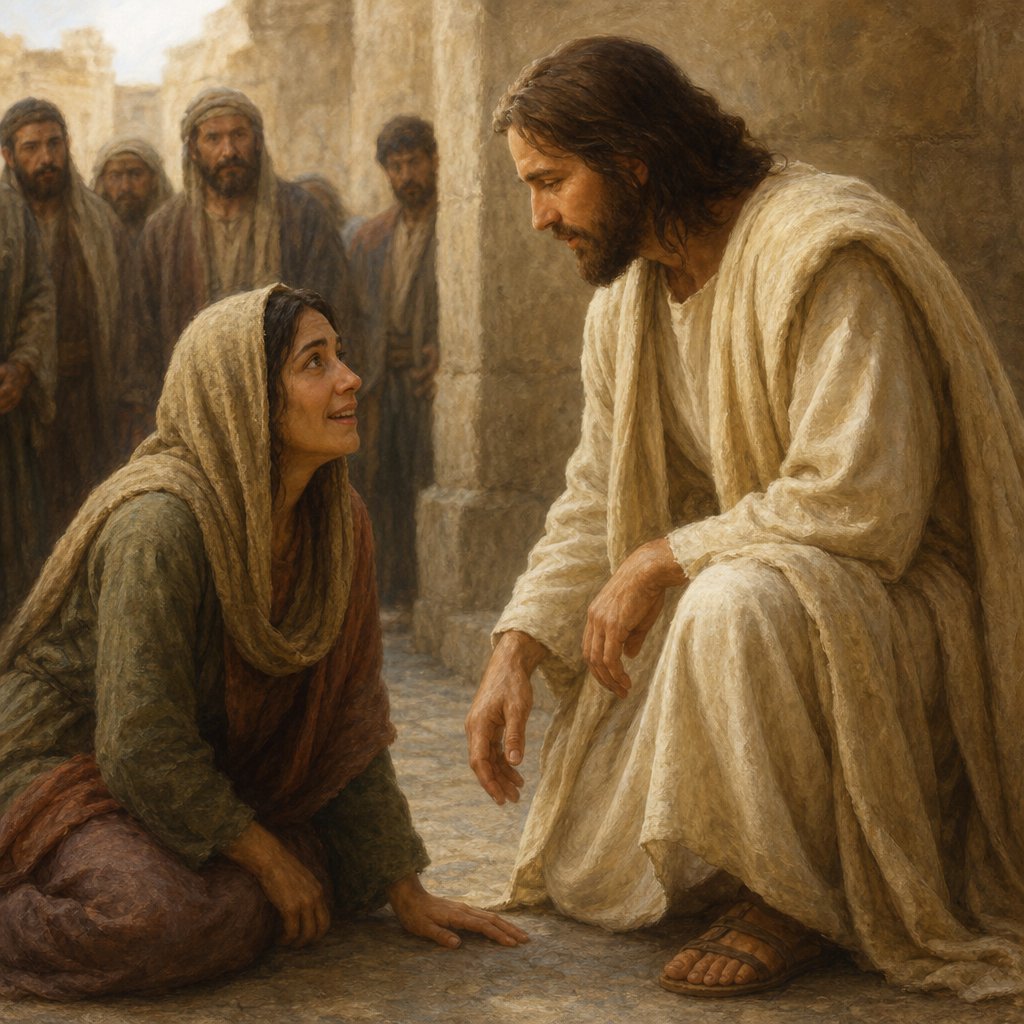
Matthew 9:22 in the King James Version reads, “But Jesus turned him about, and when he saw her, he said, Daughter, be of good comfort; thy faith hath made thee whole. And the woman was made whole from that hour.”
In its immediate context, this sentence is the turning point in a tense, interrupted journey. Jesus is on his way to the house of Jairus, a ruler whose daughter lies at the point of death, when a woman with “an issue of blood twelve years” presses through the crowd behind him and touches “the hem of his garment.” Her condition, described just before verse 22, signifies prolonged suffering, exhaustion of human remedies, and a life repeatedly diminished by weakness and likely by social and religious isolation. The narrative places her need alongside Jairus’s need on purpose: one crisis is public and urgent, brought forward by a respected man; the other is private and hidden, carried by an unnamed woman who approaches from behind. Matthew 9:22 reveals that Jesus is not only moving toward the prominent and desperate, but also attentive to the concealed and ashamed. He stops for the one who thought she could be healed without being seen. The verse shows that Christ’s mercy does not depend on social standing, visibility, or the boldness of one’s approach; it depends on his own compassion and the faith that reaches for him.
The phrase “Jesus turned him about” has weight. He had been walking forward toward another emergency, yet he turns, a physical motion that symbolizes divine attention: the Lord’s path is never so fixed that he overlooks the person who reaches for him in faith. Turning and “when he saw her” also underlines that her healing is not left to anonymity or mere contact with holy things. She is not permitted to disappear into the crowd with a secret cure. Jesus brings her into the light, not to shame her, but to restore her openly. This public seeing is itself part of her restoration. In a world where her condition would have tempted her to hide, Jesus calls her forth and addresses her with a word that reestablishes her dignity: “Daughter.”
That single title, “Daughter,” is rich with meaning. It is tender, familial, and covenantal. It identifies her as belonging, as someone to be received rather than avoided. Where her illness may have made her feel cut off—physically depleted, socially separated, spiritually uncertain—Jesus speaks her back into a place of relationship and welcome. The word does not merely comfort; it re-names her. She is not “unclean,” not “outcast,” not “a problem in the crowd,” but “Daughter.” In that moment the Lord’s speech functions like a healing in the soul that corresponds with the healing in the body.
“Be of good comfort” is not a vague encouragement; it is a directive grounded in who is speaking. Jesus does not say, “Try to feel better.” He declares comfort as something she may truly take, because the basis of it is now established: the fear that drove her to touch the hem—fear of remaining sick, fear of being discovered, fear of being disappointed again—is met with divine reassurance. The verse thus carries a theme that runs through the Gospels: when Christ meets faith, he often first addresses fear. Comfort in Scripture is frequently tied to God’s presence and his saving action. Here, comfort is warranted because salvation has touched her life in a concrete, immediate way.
“Thy faith hath made thee whole” places the emphasis where Matthew wants it: not on the garment as an object and not on the crowd’s closeness to Jesus, but on faith that seeks him. Her touch was not magic; it was a physical expression of inward trust. Many pressed upon Jesus in that crowd, but her contact was different because it carried reliance upon him. At the same time, the verse does not make faith into a power independent of Christ, as though faith itself heals by its own force. The whole scene shows that healing is the work of Jesus, and faith is the appointed means of receiving what he gives. He honors her faith by naming it, thereby teaching the crowd what truly matters: nearness to Christ is not merely bodily proximity but believing dependence.
The word “whole” is significant. It means more than the cessation of symptoms; it speaks of restoration. Her long flow of blood represented continual loss—of strength, of normal life, perhaps of hope. To be made whole implies that what was draining away is now stopped and that her life is gathered back together. In the larger biblical imagination, wholeness is connected with peace, soundness, and being set right. Matthew’s Gospel often presents Jesus as the one who brings the kingdom of heaven near, and the kingdom’s nearness is seen in restored bodies and restored lives. This woman’s wholeness, therefore, is a sign: in Jesus, God’s saving reign is not theoretical; it touches suffering people.
“And the woman was made whole from that hour” emphasizes the immediacy and decisiveness of Christ’s work. Twelve years of affliction are ended in an instant. The phrase “from that hour” also serves as a quiet witness statement, as though marking time for anyone who might question what happened. It is not gradual improvement or uncertain relief; it is a definitive change beginning at a specific moment. Matthew records it in a way that stresses the authority of Jesus: he speaks, and reality changes. Her story becomes a testimony fixed to a point in time, an “hour” when mercy intervened.
There is also symbolism in the “hem of his garment,” even though Matthew 9:22 itself does not repeat the detail. In the flow of the passage, the hem represents the seeming smallness of her approach: she does not grasp his hand, does not interrupt his speech, does not request an audience. She reaches for the lowest edge, the most modest contact. Yet the narrative shows that in Christ even what appears small becomes sufficient when joined with faith. The hem also suggests that holiness in Jesus is not fragile or threatened. Under many Old Testament patterns, uncleanness could spread by contact, but here the direction is reversed: purity and life flow outward from Christ. He is not diminished by her touch; she is restored by his presence. The verse’s theology is that Jesus is the source, not a vessel easily contaminated.
Finally, Matthew 9:22 matters because it reveals the character of Jesus in a compressed sentence. He turns toward the hidden sufferer, sees her, names her as family, commands comfort, attributes her healing to faith, and establishes her wholeness as a settled fact. The significance is not only that a miracle occurred, but that the miracle is framed as personal encounter and gracious recognition. In the midst of pressing crowds and urgent demands, Jesus gives undivided attention to one trembling woman and sends her away not merely cured but comforted, known, and restored.
Have questions about Matthew 9:22?
Dive deeper into this scripture with Bible Chat — an AI-powered tool for exploring God's Word through conversation. Ask questions, get context, and grow in your understanding of the Bible.
Get Our Apps


Matthew 9:22 Artwork
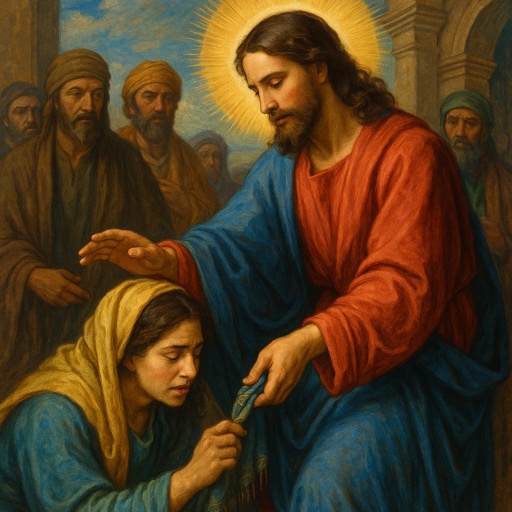
"But Jesus turned him about, and when he saw her, he said, Daughter, be of good comfort; thy faith hath made thee whole. And the woman was made whole from that hour." - Matthew 9:22

Matthew 9:22 - "But Jesus turned him about, and when he saw her, he said, Daughter, be of good comfort; thy faith hath made thee whole. And the woman was made whole from that hour."
"But Jesus turned him about, and when he saw her, he said, Daughter, be of good comfort; thy faith hath made thee whole. And the woman was made whole from that hour." - Matthew 9:22

Matthew 9:21-22

Matthew 9:21-22

Matthew 9:21-22

Matthew 9:21-22

Matthew 9:21-22

Matthew 22:9 - "Go ye therefore into the highways, and as many as ye shall find, bid to the marriage."
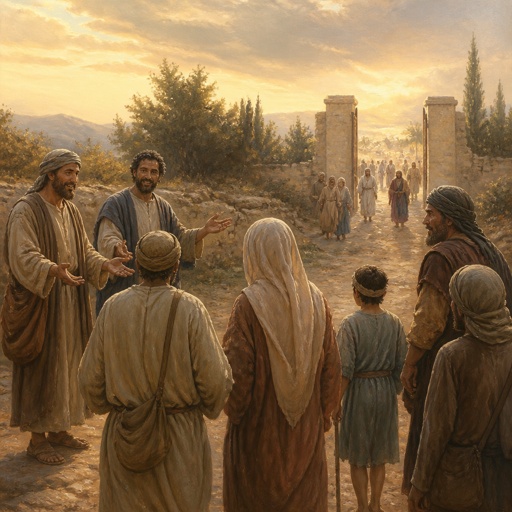
"Go ye therefore into the highways, and as many as ye shall find, bid to the marriage." - Matthew 22:9

Matthew 22:22 - "When they had heard these words, they marvelled, and left him, and went their way."

Matthew 6:22

Matthew 6:22

Matthew 6:22

Matthew 22:38 - "This is the first and great commandment."

Matthew 14:22-33

Matthew 9:21

Matthew 22:37-39

Matthew 22:14 - "For many are called, but few are chosen."

Matthew 22:36 - "Master, which is the great commandment in the law?"

Matthew 22:27 - "And last of all the woman died also."

Matthew 22:26 - "Likewise the second also, and the third, unto the seventh."

Matthew 22:40 - "On these two commandments hang all the law and the prophets."

Matthew 2:9

Matthew 9:9 - "¶ And as Jesus passed forth from thence, he saw a man, named Matthew, sitting at the receipt of custom: and he saith unto him, Follow me. And he arose, and followed him."

Matthew 2:9

Matthew 4:22 - "And they immediately left the ship and their father, and followed him."

Matthew 22:33 - "And when the multitude heard this, they were astonished at his doctrine."

Matthew 22:20 - "And he saith unto them, Whose is this image and superscription?"

Genesis 22-9