What does Matthew 9:2 mean?
"And, behold, they brought to him a man sick of the palsy, lying on a bed: and Jesus seeing their faith said unto the sick of the palsy; Son, be of good cheer; thy sins be forgiven thee." - Matthew 9:2
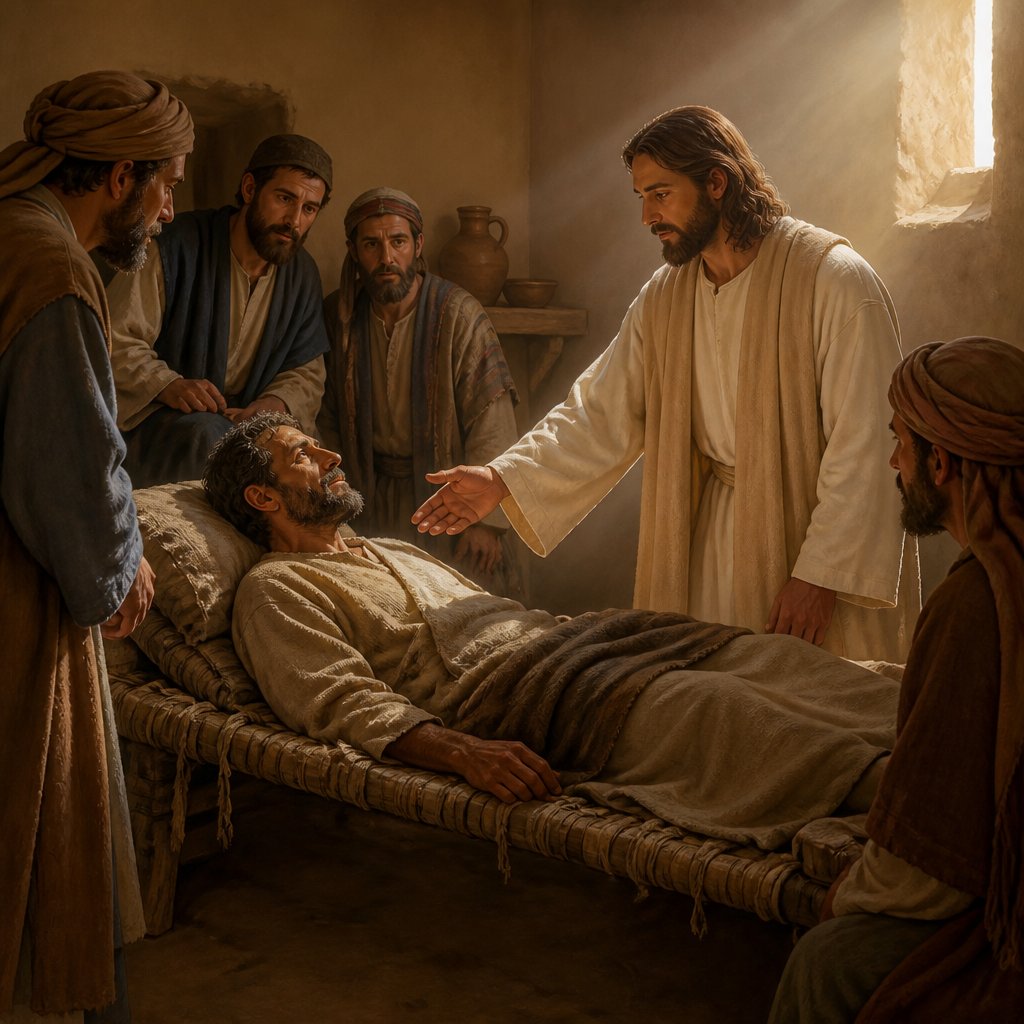
Matthew 9:2 (KJV) - "And, behold, they brought to him a man sick of the palsy, lying on a bed: and Jesus seeing their faith said unto the sick of the palsy; Son, be of good cheer; thy sins be forgiven thee."
This verse is an important and powerful moment in the ministry of Jesus Christ, as it demonstrates not only his ability to heal physical ailments but also his authority to forgive sins. The verse begins with the scene of a man who is brought to Jesus, suffering from palsy, a condition characterized by paralysis and tremors. The man is unable to move and is dependent on others to carry him on a bed. This image of the paralyzed man serves as a metaphor for the spiritual condition of humanity, who are paralyzed by sin and unable to save themselves.
The verse goes on to say that Jesus, upon seeing the faith of those who brought the paralyzed man to him, says to the man, "Son, be of good cheer; thy sins be forgiven thee." This statement is deeply profound as it reveals Jesus' understanding of the man's underlying spiritual need. While the man's physical ailment is certainly significant, Jesus addresses his spiritual condition first, indicating that forgiveness of sins is of paramount importance. This act demonstrates Jesus' divine authority to forgive sins, a power that was traditionally reserved for God alone. It also highlights Jesus' compassion and concern for the whole person, both body and soul.
In this passage, Jesus speaks directly to the paralyzed man, calling him "Son" and offering him words of comfort and reassurance. This paternal language communicates a sense of intimacy and care, as Jesus acknowledges the man as a beloved child of God. The phrase "be of good cheer" also conveys a message of hope and encouragement, assuring the man that his suffering will come to an end.
The theme of faith is central to this verse, as it is the faith of those who brought the paralyzed man to Jesus that prompts his response. This underscores the idea that faith is essential in approaching Jesus and receiving his healing and forgiveness. The passage also emphasizes the communal aspect of faith, as the friends of the paralyzed man play a crucial role in bringing him to Jesus. Their faith and actions become instrumental in facilitating the man's encounter with Jesus and ultimately his healing and forgiveness.
Furthermore, the verse illustrates the interconnectedness of physical healing and spiritual wholeness. The man's physical healing is directly linked to the forgiveness of his sins, emphasizing the holistic nature of Jesus' ministry. This aligns with the broader theme of restoration and redemption, as Jesus not only restores the man's ability to walk but also offers him the opportunity for spiritual transformation and renewal.
Symbolically, the image of the paralyzed man lying on a bed can be seen as a representation of the burden of sin that weighs heavily on humanity. By forgiving the man's sins and healing his paralysis, Jesus symbolizes the liberation and freedom that come through faith in him. The bed itself serves as a visual reminder of the man's condition, but also of the opportunity for him to rise and walk again.
In conclusion, Matthew 9:2 is a profound and multi-layered verse that highlights Jesus' authority to forgive sins, his compassion for the suffering, and the vital role of faith in experiencing healing and restoration. It encapsulates the core themes of faith, redemption, and the holistic nature of Jesus' ministry, offering a message of hope and transformation for all who come to him in faith.
Have questions about Matthew 9:2?
Dive deeper into this scripture with Bible Chat — an AI-powered tool for exploring God's Word through conversation. Ask questions, get context, and grow in your understanding of the Bible.
Get Our Apps


Matthew 9:2 Artwork

Matthew 9:2 - "And, behold, they brought to him a man sick of the palsy, lying on a bed: and Jesus seeing their faith said unto the sick of the palsy; Son, be of good cheer; thy sins be forgiven thee."
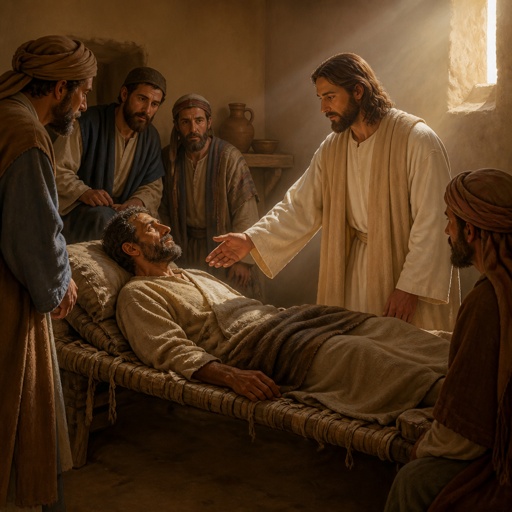
"And, behold, they brought to him a man sick of the palsy, lying on a bed: and Jesus seeing their faith said unto the sick of the palsy; Son, be of good cheer; thy sins be forgiven thee." - Matthew 9:2

Matthew 2:9

Matthew 2:9

Matthew 2:9 - "When they had heard the king, they departed; and, lo, the star, which they saw in the east, went before them, till it came and stood over where the young child was."

Matthew 9:21

Matthew 9:21-22

Matthew 9:21-22

Matthew 9:21-22

Matthew 9:21-22

Matthew 9:21-22

Matthew 9:9 - "¶ And as Jesus passed forth from thence, he saw a man, named Matthew, sitting at the receipt of custom: and he saith unto him, Follow me. And he arose, and followed him."

Matthew 6:9-13

Matthew 2:9-10 - "After they had heard the king, they went on their way, and the star they had seen when it rose went ahead of them until it stopped over the place where the child was. When they saw the star, they were overjoyed."

Matthew 9:37-38

Matthew 9:7 - "And he arose, and departed to his house."

Matthew 9:26 - "And the fame hereof went abroad into all that land."

Matthew 5:9 - "Blessed are the peacemakers: for they shall be called the children of God."

Matthew 13:9 - "Who hath ears to hear, let him hear."

Matthew 12:9 - "And when he was departed thence, he went into their synagogue:"

Matthew 9:19 - "And Jesus arose, and followed him, and so did his disciples."

Matthew 15:9 - "But in vain they do worship me, teaching for doctrines the commandments of men."

Matthew 9:3 - "And, behold, certain of the scribes said within themselves, This man blasphemeth."

Matthew 26:9 - "For this ointment might have been sold for much, and given to the poor."

Matthew 9:32 - "¶ As they went out, behold, they brought to him a dumb man possessed with a devil."

Matthew 1:9 - "And Ozias begat Joatham; and Joatham begat Achaz; and Achaz begat Ezekias;"

Matthew 9:29 - "Then touched he their eyes, saying, According to your faith be it unto you."

Matthew 2:1-2

Matthew 10:9 - "Provide neither gold, nor silver, nor brass in your purses,"

Matthew 9:31 - "But they, when they were departed, spread abroad his fame in all that country."