What does Matthew 5:39 mean?
"But I say unto you, That ye resist not evil: but whosoever shall smite thee on thy right cheek, turn to him the other also." - Matthew 5:39
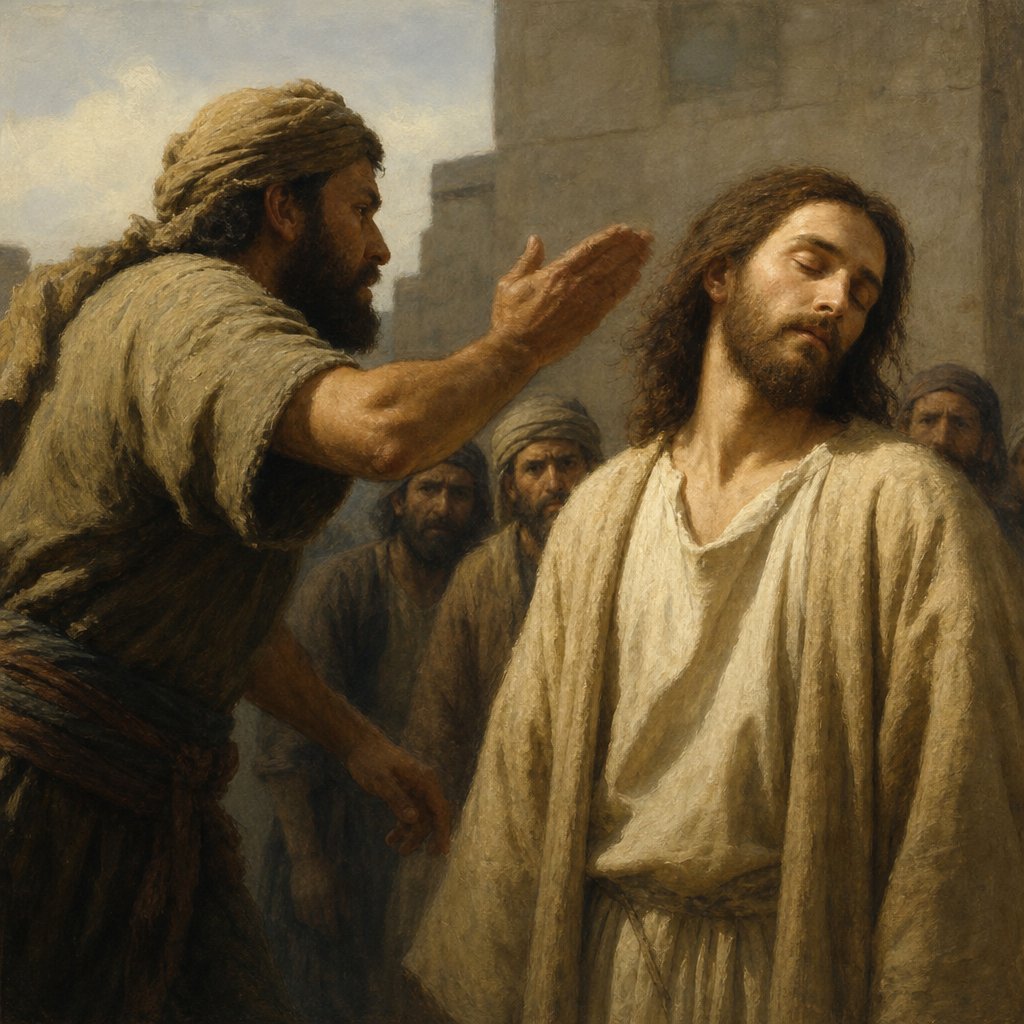
Matthew 5:39 in the King James Version reads, “But I say unto you, That ye resist not evil: but whosoever shall smite thee on thy right cheek, turn to him the other also.” It stands in the heart of the Sermon on the Mount, where Christ is not merely refining outward conduct but pressing His hearers into the inward righteousness of the kingdom of heaven. In this portion of Matthew 5, Jesus repeatedly sets His own authoritative word—“But I say unto you”—alongside what had been commonly received and practiced, exposing how easily the law’s holy intent can be reduced to a permission for retaliation, self-justification, and pride. The verse is therefore not an isolated proverb about passivity; it is a kingdom principle that confronts the instinct to answer injury with injury, insult with insult, and to secure personal honor by force.
The immediate context is the law of measured justice: “Ye have heard that it hath been said, An eye for an eye, and a tooth for a tooth” (Matthew 5:38). In the Old Testament setting, such language functioned as a restraint upon vengeance, ensuring proportion in legal judgment rather than limitless reprisal. Yet by Christ’s day it could be twisted into a moral right to pay back, as though personal retaliation were righteousness. Jesus’ corrective does not deny that God is a just Judge, nor does it dissolve all rightful civil order; rather, it addresses the personal ethic of His disciples. He calls them away from the spirit of revenge and toward a willingness to suffer wrong without returning wrong, leaving room for God’s judgment and embodying a different kind of strength.
The phrase “resist not evil” has the force of refusing to set oneself in opposition to evil in the particular manner that mirrors evil—refusing the tit-for-tat posture that is driven by pride, anger, and the demand to “even the score.” Christ is not praising evil or calling it good; He is stripping the disciple of the right to make personal vindication the ruling principle. To “resist” in the sense condemned here is to retaliate, to meet sin with the same spirit as the sinner. The disciple is summoned to a response shaped not by the offender’s action but by the Father’s character, which, as the chapter will later say, does good even to the unthankful and the evil (compare Matthew 5:44–45).
The image of the “right cheek” is vivid and purposeful. In ordinary interaction, to strike the right cheek implies a kind of insult that is not merely an act of violence but of humiliation, a deliberate affront to dignity and honor. The “cheek” stands as a symbol of the face, the public self, the place where shame is felt sharply and where pride most quickly demands satisfaction. Christ’s words therefore reach beyond physical injury to the world of scorn, contempt, and social dishonor. The Lord is dealing with the human craving to defend reputation at all costs, and He exposes how quickly that craving becomes an engine for sin. The kingdom of heaven is not sustained by the preservation of personal honor through aggression, but by humility and trust in God.
“Turn to him the other also” is not a command to enable wickedness or to invite endless abuse as an ultimate moral ideal; it is a picture of relinquished retaliation. It describes a deliberate refusal to escalate. The disciple, rather than striking back, is willing to bear another insult rather than answer with wrath. Symbolically, the “other cheek” becomes the surrender of one’s supposed rights to immediate payback. It is a posture that says, in effect, that the offender does not control the disciple’s spirit; God does. Such turning is not cowardice but a courageous renunciation of vengeance, an act of moral freedom in which the believer refuses to be mastered by anger.
This verse also belongs to a larger set of sayings in the same passage that press the same theme from different angles: being sued for a coat and giving the cloak also, being compelled to go a mile and going twain, giving to him that asketh (Matthew 5:40–42). Each image moves in the direction of voluntary surrender rather than forced extraction, generous freedom rather than tight-fisted self-protection. Together they show that Jesus is forming a people whose lives cannot be governed by the world’s calculus of repayment. The disciple is not told to ignore wisdom, but to abandon the spirit that makes self the center and retaliation the proof of strength.
The deeper significance of Matthew 5:39 is that it reveals the character of the King and the nature of His kingdom. The Sermon on the Mount is not a mere list of rules; it is the unveiling of a life that mirrors the Father. God’s righteousness is not only punitive; it is also patient, forbearing, and sovereign. When Christ commands “resist not evil” in this way, He is calling His followers to entrust themselves to God’s justice rather than seize the sword of personal vengeance. The believer’s restraint becomes a testimony that judgment belongs to God, and that the disciple lives under a higher authority than wounded pride.
There is also a Christological shadow in the verse, because the Lord who speaks it will Himself embody it. He will be smitten, mocked, and injured, and yet He will not answer in kind. In that sense, “turn to him the other also” is not only instruction but revelation: it points to a Messiah whose victory comes through suffering rather than retaliation, through meekness rather than domination. The disciple is invited into that same pattern of life, where overcoming is not achieved by returning evil for evil, but by refusing to be shaped by evil at all.
Thus Matthew 5:39 is significant because it redefines what it means to be righteous. It is not the righteousness of exacting payment; it is the righteousness of a heart transformed, a life governed by meekness, mercy, and trust in God. It confronts the natural man’s instinct to strike back and teaches that in the kingdom of heaven, true strength is the power to absorb wrong without becoming wrong, to endure insult without worshiping honor, and to answer injury with a spirit that is free from vengeance.
Have questions about Matthew 5:39?
Dive deeper into this scripture with Bible Chat — an AI-powered tool for exploring God's Word through conversation. Ask questions, get context, and grow in your understanding of the Bible.
Get Our Apps


Matthew 5:39 Artwork

Matthew 5:39 - "But I say unto you, That ye resist not evil: but whosoever shall smite thee on thy right cheek, turn to him the other also."

Matthew 5:39 But I tell you, do not resist an evil person. If anyone slaps you on the right cheek, turn to them the other cheek also.

Matthew 5:39 But I tell you, do not resist an evil person. If anyone slaps you on the right cheek, turn to them the other cheek also.

Matthew 5:39 But I tell you, do not resist an evil person. If anyone slaps you on the right cheek, turn to them the other cheek also.

Matthew 5:39 But I tell you, do not resist an evil person. If anyone slaps you on the right cheek, turn to them the other cheek also.

Matthew 5:39 But I tell you, do not resist an evil person. If anyone slaps you on the right cheek, turn to them the other cheek also.

"But I say unto you, That ye resist not evil: but whosoever shall smite thee on thy right cheek, turn to him the other also." - Matthew 5:39

Matthew 5:39 But I tell you, do not resist an evil person. If anyone slaps you on the right cheek, turn to them the other cheek also.

Matthew 5:38-39 - "You have heard that it was said, 'Eye for eye, and tooth for tooth.' But I tell you, do not resist an evil person. If anyone slaps you on the right cheek, turn to them the other cheek also."

Matthew 22:37-39

Matthew 27:39 - "¶ And they that passed by reviled him, wagging their heads,"

Luke 5:39

Matthew 21:39 - "And they caught him, and cast him out of the vineyard, and slew him."

Matthew 22:39 - "And the second is like unto it, Thou shalt love thy neighbour as thyself."

Matthew 13:39 - "The enemy that sowed them is the devil; the harvest is the end of the world; and the reapers are the angels."

Matthew 15:39 - "And he sent away the multitude, and took ship, and came into the coasts of Magdala."

Matthew 25:39 - "Or when saw we thee sick, or in prison, and came unto thee?"

"¶ And they that passed by reviled him, wagging their heads," - Matthew 27:39

Isaiah 39:5 - "Then said Isaiah to Hezekiah, Hear the word of the LORD of hosts:"

Matthew 10:39 - "He that findeth his life shall lose it: and he that loseth his life for my sake shall find it."

Matthew 24:39 - "And knew not until the flood came, and took them all away; so shall also the coming of the Son of man be."

Matthew 12:39 - "But he answered and said unto them, An evil and adulterous generation seeketh after a sign; and there shall no sign be given to it, but the sign of the prophet Jonas:"

Matthew 23:39 - "For I say unto you, Ye shall not see me henceforth, till ye shall say, Blessed is he that cometh in the name of the Lord."

Ezekiel 39:5 - "Thou shalt fall upon the open field: for I have spoken it, saith the Lord GOD."

Acts 5:39 - "But if it be of God, ye cannot overthrow it; lest haply ye be found even to fight against God."

John 5:39 - "¶ Search the scriptures; for in them ye think ye have eternal life: and they are they which testify of me."

"And they caught him, and cast him out of the vineyard, and slew him." - Matthew 21:39

Luke 5:39 - "No man also having drunk old wine straightway desireth new: for he saith, The old is better."

Job 39:5 - "Who hath sent out the wild ass free? or who hath loosed the bands of the wild ass?"

"And he sent away the multitude, and took ship, and came into the coasts of Magdala." - Matthew 15:39