What does Matthew 2:7 mean?
"Then Herod, when he had privily called the wise men, enquired of them diligently what time the star appeared." - Matthew 2:7
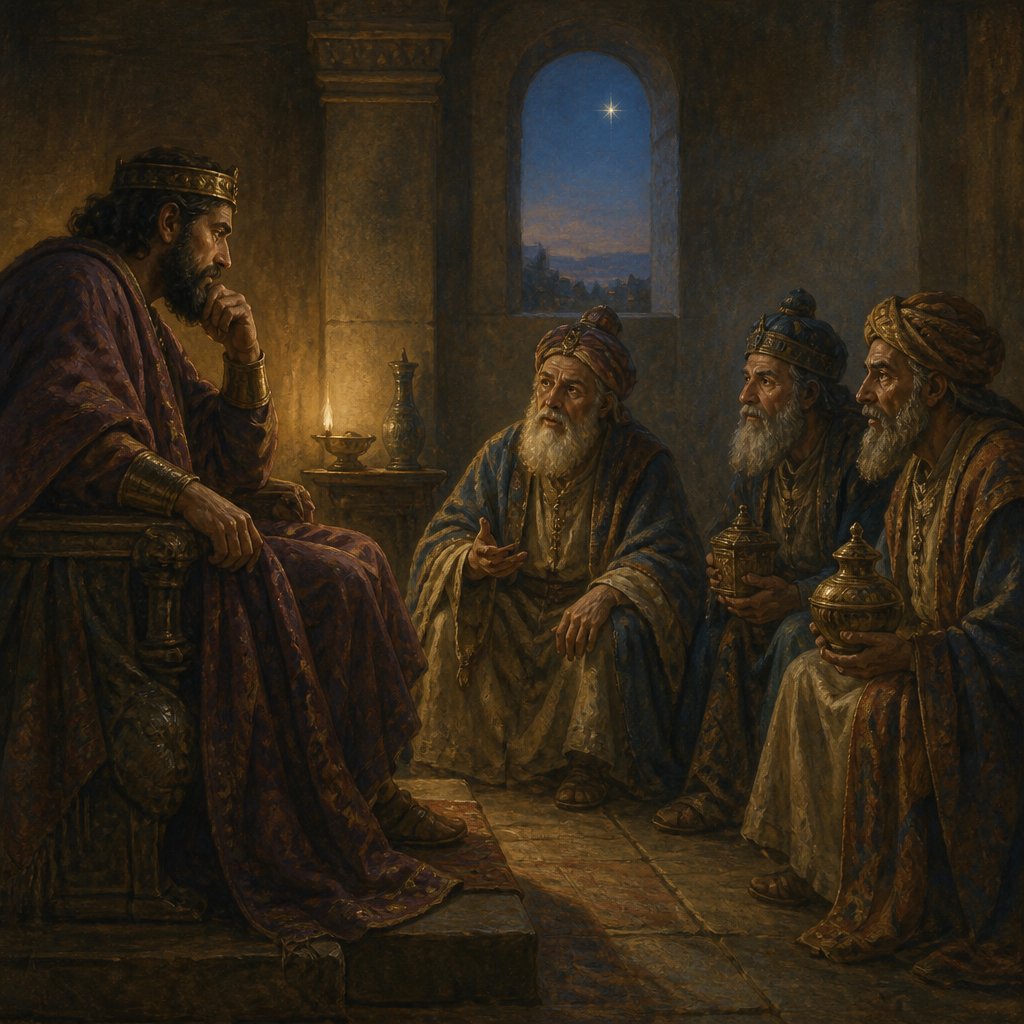
Matthew 2:7 (KJV) says, "Then Herod, when he had privily called the wise men, enquired of them diligently what time the star appeared." This verse is a part of the story of the visit of the wise men to King Herod in search of the newborn king, Jesus. The verse comes in the context of the wise men arriving in Jerusalem and inquiring about the location of the Messiah's birth.
To understand the verse, it is important to consider its broader context. The book of Matthew is the first book in the New Testament and is one of the Synoptic Gospels, along with Mark and Luke. The purpose of the Gospel of Matthew is to present Jesus as the fulfillment of Old Testament prophecies and as the long-awaited Messiah. The author, traditionally believed to be the disciple Matthew, wrote the Gospel primarily for a Jewish audience.
In Matthew 2, the author recounts the story of the Magi, or wise men, who come from the East to worship the newborn king of the Jews. They have seen a star in the East and have come to Jerusalem seeking the one who has been born. This event is significant in the Gospel narrative, as it demonstrates the recognition of Jesus' significance from outside the Jewish community. It also foreshadows the inclusion of Gentiles in the kingdom of God.
In verse 7, King Herod's response to the wise men's inquiry is one of cunning and deceit. He called the wise men secretly, or "privily," seeking to obtain information about the exact time the star had appeared. Herod's actions show his fear and jealousy, as he sees this newborn king as a threat to his own power and authority. His diligent questioning of the wise men reveals his desire to eliminate any potential rivals to his throne.
The theme of power and authority is central to this verse. Herod, as the ruler of Judea appointed by the Roman Empire, is a symbol of earthly power. His response to the news of a new king being born demonstrates the threat that Jesus' birth poses to those in positions of authority. The contrast between King Herod's earthly power and Jesus' divine authority is clear, as Jesus is recognized as the true king by the wise men who come to worship him.
Additionally, the symbolism of the star in this verse is significant. Throughout the Bible, stars are often used as symbols of divine guidance and revelation. In this context, the star that the wise men have seen represents God's guidance and the fulfillment of Old Testament prophecies regarding the Messiah. The wise men are led by the star to Jesus, emphasizing the divine nature of his birth and the fulfillment of God's plan.
The broader theological implications of this verse can also be examined. Jesus' birth is a fulfillment of Old Testament prophecies, and the recognition of his kingship by the Gentile wise men foreshadows the inclusion of all nations in the kingdom of God. The Gospel of Matthew presents Jesus as the long-awaited Messiah, who has come to fulfill God's promises and establish his kingdom on earth. The response of King Herod to Jesus' birth highlights the opposition and persecution that Jesus will face throughout his earthly ministry.
In conclusion, Matthew 2:7 is a verse that has rich theological significance. It emphasizes the themes of power and authority, divine guidance, and the fulfillment of Old Testament prophecies. The verse also serves to highlight the contrast between earthly rulers and the true king, Jesus. As a part of the broader Gospel narrative, this verse contributes to the overarching message of the Gospel of Matthew, which presents Jesus as the fulfillment of God's promises and the establishment of his kingdom on earth.
Have questions about Matthew 2:7?
Dive deeper into this scripture with Bible Chat — an AI-powered tool for exploring God's Word through conversation. Ask questions, get context, and grow in your understanding of the Bible.
Get Our Apps


Matthew 2:7 Artwork

Matthew 2:7 - "Then Herod, when he had privily called the wise men, enquired of them diligently what time the star appeared."
"Then Herod, when he had privily called the wise men, enquired of them diligently what time the star appeared." - Matthew 2:7

Matthew 7:2 - "For with what judgment ye judge, ye shall be judged: and with what measure ye mete, it shall be measured to you again."

Matthew 7:7

Matthew 7:1-2 - "Do not judge, or you too will be judged. For in the same way you judge others, you will be judged, and with the measure you use, it will be measured to you."

Matthew 7:13-14

Matthew 7:13-14

Matthew 7:13-14

Matthew 7:13-14

Matthew 7:13-14

Matthew 7:13-14

Matthew 7:13-14

Matthew 7:13-14

Matthew 7:13-14

Matthew 7:13-14

Matthew 7:13-14

Matthew 7:13

Matthew 7:12

Matthew 7:12

matthew 7:23

Matthew 7:13-14

Matthew 7:13-14

Matthew 7:13-14

Matthew 7:13-14

Matthew 7:13-14

Matthew 7:13-14

Matthew 7:13-14

Matthew 7:13-14

Matthew 7:13-14

Matthew 7:13-14