What does Matthew 27:64 mean?
"Command therefore that the sepulchre be made sure until the third day, lest his disciples come by night, and steal him away, and say unto the people, He is risen from the dead: so the last error shall be worse than the first." - Matthew 27:64
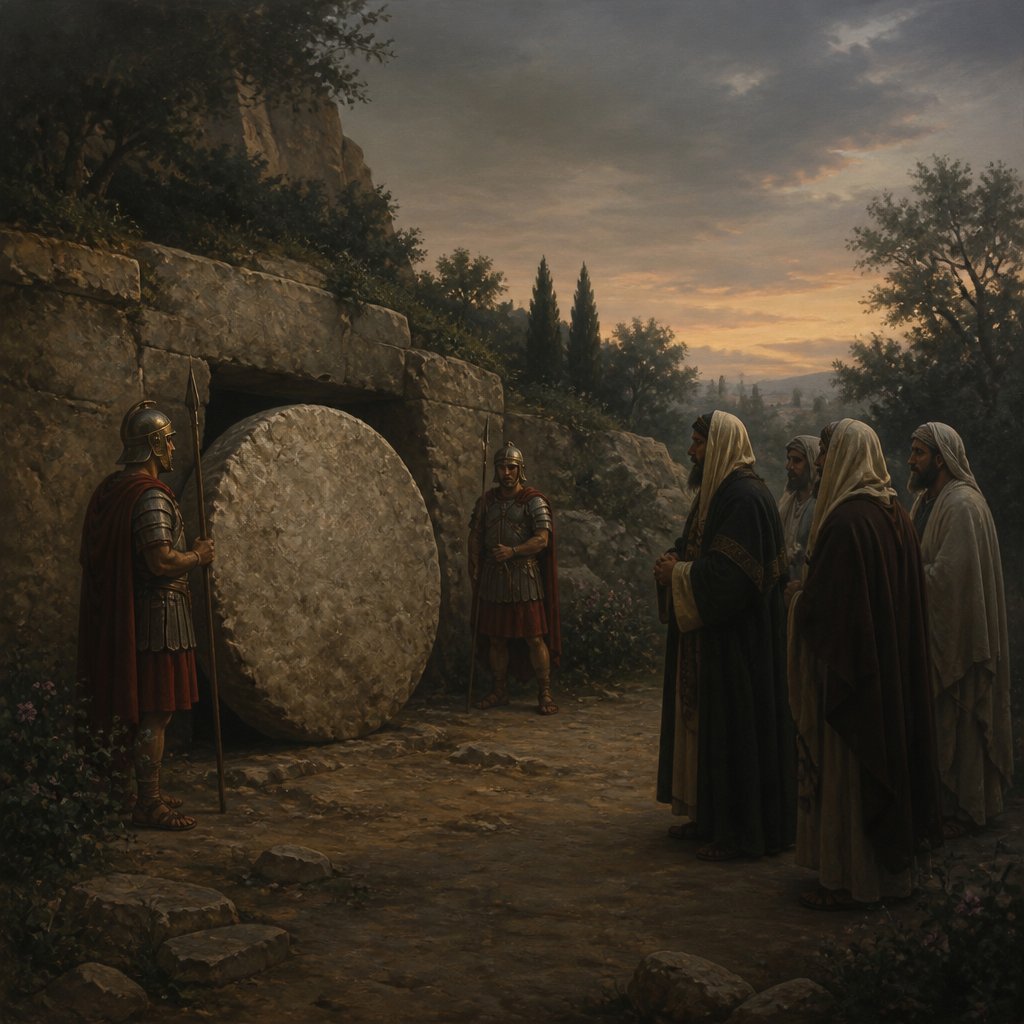
Matthew 27:64 in the King James Version of the Bible states: "Command therefore that the sepulchre be made sure until the third day, lest his disciples come by night, and steal him away, and say unto the people, He is risen from the dead: so the last error shall be worse than the first."
This verse comes from the Gospel of Matthew, which is the first book of the New Testament and one of the four canonical gospels. It is attributed to Matthew, a disciple of Jesus, and is believed to have been written between AD 70 and 100. The Gospel of Matthew focuses on the life, teachings, death, and resurrection of Jesus Christ and is considered by many to be a foundational text for Christian theology and ethics.
In Matthew 27, the verse is part of the account of Jesus's crucifixion and burial. Earlier in the chapter, we see that Jesus has been condemned to death by crucifixion, and after his death, his body is placed in a tomb. In this particular verse, the chief priests and Pharisees are coming to Pilate, the Roman governor, to request that the sepulchre (the tomb) be sealed and made secure until the third day. They express concern that Jesus's disciples might come and steal his body in order to claim that he has risen from the dead, perpetuating what they see as a deception.
The context of this verse is crucial to understanding its significance. The chief priests and Pharisees were among those who had sought to have Jesus crucified, viewing him as a threat to their religious authority. In their request to Pilate, they reveal their fear of Jesus's influence even after his death. They are troubled by the possibility of his disciples claiming that he has risen from the dead, which would validate his teachings and mission, and undermine their own authority. The verse illustrates their attempt to suppress the message of Jesus even after his death.
The themes present in this verse are central to the Christian faith and have been the subject of much theological reflection. One of the primary themes is the resurrection of Jesus Christ. The chief priests and Pharisees, in their attempt to secure the tomb, unwittingly acknowledge the possibility of Jesus's resurrection. The fear of the resurrection is founded on the belief that Jesus's teachings and claims would be vindicated if he were to rise from the dead. This reflects the central importance of the resurrection in the Christian faith, as it is seen as the ultimate confirmation of Jesus's identity as the Son of God and the fulfillment of his mission.
Another theme present in this verse is the struggle for authority and power. The chief priests and Pharisees are concerned with maintaining their position and influence, even at the cost of denying the truth of Jesus's resurrection. Their fear of the disciples' claim reveals the threat that Jesus's message poses to their authority. This theme of power and authority is a recurring motif in the Gospels, as Jesus repeatedly challenges the religious leaders of his time and teaches a message of humility, compassion, and servanthood.
The symbolism in this verse is also significant. The sealed tomb represents the attempt to confine and silence the message of Jesus. The stone that seals the entrance to the tomb becomes a symbol of human efforts to suppress the truth and power of God. However, as the narrative unfolds, the resurrection of Jesus will shatter the seal and reveal the futility of human attempts to thwart the plans of God.
In conclusion, Matthew 27:64 is a rich and complex verse that reflects the themes of resurrection, authority, and the struggle between human power and divine truth. It is a pivotal moment in the Gospel narrative, foreshadowing the triumph of Jesus over death and the vindication of his message. The verse invites readers to reflect on the enduring significance of Jesus's resurrection and the ongoing relevance of his teachings for the world today.
Have questions about Matthew 27:64?
Dive deeper into this scripture with Bible Chat — an AI-powered tool for exploring God's Word through conversation. Ask questions, get context, and grow in your understanding of the Bible.
Get Our Apps


Matthew 27:64 Artwork
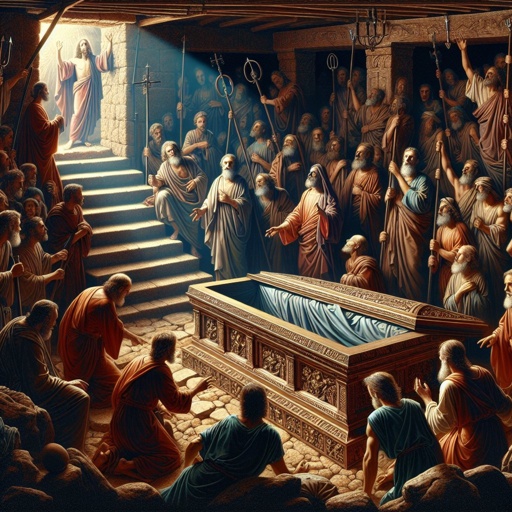
Matthew 27:64 - "Command therefore that the sepulchre be made sure until the third day, lest his disciples come by night, and steal him away, and say unto the people, He is risen from the dead: so the last error shall be worse than the first."
"Command therefore that the sepulchre be made sure until the third day, lest his disciples come by night, and steal him away, and say unto the people, He is risen from the dead: so the last error shall be worse than the first." - Matthew 27:64

Matthew 26:64 - "Jesus saith unto him, Thou hast said: nevertheless I say unto you, Hereafter shall ye see the Son of man sitting on the right hand of power, and coming in the clouds of heaven."

Matthew 27:46

Matthew 27:35

Matthew 24:27

Matthew 27:26

Matthew 27:26

Matthew 27: 38

Matthew 27:27 - "Then the soldiers of the governor took Jesus into the common hall, and gathered unto him the whole band of soldiers."

Matthew 7:24-27

Matthew 27:16 - "And they had then a notable prisoner, called Barabbas."

Matthew 27:36 - "And sitting down they watched him there;"

Matthew 27:18 - "For he knew that for envy they had delivered him."

Matthew 22:27 - "And last of all the woman died also."

Matthew 27:39 - "¶ And they that passed by reviled him, wagging their heads,"

Matthew 27:8 - "Wherefore that field was called, The field of blood, unto this day."

Matthew 27:28 - "And they stripped him, and put on him a scarlet robe."

Matthew 27:7 - "And they took counsel, and bought with them the potter's field, to bury strangers in."

Matthew 27:10 - "And gave them for the potter's field, as the Lord appointed me."

Matthew 27:41 - "Likewise also the chief priests mocking him, with the scribes and elders, said,"

Matthew 18:27 - "Then the lord of that servant was moved with compassion, and loosed him, and forgave him the debt."

Matthew 27:52 - "And the graves were opened; and many bodies of the saints which slept arose,"

Matthew 27:12 - "And when he was accused of the chief priests and elders, he answered nothing."

Matthew 27:61 - "And there was Mary Magdalene, and the other Mary, sitting over against the sepulchre."

Matthew 20:27 - "And whosoever will be chief among you, let him be your servant:"

Matthew 27:30 - "And they spit upon him, and took the reed, and smote him on the head."

Matthew 27:59 - "And when Joseph had taken the body, he wrapped it in a clean linen cloth,"

Matthew 14:27 - "But straightway Jesus spake unto them, saying, Be of good cheer; it is I; be not afraid."

Matthew 27:15 - "Now at that feast the governor was wont to release unto the people a prisoner, whom they would."