What does Matthew 27:11 mean?
"And Jesus stood before the governor: and the governor asked him, saying, Art thou the King of the Jews? And Jesus said unto him, Thou sayest." - Matthew 27:11
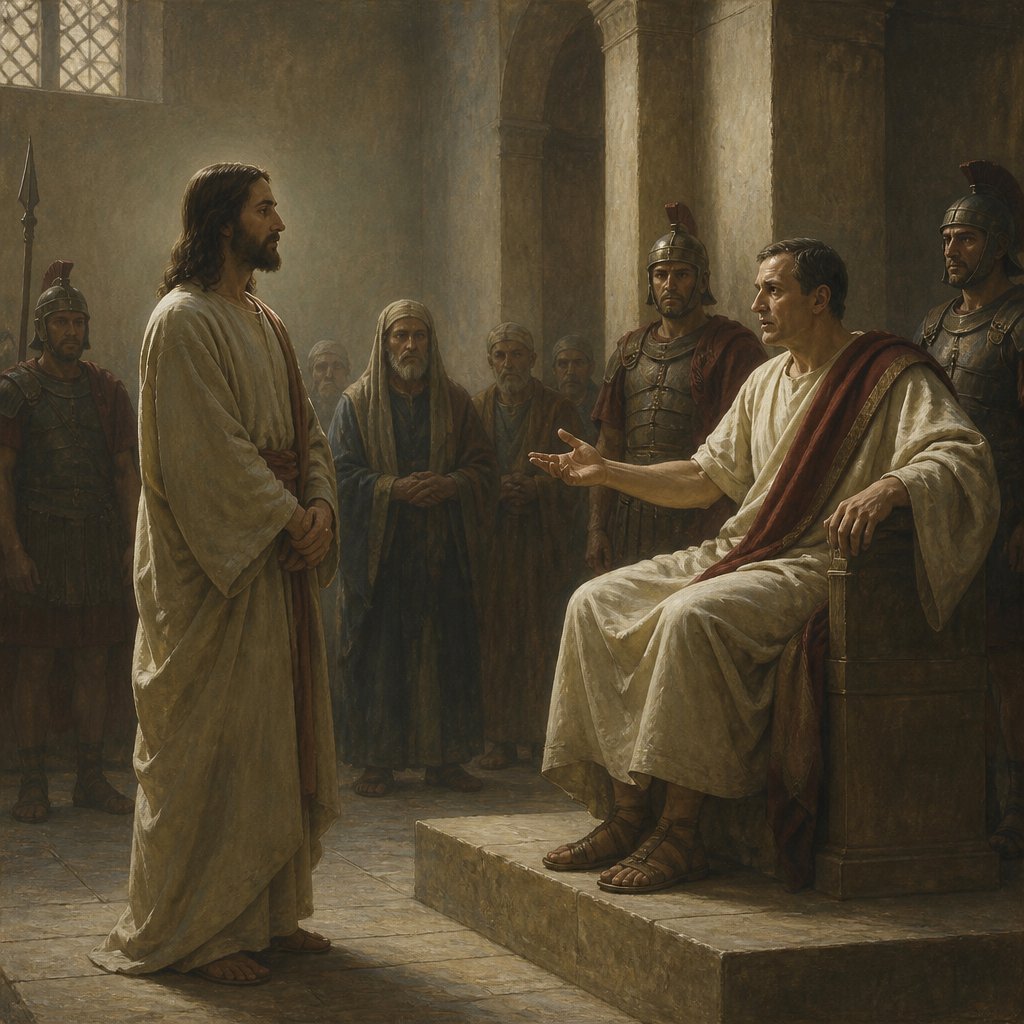
The Bible verse Matthew 27:11 in the King James Version (KJV) states, "And Jesus stood before the governor: and the governor asked him, saying, Art thou the King of the Jews? And Jesus said unto him, Thou sayest." This verse takes place during the trial of Jesus before Pontius Pilate, the Roman governor of Judea. It is a pivotal moment in the story of Jesus's crucifixion and holds significance in Christian theology.
The context of this verse is essential to understanding its significance. Jesus has been arrested by the chief priests and elders, who have brought Him before Pilate, seeking His execution. The religious leaders accuse Jesus of claiming to be the king of the Jews, a charge that would be seen as treasonous by the Roman authorities. This accusation is rooted in Jesus's claim to be the Messiah, the promised deliverer of the Jewish people, and has political implications in the context of Roman rule over Judea.
Pilate's question, "Art thou the King of the Jews?" is a crucial moment in the trial. It forces Jesus to confront the claims about His identity and mission. Jesus's response, "Thou sayest," is a subtle acknowledgment of His kingship and a confirmation of the truth of the accusation. This response can be seen as an affirmation of Jesus's divine purpose and destiny, as well as a radical challenge to the earthly powers that seek to judge and condemn Him.
The themes present in this verse are profound and far-reaching. One of the central themes is the conflict between earthly power and divine authority. Pilate represents the power of the Roman Empire, which seeks to maintain control over its subjects through force and intimidation. Jesus, on the other hand, embodies divine authority and the sovereignty of God's kingdom. His acknowledgment of being the King of the Jews is a subversive declaration that challenges the legitimacy of earthly rulers and their claims to power.
Another theme in this verse is the nature of truth and identity. Jesus's response to Pilate's question indicates His unwavering commitment to the truth of His divine mission. In a world rife with deceit and manipulation, Jesus stands as a beacon of truth and righteousness, unafraid to speak the truth in the face of judgment and condemnation.
The symbolism in this verse is also rich and multi-layered. Jesus's standing before Pilate represents the confrontation between the spiritual and the temporal, the divine and the human. Pilate, as the representative of earthly authority, stands in judgment over Jesus, who embodies the kingdom of God. This symbolic clash encapsulates the larger spiritual battle between good and evil, truth and falsehood, that is central to Christian theology.
Furthermore, the imagery of Jesus as the King of the Jews is loaded with symbolism. In the historical and religious context of first-century Judea, the title "King of the Jews" carried messianic connotations and represented the hope of liberation and salvation for the Jewish people. By claiming this title, Jesus aligns Himself with the prophetic promises of the Old Testament and signals His role as the long-awaited Messiah.
In conclusion, Matthew 27:11 in the King James Version holds profound theological, thematic, and symbolic significance. It encapsulates the pivotal moment in the trial of Jesus before Pilate, representing the conflict between earthly power and divine authority, the nature of truth and identity, and the symbolic imagery of Jesus as the King of the Jews. This verse is a crucial point in the narrative of Jesus's crucifixion and serves as a powerful reminder of the enduring message of Christ's kingship and the profound implications of His divine identity.
Have questions about Matthew 27:11?
Dive deeper into this scripture with Bible Chat — an AI-powered tool for exploring God's Word through conversation. Ask questions, get context, and grow in your understanding of the Bible.
Get Our Apps


Matthew 27:11 Artwork

Images that depicts the verse Matthew 27:11-34
Matthew 27:11 - "And Jesus stood before the governor: and the governor asked him, saying, Art thou the King of the Jews? And Jesus said unto him, Thou sayest."
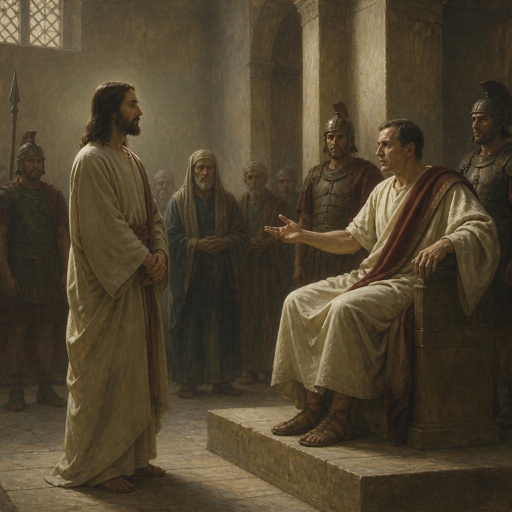
"And Jesus stood before the governor: and the governor asked him, saying, Art thou the King of the Jews? And Jesus said unto him, Thou sayest." - Matthew 27:11

Matthew 27:11-26 - "Matthew 27:11-26 Jesus stood before the governor, and the governor asked him, “Are you the king of the Jews?” Jesus replied, “You have said so.” But when he was accused by the chief priests and the elders, he gave no answer. Then Pilate said to him, “Don't you hear the testimony they are bringing against you?” But Jesus made no reply, not even to a single charge, to the great amazement of the governor. Now it was the governor's custom at the festival to release a prisoner chosen by the crowd. At that time they had a well-known prisoner whose name was Jesus Barabbas. So when the crowd had gathered, Pilate asked them, “Which one do you want me to release to you: Jesus Barabbas, or Jesus who is called the Messiah?” For he knew it was out of self-interest that they had handed Jesus over to him. While Pilate was sitting on the judge’s seat, his wife sent him this message: “Don't have anything to do with that innocent man, for I have suffered a great deal today in a dream because of him.” But the chief priests and the elders persuaded the crowd to ask for Barabbas and to have Jesus executed. “Which of the two do you want me to release to you?” asked the governor. “Barabbas,” they answered. “What shall I do, then, with Jesus who is called the Messiah?” Pilate asked. They all answered, “Crucify him!” “Why? What crime has he committed?” asked Pilate. But they shouted all the louder, “Crucify him!” When Pilate saw that he was getting nowhere, but that instead an uproar was starting, he took water and washed his hands in front of the crowd. “I am innocent of this man’s blood,” he said. “It is your responsibility!” All the people answered, “His blood is on us and on our children!” Then he released Barabbas to them. But he had Jesus flogged, and handed him over to be crucified."
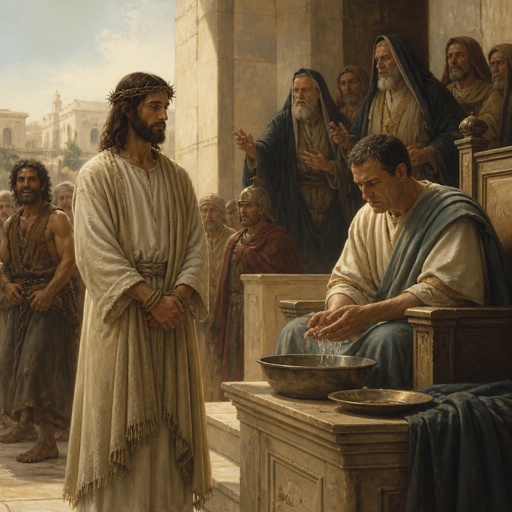
"Matthew 27:11-26 Jesus stood before the governor, and the governor asked him, “Are you the king of the Jews?” Jesus replied, “You have said so.” But when he was accused by the chief priests and the elders, he gave no answer. Then Pilate said to him, “Don't you hear the testimony they are bringing against you?” But Jesus made no reply, not even to a single charge, to the great amazement of the governor. Now it was the governor's custom at the festival to release a prisoner chosen by the crowd. At that time they had a well-known prisoner whose name was Jesus Barabbas. So when the crowd had gathered, Pilate asked them, “Which one do you want me to release to you: Jesus Barabbas, or Jesus who is called the Messiah?” For he knew it was out of self-interest that they had handed Jesus over to him. While Pilate was sitting on the judge’s seat, his wife sent him this message: “Don't have anything to do with that innocent man, for I have suffered a great deal today in a dream because of him.” But the chief priests and the elders persuaded the crowd to ask for Barabbas and to have Jesus executed. “Which of the two do you want me to release to you?” asked the governor. “Barabbas,” they answered. “What shall I do, then, with Jesus who is called the Messiah?” Pilate asked. They all answered, “Crucify him!” “Why? What crime has he committed?” asked Pilate. But they shouted all the louder, “Crucify him!” When Pilate saw that he was getting nowhere, but that instead an uproar was starting, he took water and washed his hands in front of the crowd. “I am innocent of this man’s blood,” he said. “It is your responsibility!” All the people answered, “His blood is on us and on our children!” Then he released Barabbas to them. But he had Jesus flogged, and handed him over to be crucified." - Matthew 27:11-26

Matthew 11:27 - "All things are delivered unto me of my Father: and no man knoweth the Son, but the Father; neither knoweth any man the Father, save the Son, and he to whomsoever the Son will reveal him."

Matthew 27:26

Matthew 27:46

Matthew 27:35

Matthew 24:27

Matthew 27:26

Matthew 27: 38

Matthew 27:27 - "Then the soldiers of the governor took Jesus into the common hall, and gathered unto him the whole band of soldiers."

Matthew 7:24-27

Matthew 27:16 - "And they had then a notable prisoner, called Barabbas."

Matthew 27:36 - "And sitting down they watched him there;"

Matthew 27:18 - "For he knew that for envy they had delivered him."

Matthew 22:27 - "And last of all the woman died also."

Matthew 27:39 - "¶ And they that passed by reviled him, wagging their heads,"

Matthew 27:8 - "Wherefore that field was called, The field of blood, unto this day."

Matthew 27:28 - "And they stripped him, and put on him a scarlet robe."

Matthew 3:11

Matthew 3:11

Matthew 3:11

Matthew 3:11

Matthew 3:11

Matthew 3:11

Matthew 27:7 - "And they took counsel, and bought with them the potter's field, to bury strangers in."

Matthew 27:10 - "And gave them for the potter's field, as the Lord appointed me."

Matthew 3:11-12