What does Matthew 17:17 mean?
"Then Jesus answered and said, O faithless and perverse generation, how long shall I be with you? how long shall I suffer you? bring him hither to me." - Matthew 17:17
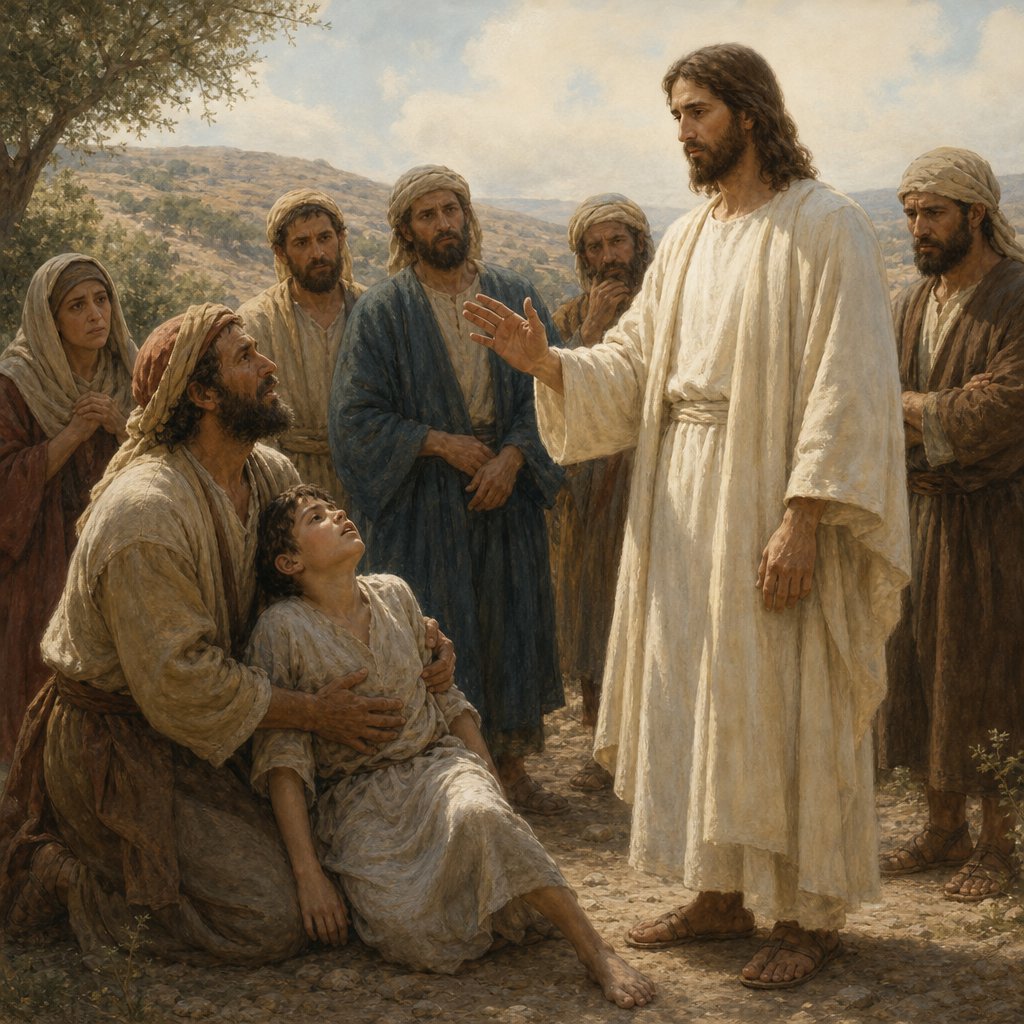
Matthew 17 sits immediately after the Transfiguration, where Jesus is revealed in glory on the mount before Peter, James, and John, and the Father’s voice identifies him: “This is my beloved Son, in whom I am well pleased; hear ye him.” Coming down from that height of unveiled majesty, Jesus meets a scene of confusion, suffering, and spiritual failure. A man has brought his tormented son to the disciples, and they cannot heal him. The contrast is intentional: the mountain displays Christ’s divine authority; the valley exposes human weakness and the misery that sin and satanic bondage inflict. In that setting Jesus speaks the words of Matthew 17:17 in the King James Version: “Then Jesus answered and said, O faithless and perverse generation, how long shall I be with you? how long shall I suffer you? bring him hither to me.”
In the immediate narrative, this sentence is both a rebuke and a turning point. The disciples’ inability is not merely a technical failure; it reveals a deeper spiritual problem. When Jesus says, “O faithless and perverse generation,” he is not addressing only the father, or only the scribes present in parallel accounts, or only the nine disciples left below while three were on the mount. The wording “generation” widens the scope to the spiritual atmosphere of the whole people in that moment: a community surrounded by evidence of God’s work, yet slow to trust God and quick to twist away from him. In the KJV, “faithless” is not simply the absence of optimism; it is the absence of reliance upon God. “Perverse” carries the sense of being turned aside, bent out of the straight way. Together they describe a people who do not rest in God’s power and do not walk in God’s order. The boy’s misery is a vivid symptom of a world out of joint; the disciples’ failure shows that even those closest to Jesus can act without the steady dependence that faith implies.
Jesus’ double question, “how long shall I be with you? how long shall I suffer you?” adds a solemn emotional weight. It is not a confession of weakness in Christ but a revelation of divine patience under the burden of persistent unbelief. “How long shall I be with you?” points toward the limited time of his earthly ministry and, in the broader arc of the Gospel, toward his approaching death, resurrection, and ascension. His presence among them is a gift, yet they behave as though they can remain unchanged indefinitely. “How long shall I suffer you?” uses “suffer” in the older KJV sense of “bear,” “endure,” or “put up with.” The word communicates the strain of holy love in the face of repeated dullness of heart. It echoes the way the Old Testament prophets and even Moses spoke when dealing with a stubborn people; it is the voice of the righteous one confronting a deep-rooted human pattern. The significance is that Christ’s rebuke is not petty irritation but moral clarity: unbelief is not a small flaw; it is a serious resistance to the God who is present and speaking.
Yet the sentence does not end with rejection; it ends with invitation and command: “bring him hither to me.” That final clause is the key that unlocks the meaning of the whole verse. Jesus identifies the problem—faithlessness and perversity—but he does not leave the suffering child at a distance, nor does he tell the father to go away and try harder. He calls for the boy to be brought to him personally. The symbolism here is simple and profound. The failure of the disciples highlights that spiritual power is not a possession independent of fellowship with Christ; it is exercised rightly only in dependence on him. The helpless child represents human inability; the father’s plea represents desperate need; the disciples represent insufficient faith; but Jesus stands as the decisive center. “Bring him hither to me” shows that the remedy for the chaos in the valley is the same glory revealed on the mount: the authority of the Son, accessible not through human technique but through coming to him.
Within the larger themes of Matthew, this verse underscores what it means to be a disciple. The disciples have been given authority in earlier chapters, and yet here they discover that authority without continued faith is empty. The verse also exposes the moral character of unbelief. It is not merely ignorance; it is crookedness of heart, a turning from the straight path of trusting God. At the same time, the verse shows the compassion of Christ in action. His rebuke is sharp, but his next move is to draw the sufferer near. In the flow of the chapter, Jesus will rebuke the devil and the child will be cured “from that very hour,” demonstrating that the frustration of verse 17 does not cancel his mercy. Rather, it sets mercy in its true light: God’s help is real and immediate, but it calls people out of unbelief into trust.
Matthew 17:17 is therefore significant as a portrait of the human condition and of Christ’s response to it. It speaks of a world that is “faithless and perverse,” even when the Son of God walks among it. It hints at the impending transition when Jesus will no longer be physically “with” them, pressing the urgency of learning faith now. And it directs the reader to the heart of the Gospel’s remedy: when spiritual incapacity, suffering, and confusion converge, the decisive act is to bring the need to Christ himself. The rebuke tells the truth about the generation; the command to bring the boy tells the truth about the Savior.
Have questions about Matthew 17:17?
Dive deeper into this scripture with Bible Chat — an AI-powered tool for exploring God's Word through conversation. Ask questions, get context, and grow in your understanding of the Bible.
Get Our Apps


Matthew 17:17 Artwork

Matthew 17:17-18

Matthew 17:17-18

"Then Jesus answered and said, O faithless and perverse generation, how long shall I be with you? how long shall I suffer you? bring him hither to me." - Matthew 17:17

Matthew 17:17 - "Then Jesus answered and said, O faithless and perverse generation, how long shall I be with you? how long shall I suffer you? bring him hither to me."
"Then Jesus answered and said, O faithless and perverse generation, how long shall I be with you? how long shall I suffer you? bring him hither to me." - Matthew 17:17

Matthew 6:17

Matthew 17:20

Matthew 17:20

Matthew 6:17-18

Matthew 19:16-17

Matthew 17:14-21

Matthew 17:14-15

Matthew 3:13-17

Matthew 2:17 - "Then was fulfilled that which was spoken by Jeremy the prophet, saying,"

Matthew 17:21 - "Howbeit this kind goeth not out but by prayer and fasting."

Matthew 12:17 - "That it might be fulfilled which was spoken by Esaias the prophet, saying,"

Matthew 17:7 - "And Jesus came and touched them, and said, Arise, and be not afraid."

Matthew 28:17 - "And when they saw him, they worshipped him: but some doubted."

Matthew 17:6 - "And when the disciples heard it, they fell on their face, and were sore afraid."

Matthew 17:3 - "And, behold, there appeared unto them Moses and Elias talking with him."

Matthew 17:16 - "And I brought him to thy disciples, and they could not cure him."

Matthew 17:13 - "Then the disciples understood that he spake unto them of John the Baptist."

Matthew 21:17 - "¶ And he left them, and went out of the city into Bethany; and he lodged there."

Matthew 10:17 - "But beware of men: for they will deliver you up to the councils, and they will scourge you in their synagogues;"

Matthew 23:17 - "Ye fools and blind: for whether is greater, the gold, or the temple that sanctifieth the gold?"

Matthew 4:17 - "¶ From that time Jesus began to preach, and to say, Repent: for the kingdom of heaven is at hand."

Matthew 6:17 - "But thou, when thou fastest, anoint thine head, and wash thy face;"

Matthew 17:8 - "And when they had lifted up their eyes, they saw no man, save Jesus only."

Matthew 14:17 - "And they say unto him, We have here but five loaves, and two fishes."

Matthew 25:17 - "And likewise he that had received two, he also gained other two."