What does Mark 9:16 mean?
"And he asked the scribes, What question ye with them?" - Mark 9:16

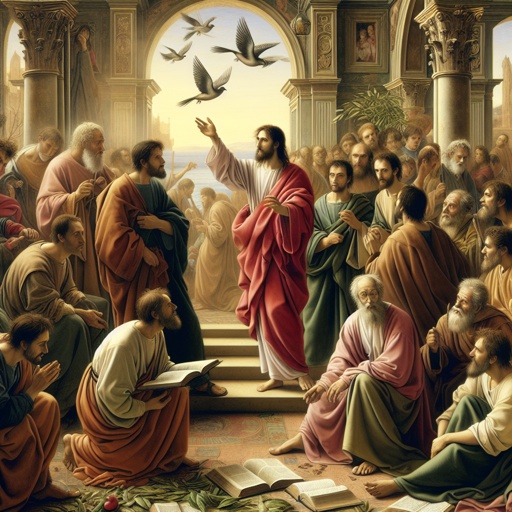
The King James Version of Mark 9:16 reads, "And he asked the scribes, What question ye with them?" This verse is part of a larger passage in the Gospel of Mark, which tells the story of Jesus' transfiguration. In this particular verse, Jesus has just come down from the mountain where he was transfigured and sees a crowd gathered around his disciples. He approaches the crowd and asks the scribes (religious scholars) what they are disputing with his disciples.
In order to fully understand the meaning and significance of this verse, we must look at the broader context of the passage in which it appears. The transfiguration of Jesus is a pivotal moment in the narrative of the Gospel of Mark. It signifies a turning point in Jesus' ministry and reveals his divine nature to his closest disciples. The events leading up to and immediately following the transfiguration are filled with dynamic and intense moments, each of which showcases the power and authority of Jesus.
The verse in question serves as a bridge between the transfiguration and the confrontation between Jesus and the scribes over a boy possessed by a demon. It sets the stage for a powerful demonstration of Jesus' authority over evil spirits, and ultimately serves as a powerful reminder of the importance of faith and belief in Jesus' ability to heal and deliver.
One of the key themes present in this verse and the broader passage is the idea of spiritual authority. Jesus' question to the scribes reflects his rightful authority as the Son of God and Messiah to inquire about the interactions between his disciples and the religious leaders. This theme of authority continues to be a central focus throughout the Gospels, as Jesus often challenges the religious leaders and demonstrates his authority through his actions and teachings.
Another important theme in this passage is the power of faith. The interaction between Jesus and the scribes over the possessed boy highlights the disciples' lack of faith in their ability to cast out the demon. Jesus admonishes them for their lack of belief, stating that all things are possible for those who have faith. This theme of faith and belief in Jesus' power to overcome any obstacle is a central message in the Gospel of Mark and is exemplified in this passage.
The symbolism in this verse can be found in the confrontation between Jesus and the scribes over the possessed boy. The presence of the scribes represents the religious establishment and their inability to help the boy, while Jesus symbolizes the divine authority and power to heal and deliver. The possessed boy serves as a symbol of the spiritual warfare that is taking place, and the disciples' lack of faith represents the struggle to fully trust in Jesus' authority.
In conclusion, Mark 9:16 from the King James Version of the Bible holds significant meaning within the broader context of the Gospel of Mark. It serves as a pivotal moment in the narrative, highlighting themes of spiritual authority, the power of faith, and the symbolism of Jesus' divine authority. This verse and the passage in which it appears continues to be a powerful reminder of the importance of believing in Jesus' ability to heal and deliver, and his ultimate authority as the Son of God.
Have questions about Mark 9:16?
Dive deeper into this scripture with Bible Chat — an AI-powered tool for exploring God's Word through conversation. Ask questions, get context, and grow in your understanding of the Bible.
Get Our Apps


Mark 9:16 Artwork

Mark 9:16 - "And he asked the scribes, What question ye with them?"

"And he asked the scribes, What question ye with them?" - Mark 9:16

african american mary magdalene, mark 16: 9

Mark 16:9 - "¶ Now when Jesus was risen early the first day of the week, he appeared first to Mary Magdalene, out of whom he had cast seven devils."

Mark 16:20
Mark 16:20
Mark 16:20

Mark 16:20

Mark 16:20

Mark 9:2 Show only 4 people Show a mountain area According to Mark 9:2

Mark 2:9

Mark 16:1-2

Mark 16:6-8

Mark 9:2 Show only 4 people and one of them is Jesus Show a mountain area According to Mark 9:2

Mark 16:4-5

Mark 16:6-8

Mark 16:4-5

Mark 10:13–16

Mark 16:4-5

Mark 16:6-8

Mark 9:38

Mark 2:9

Mark 3:16 - "And Simon he surnamed Peter;"

Mark 9:36-37

african american mark 16:11

Mark 9:48 - "Where their worm dieth not, and the fire is not quenched."

Mark 6:9 - "But be shod with sandals; and not put on two coats."

Mark 16:13 - "And they went and told it unto the residue: neither believed they them."

Mark 9:40 - "For he that is not against us is on our part."

Mark 9:46 - "Where their worm dieth not, and the fire is not quenched."