What does Mark 2:9 mean?
"Whether is it easier to say to the sick of the palsy, Thy sins be forgiven thee; or to say, Arise, and take up thy bed, and walk?" - Mark 2:9
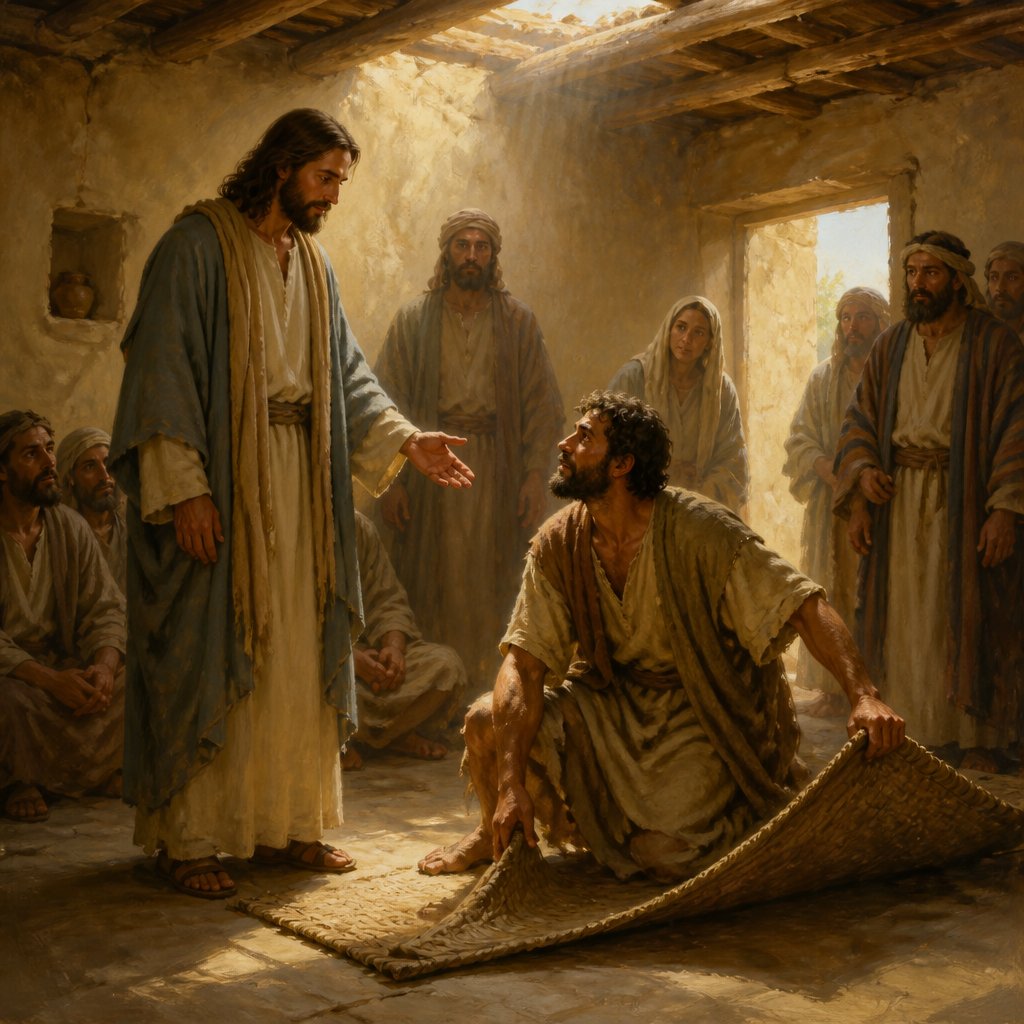
The Bible verse Mark 2:9 in the King James Version states:
"Whether is it easier to say to the sick of the palsy, Thy sins be forgiven thee; or to say, Arise, and take up thy bed, and walk?"
This verse is part of a larger passage in the Gospel of Mark, which tells the story of Jesus healing a paralyzed man. The verse raises a significant question about the authority and power of Jesus and serves as a demonstration of his divinity.
The context of this verse is essential for understanding its significance. In the preceding verses, Jesus was in Capernaum, and a large crowd had gathered to hear him speak. There were so many people that there was no more room in the house where Jesus was teaching. Four men brought a paralyzed man to be healed. Unable to get in because of the crowd, they went up on the roof, removed some tiles, and lowered the man down on his mat right in front of Jesus. When Jesus saw their faith, he said to the paralyzed man, "Son, your sins are forgiven” (Mark 2:5).
This proclamation stirred up controversy among the scribes who were present. They were questioning in their hearts, "Why doth this man thus speak blasphemies? Who can forgive sins but God only?" (Mark 2:7). Jesus, perceiving their thoughts, asked them, "Whether is it easier to say to the sick of the palsy, Thy sins be forgiven thee; or to say, Arise, and take up thy bed, and walk?" (Mark 2:9). With this question, Jesus pointed out that both healing and forgiveness of sins are equally possible for him to accomplish.
The significance of this verse lies in its illustration of Jesus' divine authority. By forgiving the paralyzed man’s sins, Jesus was demonstrating that he had the power to forgive sins, a power that was traditionally associated only with God. The question posed by Jesus challenges the scribes to consider the true nature of his authority. By posing this question, Jesus is not only showing his divine power but also challenging the understanding of the religious leaders at the time.
The themes present in this verse are forgiveness, healing, and the authority of Jesus. The forgiveness of sins is a central theme in the Christian faith. In this passage, Jesus not only physically heals the paralyzed man but also provides spiritual healing through the forgiveness of his sins. This serves as a powerful illustration of God's mercy and compassion.
The authority of Jesus is another central theme in this verse. By demonstrating his ability to forgive sins and heal the sick, Jesus is asserting his divine authority as the Son of God. This challenges the traditional understanding of religious authority and establishes Jesus as the ultimate authority.
The symbolism in this verse is profound. The paralysis of the man represents the spiritual condition of humanity. Through sin, humanity is spiritually paralyzed and in need of healing and forgiveness. Jesus, by healing the man and forgiving his sins, symbolizes the redemption and restoration that he offers to all who believe in him. The bed on which the paralyzed man was lying represents the burden of sin and guilt that Jesus has the power to remove.
In summary, Mark 2:9 in the King James Version presents a powerful demonstration of Jesus' divinity, authority, and compassion. It challenges traditional religious understanding and establishes Jesus as the ultimate authority in matters of forgiveness and healing. This verse serves as a reminder of the transformative power of Jesus Christ to heal and restore all who come to him in faith.
Have questions about Mark 2:9?
Dive deeper into this scripture with Bible Chat — an AI-powered tool for exploring God's Word through conversation. Ask questions, get context, and grow in your understanding of the Bible.
Get Our Apps


Mark 2:9 Artwork

Mark 2:9

Mark 2:9

Mark 2:9 - "Whether is it easier to say to the sick of the palsy, Thy sins be forgiven thee; or to say, Arise, and take up thy bed, and walk?"
"Whether is it easier to say to the sick of the palsy, Thy sins be forgiven thee; or to say, Arise, and take up thy bed, and walk?" - Mark 2:9

Mark 9:2 Show only 4 people Show a mountain area According to Mark 9:2

Mark 9:2 Show only 4 people and one of them is Jesus Show a mountain area According to Mark 9:2

Mark 9:2 Do not show Jesus' face Show only 4 people including Jesus Show a mountain area therefore, show only 4 people in a mountain area and for one of them don't show the face. Mark 9:2

Mark 9:2 - "¶ And after six days Jesus taketh with him Peter, and James, and John, and leadeth them up into an high mountain apart by themselves: and he was transfigured before them."

Mark 9:38

Mark 9:36-37

Mark 9:48 - "Where their worm dieth not, and the fire is not quenched."

Mark 6:9 - "But be shod with sandals; and not put on two coats."

Mark 9:40 - "For he that is not against us is on our part."

Mark 9:46 - "Where their worm dieth not, and the fire is not quenched."

Mark 9:44 - "Where their worm dieth not, and the fire is not quenched."

Mark 9:32 - "But they understood not that saying, and were afraid to ask him."

Mark 2:2

african american mary magdalene, mark 16: 9

Mark 9:16 - "And he asked the scribes, What question ye with them?"

Mark 9:6 - "For he wist not what to say; for they were sore afraid."

Mark 9:4 - "And there appeared unto them Elias with Moses: and they were talking with Jesus."

Mark 9:27 - "But Jesus took him by the hand, and lifted him up; and he arose."

Mark 2

Mark 2

Mark 9:49 - "For every one shall be salted with fire, and every sacrifice shall be salted with salt."

Mark 9:34 - "But they held their peace: for by the way they had disputed among themselves, who should be the greatest."

Mark 8:9 - "And they that had eaten were about four thousand: and he sent them away."

Mark 10:9 - "What therefore God hath joined together, let not man put asunder."

Mark 9:11 - "¶ And they asked him, saying, Why say the scribes that Elias must first come?"

Mark 15:9 - "But Pilate answered them, saying, Will ye that I release unto you the King of the Jews?"