What does Mark 2:5 mean?
"When Jesus saw their faith, he said unto the sick of the palsy, Son, thy sins be forgiven thee." - Mark 2:5
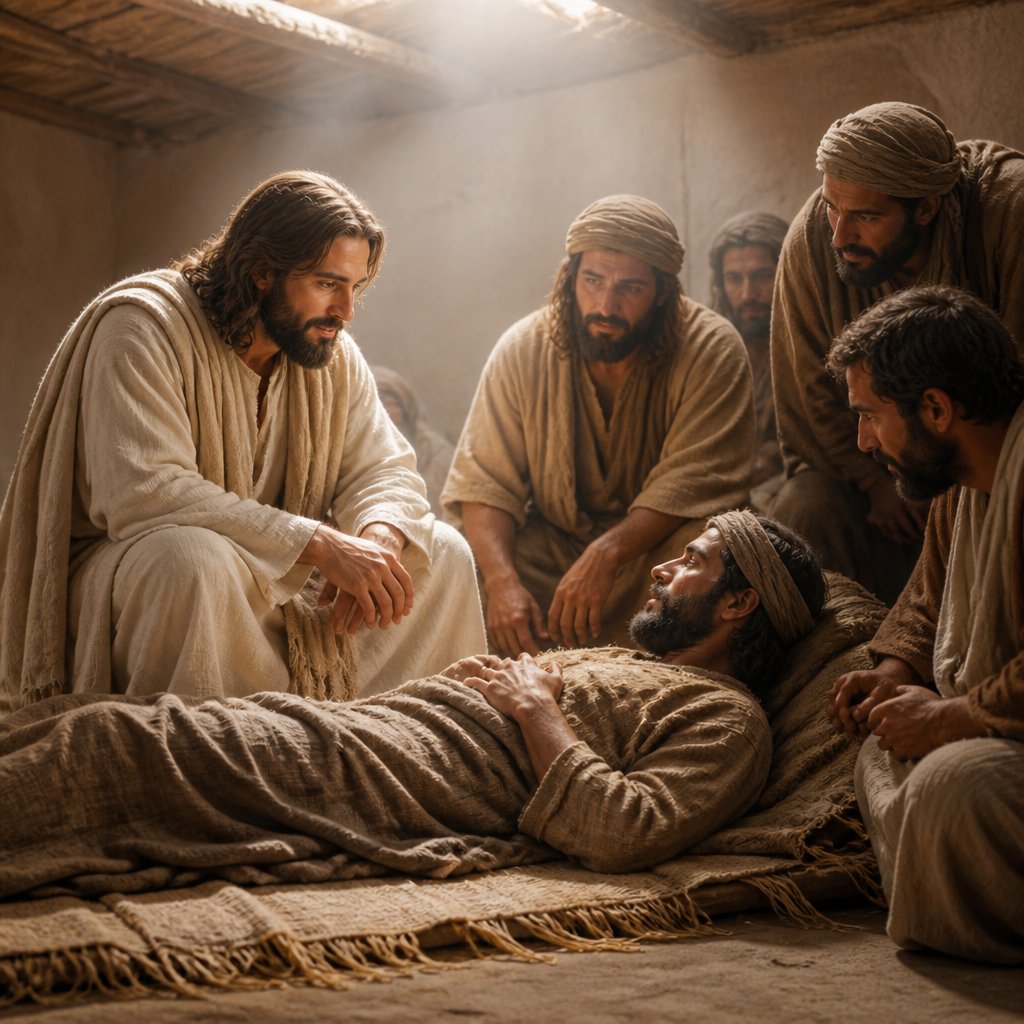
The Bible verse Mark 2:5 from the King James Version (KJV) states, "When Jesus saw their faith, he said unto the sick of the palsy, Son, thy sins be forgiven thee."
This verse is a powerful example of both the compassion and the divine authority of Jesus Christ. It takes place in the town of Capernaum, where Jesus had returned to preach and heal the sick. The verse begins with the phrase "When Jesus saw their faith," which is significant because it highlights the importance of faith in the healing and forgiveness that Jesus offers. At this moment, Jesus noticed the genuine belief and trust of those who brought the paralyzed man to him, and this faith moved him to action.
The scene depicts a paralyzed man being brought to Jesus by four of his friends. When they were unable to get close to Jesus because of the crowd, they took extraordinary measures to lower the man through the roof. This demonstrates the persistence and determination of the friends and their unwavering faith in Jesus' ability to heal. It is their faith and action that immediately capture Jesus' attention.
When Jesus addresses the paralyzed man as "Son," it shows his loving and caring nature. In that period of time, calling someone "son" was a term of endearment, showing a close and intimate relationship. Jesus not only offers physical healing to the man but also spiritual healing by pronouncing, "thy sins be forgiven thee." This statement is significant because it reveals Jesus' divine authority to forgive sins, something that was typically reserved for God alone. It also emphasizes the inseparable connection between physical healing and spiritual healing in Jesus' ministry.
The response of the religious leaders and scribes who were present in the crowd reflects the context of the verse. They were astonished and questioned Jesus' authority to forgive sins, as they viewed it as blasphemy. In response, Jesus clarifies his authority by performing a physical miracle of healing, demonstrating that he has the power to forgive sins as the Son of God.
This verse is rich in symbolism, highlighting several key themes. Firstly, it emphasizes the interconnectedness of faith, healing, and forgiveness. The faith of the paralyzed man's friends led to his physical healing and the forgiveness of his sins. It also portrays the intimate and personal nature of Jesus' relationship with each individual, addressing the man as "Son" and offering him forgiveness.
The verse also highlights the theme of Jesus' divine authority. By forgiving the paralyzed man's sins, he demonstrates that he possesses the authority and power of God. This challenges the traditional religious beliefs and asserts Jesus as the ultimate source of healing and redemption.
Furthermore, the verse illustrates the compassion and empathy of Jesus. He not only addresses the physical ailment of the paralyzed man but also attends to his spiritual well-being. This reflects Jesus' mission to bring holistic restoration and salvation to humanity.
In a broader context, this verse serves as a reminder of the significance of faith in Jesus' ministry. It encourages believers to approach Jesus with unwavering faith, trusting in his ability to heal, redeem, and forgive. It also challenges us to consider the interconnectedness of our physical and spiritual well-being and to seek healing and forgiveness through our faith in Jesus.
In conclusion, Mark 2:5 from the King James Version of the Bible is a profound and impactful verse that encapsulates the compassion, divine authority, and the inseparable connection between faith, healing, and forgiveness in Jesus' ministry. Its themes and symbolism offer valuable insights into the nature of Jesus' relationship with humanity and the transformative power of faith in his redemptive work.
Have questions about Mark 2:5?
Dive deeper into this scripture with Bible Chat — an AI-powered tool for exploring God's Word through conversation. Ask questions, get context, and grow in your understanding of the Bible.
Get Our Apps


Mark 2:5 Artwork

Mark 2:5

Mark 2:5 - "When Jesus saw their faith, he said unto the sick of the palsy, Son, thy sins be forgiven thee."
"When Jesus saw their faith, he said unto the sick of the palsy, Son, thy sins be forgiven thee." - Mark 2:5

Mark 5:2 - "And when he was come out of the ship, immediately there met him out of the tombs a man with an unclean spirit,"

Mark 16:4-5

Mark 16:4-5

Mark 16:4-5

Mark 5:17 - "And they began to pray him to depart out of their coasts."

Mark 2:2

Mark 15:5 - "But Jesus yet answered nothing; so that Pilate marvelled."

"And when he was come out of the ship, immediately there met him out of the tombs a man with an unclean spirit," - Mark 5:2

Mark 5:1 - "And they came over unto the other side of the sea, into the country of the Gadarenes."

Mark 2

Mark 2

Mark 5:11 - "Now there was there nigh unto the mountains a great herd of swine feeding."

Mark 5:25 - "And a certain woman, which had an issue of blood twelve years,"

Mark 5:32 - "And he looked round about to see her that had done this thing."

Mark 5:24 - "And Jesus went with him; and much people followed him, and thronged him."

Job 21:5 - "Mark me, and be astonished, and lay your hand upon your mouth."

Mark 9:2 Show only 4 people Show a mountain area According to Mark 9:2

mark 2:4

Mark 2:1

Mark 2:27

Mark 2:10

mark 2:4

mark 2:4

Mark 2:9

Mark 9:2 Show only 4 people and one of them is Jesus Show a mountain area According to Mark 9:2

Mark 5:8 - "For he said unto him, Come out of the man, thou unclean spirit."

Mark 5:6 - "But when he saw Jesus afar off, he ran and worshipped him,"