What does Mark 15:6-15 mean?
"Now at that feast he released unto them one prisoner, whomsoever they desired. And there was one named Barabbas, which lay bound with them that had made insurrection with him, who had committed murder in the insurrection. And the multitude crying aloud began to desire him to do as he had ever done unto them. But Pilate answered them, saying, Will ye that I release unto you the King of the Jews? For he knew that the chief priests had delivered him for envy. But the chief priests moved the people, that he should rather release Barabbas unto them. And Pilate answered and said again unto them, What will ye then that I shall do unto him whom ye call the King of the Jews? And they cried out again, Crucify him. Then Pilate said unto them, Why, what evil hath he done? And they cried out the more exceedingly, Crucify him. And so Pilate, willing to content the people, released Barabbas unto them, and delivered Jesus, when he had scourged him, to be crucified." - Mark 15:6-15
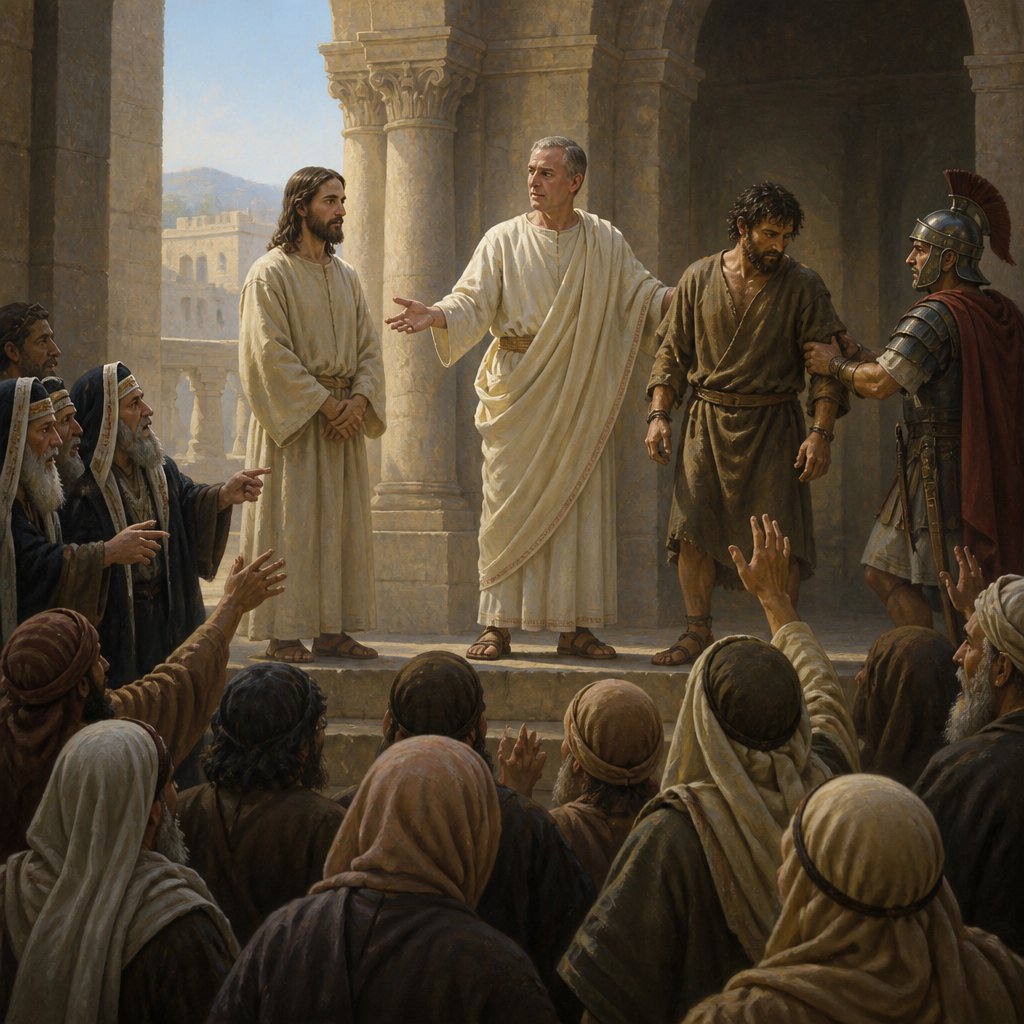
Mark 15: 6-15 (KJV):
6 Now at that feast he released unto them one prisoner, whomsoever they desired.
7 And there was one named Barabbas, which lay bound with them that had made insurrection with him, who had committed murder in the insurrection.
8 And the multitude crying aloud began to desire him to do as he had ever done unto them.
9 But Pilate answered them, saying, Will ye that I release unto you the King of the Jews?
10 For he knew that the chief priests had delivered him for envy.
11 But the chief priests moved the people, that he should rather release Barabbas unto them.
12 And Pilate answered and said again unto them, What will ye then that I shall do unto him whom ye call the King of the Jews?
13 And they cried out again, Crucify him.
14 Then Pilate said unto them, Why, what evil hath he done? And they cried out the more exceedingly, Crucify him.
15 And so Pilate, willing to content the people, released Barabbas unto them, and delivered Jesus, when he had scourged him, to be crucified.
This passage occurs in the narrative of the trial of Jesus before Pontius Pilate. It is a crucial moment in the crucifixion story, as it portrays the contrast between the innocence of Jesus and the guilt of Barabbas, who is a notorious criminal. The events that unfold in this passage are pivotal in the Christian faith and have important themes of justice, sacrifice, and the redemption of humanity.
The context of this passage is set during the Passover feast, a significant religious event for the Jewish people. Pilate, as the Roman governor, had the authority to release one prisoner as a customary gesture of goodwill to the Jewish people during the festival. Pilate, however, had no real interest in the Jewish religion or customs, and his primary concern was to maintain order and prevent uprisings.
The choice that Pilate presents to the crowd is between Jesus, whom he refers to as the "King of the Jews," and Barabbas, a convicted criminal and murderer. Pilate is aware that the chief priests handed over Jesus out of envy, recognizing that Jesus was seen as a threat to their religious authority. Despite knowing Jesus' innocence, Pilate tries to manipulate the crowd's emotions to secure Jesus' release. He presents Jesus as the preferable choice, expecting the people to choose his release over Barabbas, given his innocence and the lack of any substantial crime on his part.
However, the crowd, under the influence of the chief priests, demands the release of Barabbas and the crucifixion of Jesus. They choose to spare the life of a criminal over an innocent man. Pilate, faced with the mounting pressure from the crowd, gives in to their demands and releases Barabbas while handing Jesus over to be crucified after having him scourged.
This passage raises profound theological themes. Firstly, it underscores the injustice and corruption within the legal and religious institutions of the time. Pilate, despite knowing Jesus' innocence, succumbs to the pressure of the crowd and the chief priests, ultimately sacrificing justice for the sake of political expediency.
Secondly, the contrasting figures of Jesus and Barabbas serve as symbols of righteousness and sin, innocence and guilt, and the concept of substitutionary atonement. Jesus, the sinless Son of God, willingly takes on the punishment that rightfully belonged to Barabbas and all of humanity.
The imagery and symbolism in this passage are rich and profound. On one level, Barabbas represents the sinful and rebellious nature of humanity, and his release symbolizes the undeserved mercy and grace of God. Jesus, on the other hand, willingly accepts the unjust punishment, symbolizing the sacrificial atonement for the sins of humanity. The exchange of an innocent life for a guilty one reflects the central Christian belief in the redemptive power of Christ's sacrifice on the cross.
Moreover, this passage illuminates the broader theme of the nature of power and its abuse. Both Pilate and the chief priests wield their authority to manipulate the crowd and secure their own interests. The human inclination towards injustice and the misuse of power are highlighted here, and it serves as a reminder of the fallen nature of humanity and the desperate need for redemption.
In conclusion, the Bible verse Mark 15: 6-15 portrays a profound moral and theological dilemma. It encapsulates themes of injustice, sacrifice, redemption, and the profound love of God for humanity. The story of the exchange of Barabbas for Jesus foreshadows the ultimate atoning sacrifice of Christ on the cross, which lies at the heart of the Christian faith. This passage offers a powerful reflection on the nature of sin, the grace of God, and the depth of Christ's love for humanity.
Have questions about Mark 15:6-15?
Dive deeper into this scripture with Bible Chat — an AI-powered tool for exploring God's Word through conversation. Ask questions, get context, and grow in your understanding of the Bible.
Get Our Apps


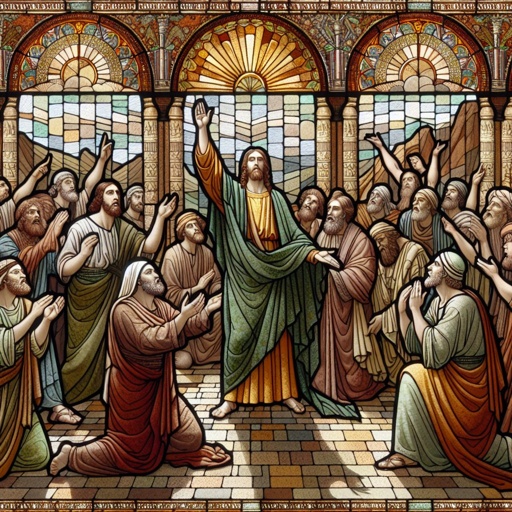
Mark 15:6-15 Artwork

Mark 15:6-15 - "Now at the feast he used to release for them one prisoner for whom they asked. And among the rebels in prison, who had committed murder in the insurrection, there was a man called Barabbas. And the crowd came up and began to ask Pilate to do as he usually did for them. And he answered them, saying, “Do you want me to release for you the King of the Jews?” For he perceived that it was out of envy that the chief priests had delivered him up. But the chief priests stirred up the crowd to have him release for them Barabbas instead. And Pilate again said to them, “Then what shall I do with the man you call the King of the Jews?” And they cried out again, “Crucify him.” And Pilate said to them, “Why, what evil has he done?” But they shouted all the more, “Crucify him.” So Pilate, wishing to satisfy the crowd, released for them Barabbas, and having scourged Jesus, he delivered him to be crucified."
"Now at the feast he used to release for them one prisoner for whom they asked. And among the rebels in prison, who had committed murder in the insurrection, there was a man called Barabbas. And the crowd came up and began to ask Pilate to do as he usually did for them. And he answered them, saying, “Do you want me to release for you the King of the Jews?” For he perceived that it was out of envy that the chief priests had delivered him up. But the chief priests stirred up the crowd to have him release for them Barabbas instead. And Pilate again said to them, “Then what shall I do with the man you call the King of the Jews?” And they cried out again, “Crucify him.” And Pilate said to them, “Why, what evil has he done?” But they shouted all the more, “Crucify him.” So Pilate, wishing to satisfy the crowd, released for them Barabbas, and having scourged Jesus, he delivered him to be crucified." - Mark 15:6-15

Mark 6:15 - "Others said, That it is Elias. And others said, That it is a prophet, or as one of the prophets."

Mark 15:6 - "Now at that feast he released unto them one prisoner, whomsoever they desired."
"Others said, That it is Elias. And others said, That it is a prophet, or as one of the prophets." - Mark 6:15

Mark 15:12
"Now at that feast he released unto them one prisoner, whomsoever they desired." - Mark 15:6

Mark 15:25 - "And it was the third hour, and they crucified him."

Mark 15:13 - "And they cried out again, Crucify him."

Mark 15:15 - "¶ And so Pilate, willing to content the people, released Barabbas unto them, and delivered Jesus, when he had scourged him, to be crucified."
Mark 15:18 - "And began to salute him, Hail, King of the Jews!"

Mark 15:30 - "Save thyself, and come down from the cross."

Mark 15:28 - "And the scripture was fulfilled, which saith, And he was numbered with the transgressors."

Mark 3:15 - "And to have power to heal sicknesses, and to cast out devils:"

Mark 15:5 - "But Jesus yet answered nothing; so that Pilate marvelled."

Mark 15:47 - "And Mary Magdalene and Mary the mother of Joses beheld where he was laid."

Mark 15:26 - "And the superscription of his accusation was written over, THE KING OF THE JEWS."

Mark 15:38 - "And the veil of the temple was rent in twain from the top to the bottom."

Mark 15:37 - "And Jesus cried with a loud voice, and gave up the ghost."

Mark 15:45 - "And when he knew it of the centurion, he gave the body to Joseph."

Mark 15:23 - "And they gave him to drink wine mingled with myrrh: but he received it not."

Acts 15:37 - "And Barnabas determined to take with them John, whose surname was Mark."

Mark 15:10 - "For he knew that the chief priests had delivered him for envy."

Mark 15:3 - "And the chief priests accused him of many things: but he answered nothing."

"And it was the third hour, and they crucified him." - Mark 15:25

Mark 15:42 - "¶ And now when the even was come, because it was the preparation, that is, the day before the sabbath,"

Mark 15:22 - "And they bring him unto the place Golgotha, which is, being interpreted, The place of a skull."

Mark 1:15 - "And saying, The time is fulfilled, and the kingdom of God is at hand: repent ye, and believe the gospel."

Mark 15:35 - "And some of them that stood by, when they heard it, said, Behold, he calleth Elias."

Mark 15:17 - "And they clothed him with purple, and platted a crown of thorns, and put it about his head,"