What does Mark 12:41-44 mean?
"And Jesus sat over against the treasury, and beheld how the people cast money into the treasury: and many that were rich cast in much. And there came a certain poor widow, and she threw in two mites, which make a farthing. And he called unto him his disciples, and saith unto them, Verily I say unto you, That this poor widow hath cast more in, than all they which have cast into the treasury: For all they did cast in of their abundance; but she of her want did cast in all that she had, even all her living." - Mark 12:41-44
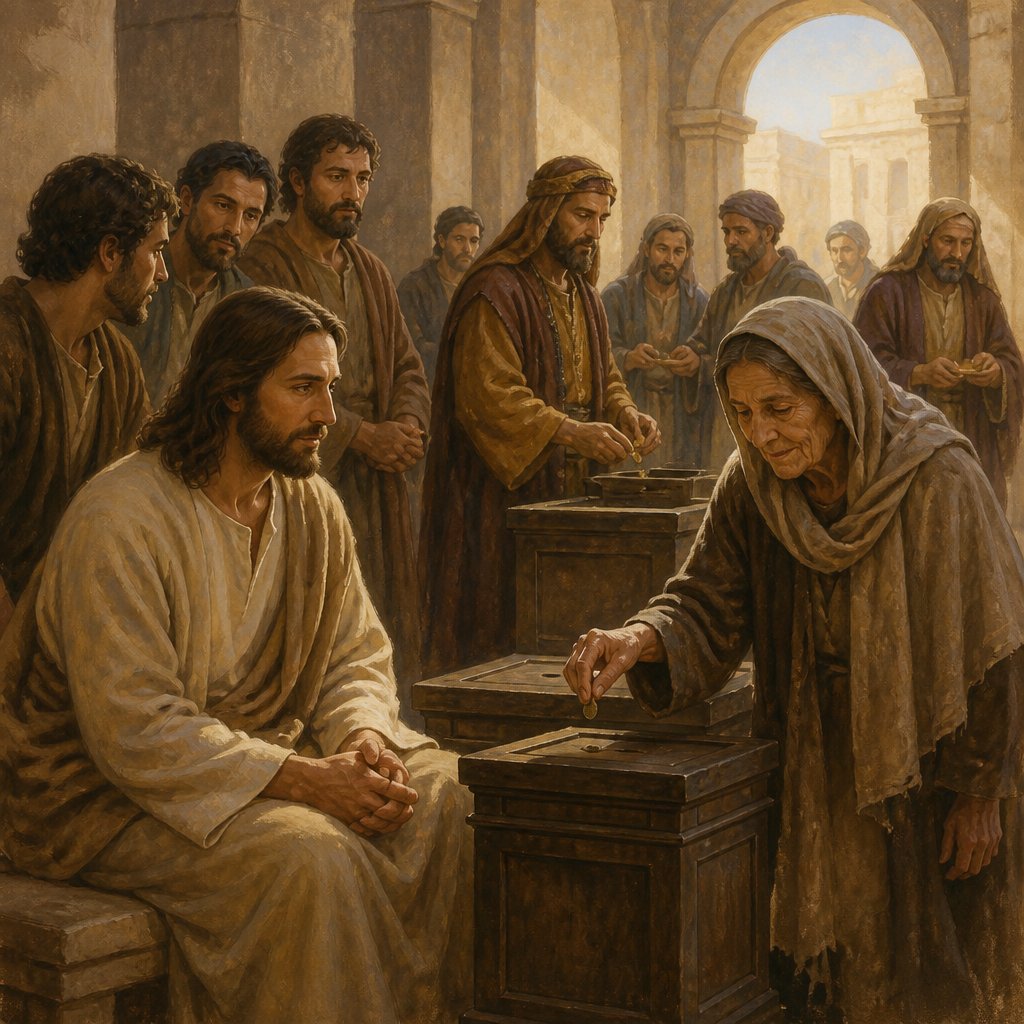
Mark 12:41-44 (KJV) states:
41 And Jesus sat over against the treasury, and beheld how the people cast money into the treasury: and many that were rich cast in much.
42 And there came a certain poor widow, and she threw in two mites, which make a farthing.
43 And he called unto him his disciples, and saith unto them, Verily I say unto you, That this poor widow hath cast more in, than all they which have cast into the treasury:
44 For all they did cast in of their abundance; but she of her want did cast in all that she had, even all her living.
This passage from the Gospel of Mark recounts an incident in which Jesus observes and comments on the actions of the people as they contribute to the treasury at the temple. It is a story that illustrates the value of generosity and sacrificial giving.
The setting for this passage is significant. Jesus is sitting across from the treasury, the place where people would come to offer their financial contributions to the temple. This was a public and visible act of worship, and it was customary for the wealthy to make substantial donations. The motivation for such donations could vary, ranging from genuine generosity and devotion to a desire for public recognition and praise. In observing this scene, Jesus takes note of the different offerings, specifically contrasting the giving of the rich with that of a poor widow.
The poor widow’s contribution is striking in its insignificance from a monetary perspective. She gives only two small coins, which are identified as “mites” or “lepta” in Greek. These coins were of very low value, even less than a penny. The account emphasizes her poverty by noting that the two mites only add up to a fraction of a farthing, a small fraction of the smallest Hebrew coin in circulation at the time. Despite their minimal value, the widow’s offering is highlighted by the fact that it represents all that she had.
When Jesus calls his disciples to him and comments on the giving of the people, he makes a profound statement about the significance of the widow’s gift. He tells them that the poor widow has actually contributed more than all the rich donors. This may have seemed perplexing to the disciples and the onlookers, as it defied the conventional understanding of value and contribution. From a purely quantitative standpoint, the rich donors had given much more in terms of monetary value. However, Jesus explains that the widow’s offering is more significant because it represents a greater personal sacrifice.
The lesson in this passage is clear: it is not the amount of the gift that matters, but the heart and the spirit with which it is given. The widow’s offering, though small in material wealth, is magnified in value by her selflessness and genuine devotion. Her act of giving from her poverty is a powerful demonstration of faith and trust in God. It reflects her understanding that true worship and generosity involve total surrender and commitment, regardless of one’s circumstances.
The broader context of this passage also highlights the theme of social justice and care for the marginalized. Jesus frequently highlighted the importance of caring for the poor and vulnerable, and his teachings consistently challenged the prevailing social norms and values. In this specific case, the widow represents the marginalized and overlooked members of society, yet she becomes the principal figure in this teaching on generosity and the Kingdom of God.
Symbolically, this passage represents an enduring lesson for Christians about the nature of giving and the heart of worship. It challenges believers to examine their own attitudes towards material wealth, generosity, and devotion. The story of the poor widow’s offering serves as a reminder that God values genuine sacrifice and commitment, and that the Kingdom of God operates on principles that are often contrary to worldly standards.
In conclusion, Mark 12:41-44 presents a powerful message about the true nature of generosity and worship. It emphasizes the importance of sacrificial giving and the value of a sincere and selfless heart. The passage calls for a reevaluation of our attitudes towards material wealth and a deeper understanding of the true meaning of generosity. It challenges us to emulate the poor widow’s example of wholehearted dedication and trust in God. This passage continues to serve as an inspirational and convicting reminder for Christians to prioritize faithfulness and authenticity in their worship and giving.
Have questions about Mark 12:41-44?
Dive deeper into this scripture with Bible Chat — an AI-powered tool for exploring God's Word through conversation. Ask questions, get context, and grow in your understanding of the Bible.
Get Our Apps


Mark 12:41-44 Artwork

Mark 12:41 - 44
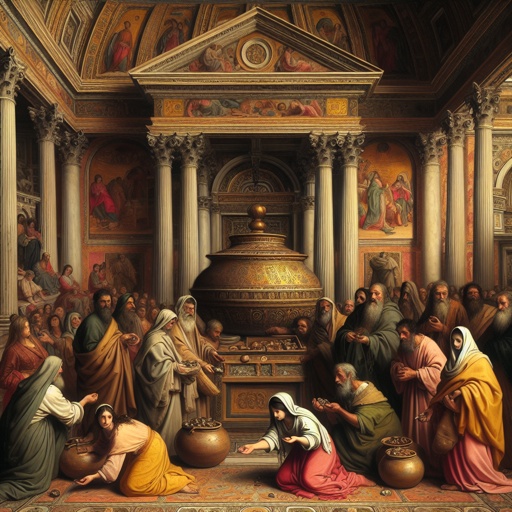
Mark 12:41 - 44

Mark 12:41 - 44

Mark 12:41 - 44

Mark 12:41 - 44

Mark 12:41-44 - "And Jesus sat over against the treasury, and beheld how the people cast money into the treasury: and many that were rich cast in much. And there came a certain poor widow, and she threw in two mites, which make a farthing. And he called unto him his disciples, and saith unto them, Verily I say unto you, That this poor widow hath cast more in, than all they which have cast into the treasury: For all they did cast in of their abundance; but she of her want did cast in all that she had, even all her living."
"And Jesus sat over against the treasury, and beheld how the people cast money into the treasury: and many that were rich cast in much. And there came a certain poor widow, and she threw in two mites, which make a farthing. And he called unto him his disciples, and saith unto them, Verily I say unto you, That this poor widow hath cast more in, than all they which have cast into the treasury: For all they did cast in of their abundance; but she of her want did cast in all that she had, even all her living." - Mark 12:41-44

Mark 12:44 - "For all they did cast in of their abundance; but she of her want did cast in all that she had, even all her living."

Mark 12:41 - "And Jesus sat over against the treasury, and beheld how the people cast money into the treasury: and many that were rich cast in much."

Mark 4:41

Mark 4:41

Mark 4:41

Mark 4:41

Mark 10:44 - "And whosoever of you will be the chiefest, shall be servant of all."

Mark 9:44 - "Where their worm dieth not, and the fire is not quenched."

Mark 4:35-41

Mark 6:44 - "And they that did eat of the loaves were about five thousand men."

Mark 12:43-44 - "Calling his disciples to him, Jesus said, "Truly I tell you, this poor widow has put more into the treasury than all the others. They all gave out of their wealth; but she, out of her poverty, put in everything—all she had to live on.""

Ephesians 4:1-2

Ephesians 4:1-2

Ephesians 4:1-2

Ephesians 4:1-2

Ephesians 4:1-2

Ephesians 4:1-2

Ephesians 4:1-2

Ephesians 4:1-2

Ephesians 4:1-2

Ephesians 4:1-2

Ephesians 4:1-2

Ephesians 4:1-2