What does Luke 6:38 mean?
"Give, and it shall be given unto you; good measure, pressed down, and shaken together, and running over, shall men give into your bosom. For with the same measure that ye mete withal it shall be measured to you again." - Luke 6:38
Luke 6:38 in the King James Version reads, “Give, and it shall be given unto you; good measure, pressed down, and shaken together, and running over, shall men give into your bosom. For with the same measure that ye mete withal it shall be measured to you again.”
This saying belongs to a larger section in Luke 6 where Jesus is teaching what life looks like under the rule of God. Just before this verse, He commands mercy and a refusal to live by the world’s reflex of retaliation: “Love ye your enemies,” “do good,” “lend, hoping for nothing again,” and then, “Be ye therefore merciful, as your Father also is merciful” (Luke 6:27–36). Immediately after that He warns against a condemning spirit: “Judge not, and ye shall not be judged: condemn not, and ye shall not be condemned: forgive, and ye shall be forgiven” (Luke 6:37). Luke 6:38 completes that sequence by turning from negative restraint (do not judge, do not condemn) to positive action (give), and it carries the same logic: the posture you adopt toward others will return to you in the ways God orders life. The verse is not an isolated proverb about money; it is part of a sustained call to mercy, generosity, forgiveness, and humility that reflects the Father’s own character.
The first words, “Give, and it shall be given unto you,” present giving as a way of being, not merely an occasional transaction. In this context “give” includes material generosity, but it also reaches to the whole spirit Jesus has been describing: giving kindness to enemies, giving forgiveness instead of condemnation, giving help without demanding repayment, giving the benefit of mercy where harshness would be easier. The promise “it shall be given unto you” does not reduce God to a vending machine, as though the main purpose of giving were to get. Rather, it teaches that God is not indifferent to the merciful life; He is the One who sustains it, and He often does so through human channels, as the verse later says, “shall men give into your bosom.” The giving you do becomes part of the moral fabric of your relationships, and God’s providence commonly works through those very relationships.
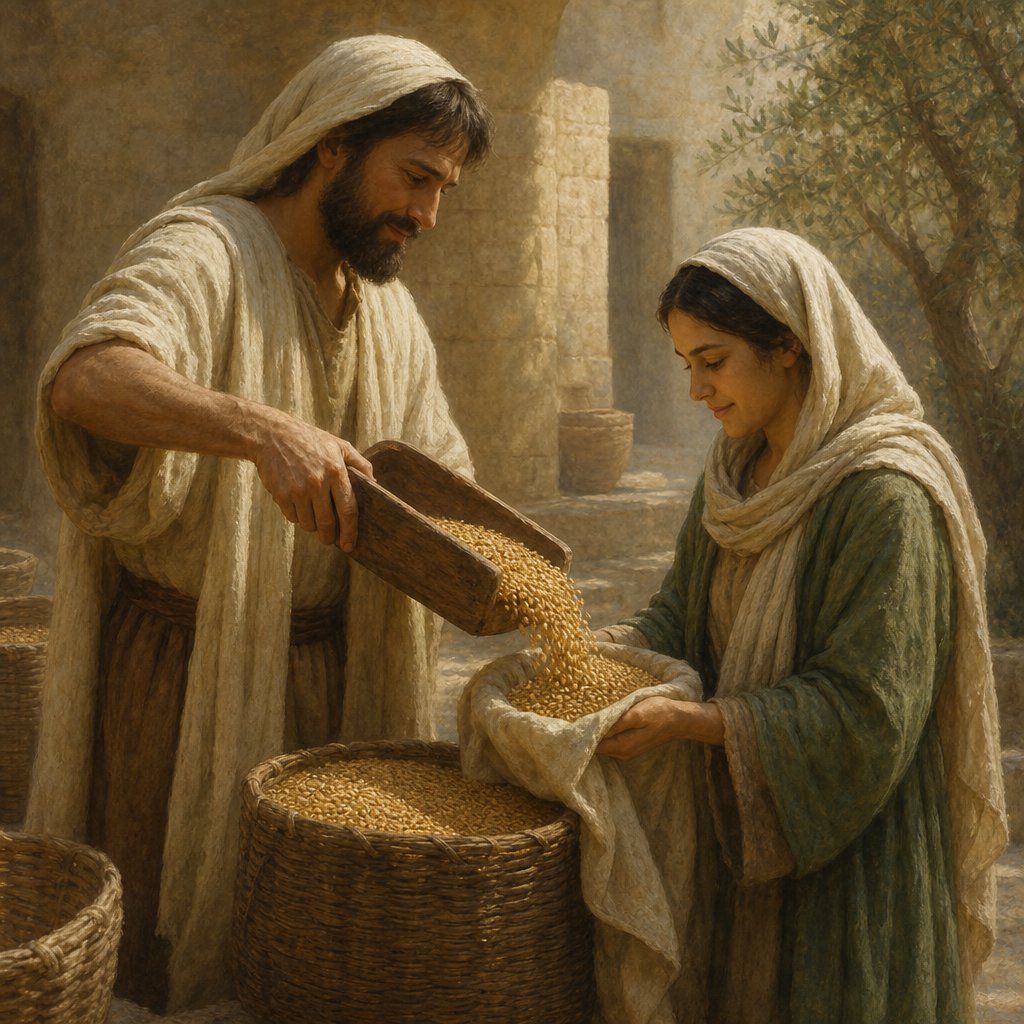
The imagery that follows is vivid and earthy, drawn from everyday measuring of grain. “Good measure, pressed down, and shaken together, and running over” describes a merchant filling a measure as generously as possible. Grain could be poured loosely with air pockets; if the seller “pressed down” the grain, and “shaken together” the container, it settled, making room for more. “Running over” is the picture of abundance, not scarcity—more than the container seems able to hold. The point is not a cold equivalence, as though God merely matches your gift in strict proportion, but a picture of bounty: the return is described as full, compacted, and overflowing. Jesus is teaching that the economy of mercy is not stingy. When God gives, He gives “good measure,” not a grudging remainder.
The phrase “shall men give into your bosom” carries the symbolism of clothing in the ancient world. People commonly gathered goods by using the fold of a garment, the “bosom,” like a pouch formed by pulling the robe up and holding it. To have something “given into your bosom” is to receive it as a personal, carried supply—provision placed where you can bear it away. Symbolically, it suggests that the return of generosity is not abstract. It becomes something that enters your life and is carried with you: help, friendship, support, relief, protection, and the quiet strength that comes from living in mercy rather than in bitterness. Even when the return is material, it is pictured as a gift placed close, not flung from a distance.
The final sentence states the governing principle: “For with the same measure that ye mete withal it shall be measured to you again.” To “mete” is to measure out. Jesus draws on the marketplace image of a measuring vessel to speak of the heart’s capacity and intent. If you measure out grace with a thimble—tight, suspicious, calculating—you should not expect the world shaped by God’s justice and providence to feel wide and generous toward you. If you measure out mercy with a large measure—open-handed, forgiving, ready to bless—then you are living in harmony with God’s own merciful nature, and you will meet that mercy again. This does not mean every generous act results in immediate, visible repayment by the same person, or that righteous people never suffer lack. In Luke’s broader teaching, disciples may be hated, persecuted, and poor; Jesus has already said, “Blessed be ye poor,” and He speaks of those who “weep now” (Luke 6:20–21). So the promise cannot be flattened into a guarantee of uninterrupted prosperity. Rather, Jesus is describing how God’s moral order works: the merciless life tends toward isolation, conflict, and judgment; the merciful life tends toward peace, community, and the kinds of help God is pleased to supply, both now and ultimately in His final vindication.
Several themes converge in this verse. Mercy is central: the measure you use with others reflects whether you have understood the Father who is “merciful.” Humility is implied: giving is the opposite of self-protective hoarding, and refusing to judge and condemn (Luke 6:37) requires an awareness of one’s own need for mercy. Community is assumed: “shall men give” shows that God’s blessings often travel through ordinary human hands. Integrity of heart is also at stake: Jesus is not encouraging theatrical giving, but a generous spirit that matches the inner life of a disciple. Finally, the verse reveals something about God Himself. The overflowing measure is a window into His character, suggesting that He delights to give in a way that is “pressed down,” “shaken together,” and “running over,” and that He calls His people to mirror that generosity.
In significance, Luke 6:38 functions as both invitation and warning. It invites the disciple into a life that resembles God’s own generous mercy, assuring that such a life is not wasted and will not be met by God with stinginess. It warns that the standards one applies to others are not harmless preferences; they become the very “measure” by which one experiences life before God and among people. Jesus is not merely teaching etiquette. He is describing a kingdom way of living in which giving, forgiving, and merciful dealing create a receptivity to God’s overflowing provision, while harshness and tight-fisted judgment train the soul to live in a narrow measure that eventually returns upon itself.
Have questions about Luke 6:38?
Dive deeper into this scripture with Bible Chat — an AI-powered tool for exploring God's Word through conversation. Ask questions, get context, and grow in your understanding of the Bible.
Get Our Apps


Luke 6:38 Artwork

Luke 6:38 Give, and it will be given to you
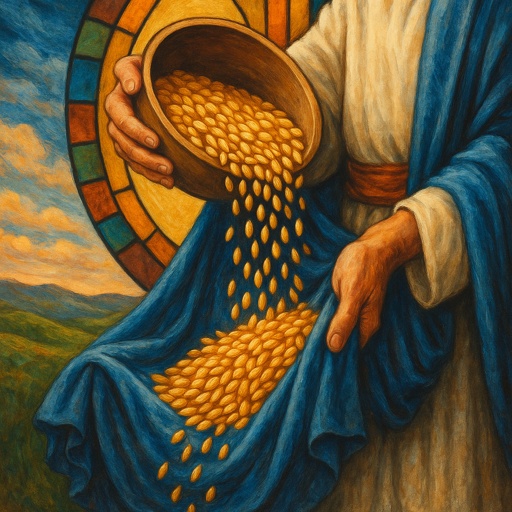
"Give, and it shall be given unto you; good measure, pressed down, and shaken together, and running over, shall men give into your bosom. For with the same measure that ye mete withal it shall be measured to you again." - Luke 6:38

Luke 6:38 - "Give, and it shall be given unto you; good measure, pressed down, and shaken together, and running over, shall men give into your bosom. For with the same measure that ye mete withal it shall be measured to you again."

Luke 6:38 - Giving and receiving generously - A full scoop or measuring cup - Ingredients like four, grains or seeds overflowing from the scoop - A warm and inviting color scheme - A simple, yet meaningful background that conveys generosity and abundance

"Give, and it shall be given unto you; good measure, pressed down, and shaken together, and running over, shall men give into your bosom. For with the same measure that ye mete withal it shall be measured to you again." - Luke 6:38
"Give, and it shall be given unto you; good measure, pressed down, and shaken together, and running over, shall men give into your bosom. For with the same measure that ye mete withal it shall be measured to you again." - Luke 6:38

Luke 6:27-38

Luke 6: 27-38

Luke 5:38 - "But new wine must be put into new bottles; and both are preserved."

Luke 20:38 - "For he is not a God of the dead, but of the living: for all live unto him."

Luke 21:38 - "And all the people came early in the morning to him in the temple, for to hear him."

Luke 20:27-38. All people of color.

Luke 18:38 - "And he cried, saying, Jesus, thou Son of David, have mercy on me."

Luke 19:38 - "Saying, Blessed be the King that cometh in the name of the Lord: peace in heaven, and glory in the highest."

Luke 22:38 - "And they said, Lord, behold, here are two swords. And he said unto them, It is enough."

Luke 23:38 - "And a superscription also was written over him in letters of Greek, and Latin, and Hebrew, THIS IS THE KING OF THE JEWS."

Luke 11:38 - "And when the Pharisee saw it, he marvelled that he had not first washed before dinner."

Luke 3:38 - "Which was the son of Enos, which was the son of Seth, which was the son of Adam, which was the son of God."

Luke 24:38 - "And he said unto them, Why are ye troubled? and why do thoughts arise in your hearts?"

Luke 1:38 - "And Mary said, Behold the handmaid of the Lord; be it unto me according to thy word. And the angel departed from her."

Luke 12:38 - "And if he shall come in the second watch, or come in the third watch, and find them so, blessed are those servants."

Exodus 38:6 - "And he made the staves of shittim wood, and overlaid them with brass."

Luke 2:38 - "And she coming in that instant gave thanks likewise unto the Lord, and spake of him to all them that looked for redemption in Jerusalem."

Job 38:6 - "Whereupon are the foundations thereof fastened? or who laid the corner stone thereof;"

Genesis 38:6 - "And Judah took a wife for Er his firstborn, whose name was Tamar."

1 Chronicles 6:38 - "The son of Izhar, the son of Kohath, the son of Levi, the son of Israel."

Luke 4:38 - "¶ And he arose out of the synagogue, and entered into Simon's house. And Simon's wife's mother was taken with a great fever; and they besought him for her."

Luke 10:38 - "¶ Now it came to pass, as they went, that he entered into a certain village: and a certain woman named Martha received him into her house."

Luke 8:38 - "Now the man out of whom the devils were departed besought him that he might be with him: but Jesus sent him away, saying,"

Isaiah 38:6 - "And I will deliver thee and this city out of the hand of the king of Assyria: and I will defend this city."