What does Luke 6:35 mean?
"But love ye your enemies, and do good, and lend, hoping for nothing again; and your reward shall be great, and ye shall be the children of the Highest: for he is kind unto the unthankful and to the evil." - Luke 6:35

Luke 6:35 in the King James Version reads, “But love ye your enemies, and do good, and lend, hoping for nothing again; and your reward shall be great, and ye shall be the children of the Highest: for he is kind unto the unthankful and to the evil.”
This saying belongs to Jesus’ teaching in Luke 6, where he is forming the moral and spiritual character of his disciples in a world shaped by retaliation, pride, and strict accounting of merit. The immediate context is Jesus’ command to love enemies and to respond to injury without mirroring the injury. In the verses surrounding it he speaks of blessing those who curse, praying for those who despitefully use, turning the other cheek, and giving without demanding back. Luke 6:35 gathers these demands into a single, concentrated picture: a disciple is to act toward hostile and undeserving people with the same surprising benevolence that God himself displays.
The first word that governs the verse is love: “love ye your enemies.” In this context love is not sentimental agreement or affection; it is a deliberate posture of the will that seeks another’s good. An “enemy” in ordinary human terms is someone outside the circle of reciprocity, someone from whom we expect harm rather than gratitude. Jesus’ point is that the disciple’s goodness must not be limited to those who will return it. In the logic of the fallen world, kindness is often a kind of trade—affection for affection, help for help. Here Jesus forbids reducing love to a transaction. Loving an enemy means refusing to let another person’s hostility set the boundaries of your obedience to God.
That refusal is immediately expressed in action: “and do good.” This moves the command from inward attitude to outward practice. “Do good” is the concrete expression of love, including acts of mercy, fairness, restraint, and generosity toward those who least deserve it by human reckoning. It implies that the disciple’s moral life is not simply abstaining from revenge, but actively pursuing benevolence. In Luke’s larger portrait of Jesus, this active goodness resembles Christ’s own pattern: he healed, fed, taught, and forgave amid misunderstanding and opposition, and he persisted in mercy even when met with ingratitude.
Then Jesus adds a specific form of doing good: “and lend, hoping for nothing again.” Lending in the ancient world could easily become a tool for control, shame, and exploitation, especially for the poor. Yet Jesus directs his disciples to lend without the inner condition of guaranteed return. The phrase “hoping for nothing again” does not merely mean that repayment is forbidden; it means the heart must not be governed by the expectation of getting back what was given, whether money, honor, influence, or future favors. The symbolism is a kind of liberation from the anxious calculations that often accompany generosity. The disciple gives in faith, trusting God rather than securing oneself by keeping a ledger against others.
At this point Jesus introduces the divine logic that makes such a life possible: “and your reward shall be great.” The verse does not deny that there is reward; it relocates reward from human repayment to God’s righteous and gracious recognition. What is “great” about the reward is not simply its size, but its source and quality. It is not dependent on the enemy’s change of heart, or the borrower’s capacity to repay, or the community’s applause. It comes from God, who sees in secret and judges with truth. In Luke’s framework, this also exposes a theme that runs throughout the Gospel: present sacrifice and present mercy are not wasted, because God’s kingdom reverses the world’s values. What looks like loss when you love an enemy becomes gain in the economy of heaven.
The statement “and ye shall be the children of the Highest” is central to the significance of the verse. Jesus is not saying that people become God’s children by earning adoption through good deeds, as though sonship were wages. In Luke’s way of speaking, being “children” is shown by resemblance. A child bears the family likeness. The disciple reveals whose life is ruling him by the character he displays. When Jesus calls God “the Highest,” he emphasizes God’s supreme authority and majesty, and then makes the startling claim that the Highest is known not only by power but by mercy. To act with unearned kindness is to bear the likeness of that God.
The final clause provides the theological foundation for everything that came before: “for he is kind unto the unthankful and to the evil.” This is both a description of God and a mirror held up to the disciple. God’s kindness is not restricted to those who deserve it. The “unthankful” are those who receive benefits and return no gratitude; the “evil” are those whose lives oppose God’s will. Yet God shows kindness even there. In the background is the everyday providence of God, who continues to sustain life, give breath, and extend patience to a world that often refuses him. Jesus anchors the call to love enemies in the very nature of God: divine kindness is not a response to human worthiness but an expression of divine goodness. That is why disciples can love beyond reciprocity—they are not inventing a new ethic from human resources; they are living out the Father’s character.
Several themes converge in Luke 6:35. One is mercy that breaks the cycle of retaliation. Loving enemies disarms the spiral of harm-for-harm and invites a different kind of power, the power of goodness that does not depend on domination. Another theme is true generosity, not as a strategy to gain control, but as trust in God. “Lend, hoping for nothing again” challenges the impulse to protect oneself by demanding guarantees. It calls the disciple into a posture of open-handedness that reflects God’s own open-handed providence. A third theme is identity: the believer’s life is meant to display the Father’s likeness. The command is not merely moral improvement; it is family resemblance, a visible testimony of the kingdom of God in a hostile world.
The verse also carries an implicit contrast between two kinds of “reward.” Human society rewards those who reward it; it returns favors to friends and punishes enemies. Jesus describes a life that may receive no repayment from people and yet is “great” in reward with God. This does not make kindness a secret technique to get heavenly payment; rather, it insists that obedience is sustained by a higher hope than immediate results. Loving an enemy may not change the enemy. Lending without expectation may not produce gratitude. Yet the disciple’s faithfulness is held within God’s promise, and that promise frees the disciple to act rightly regardless of the other person’s response.
In sum, Luke 6:35 is Jesus’ invitation into the divine pattern. It commands a love that is practical, costly, and non-transactional; it grounds that love in the character of God “kind unto the unthankful and to the evil”; and it attaches to it a hope that rests not on human reciprocity but on the “great” reward of God. The significance is that the disciple’s way of life becomes a living sign of the Highest—his kingdom, his mercy, and his family likeness—displayed precisely where ordinary human love would end.
Have questions about Luke 6:35?
Dive deeper into this scripture with Bible Chat — an AI-powered tool for exploring God's Word through conversation. Ask questions, get context, and grow in your understanding of the Bible.
Get Our Apps


Luke 6:35 Artwork

"But love ye your enemies, and do good, and lend, hoping for nothing again; and your reward shall be great, and ye shall be the children of the Highest: for he is kind unto the unthankful and to the evil." - Luke 6:35
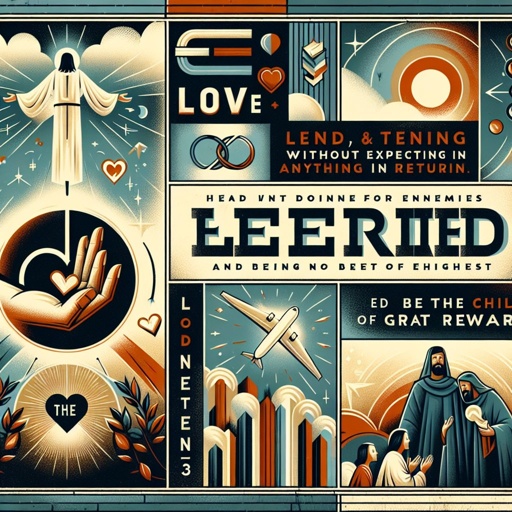
Luke 6:35 - "But love ye your enemies, and do good, and lend, hoping for nothing again; and your reward shall be great, and ye shall be the children of the Highest: for he is kind unto the unthankful and to the evil."

Luke 6:35-36 - "But love your enemies, do good to them, and lend to them without expecting to get anything back. Then your reward will be great, and you will be children of the Most High, because he is kind to the ungrateful and wicked. Be merciful, just as your Father is merciful."

"But love ye your enemies, and do good, and lend, hoping for nothing again; and your reward shall be great, and ye shall be the children of the Highest: for he is kind unto the unthankful and to the evil." - Luke 6:35

"But love your enemies, do good to them, and lend to them without expecting to get anything back. Then your reward will be great, and you will be children of the Most High, because he is kind to the ungrateful and wicked. Be merciful, just as your Father is merciful." - Luke 6:35-36

luke 9:35

luke 9:35

Luke 24:35

Luke 24:13-35

Luke 7:35 - "But wisdom is justified of all her children."

Luke 11:35 - "Take heed therefore that the light which is in thee be not darkness."

Luke 12:35 - "Let your loins be girded about, and your lights burning;"

Luke 21:35 - "For as a snare shall it come on all them that dwell on the face of the whole earth."

Luke 19:35 - "And they brought him to Jesus: and they cast their garments upon the colt, and they set Jesus thereon."

Luke 17:35 - "Two women shall be grinding together; the one shall be taken, and the other left."

Luke 9:35 - "And there came a voice out of the cloud, saying, This is my beloved Son: hear him."

Luke 24:35 - "And they told what things were done in the way, and how he was known of them in breaking of bread."

"But wisdom is justified of all her children." - Luke 7:35

Luke 5:35 - "But the days will come, when the bridegroom shall be taken away from them, and then shall they fast in those days."

Exodus 35:6 - "And blue, and purple, and scarlet, and fine linen, and goats' hair,"

Luke 2:35 - "(Yea, a sword shall pierce through thy own soul also,) that the thoughts of many hearts may be revealed."

Luke 18:35 - "¶ And it came to pass, that as he was come nigh unto Jericho, a certain blind man sat by the way side begging:"

Luke 20:35 - "But they which shall be accounted worthy to obtain that world, and the resurrection from the dead, neither marry, nor are given in marriage:"

Luke 3:35 - "Which was the son of Saruch, which was the son of Ragau, which was the son of Phalec, which was the son of Heber, which was the son of Sala,"

Psalms 35:6 - "Let their way be dark and slippery: and let the angel of the LORD persecute them."

1 Chronicles 6:35 - "The son of Zuph, the son of Elkanah, the son of Mahath, the son of Amasai,"

2 Chronicles 6:35 - "Then hear thou from the heavens their prayer and their supplication, and maintain their cause."

Luke 14:35 - "It is neither fit for the land, nor yet for the dunghill; but men cast it out. He that hath ears to hear, let him hear."

"Take heed therefore that the light which is in thee be not darkness." - Luke 11:35

Luke 6