What does Luke 5:30 mean?
"But their scribes and Pharisees murmured against his disciples, saying, Why do ye eat and drink with publicans and sinners?" - Luke 5:30
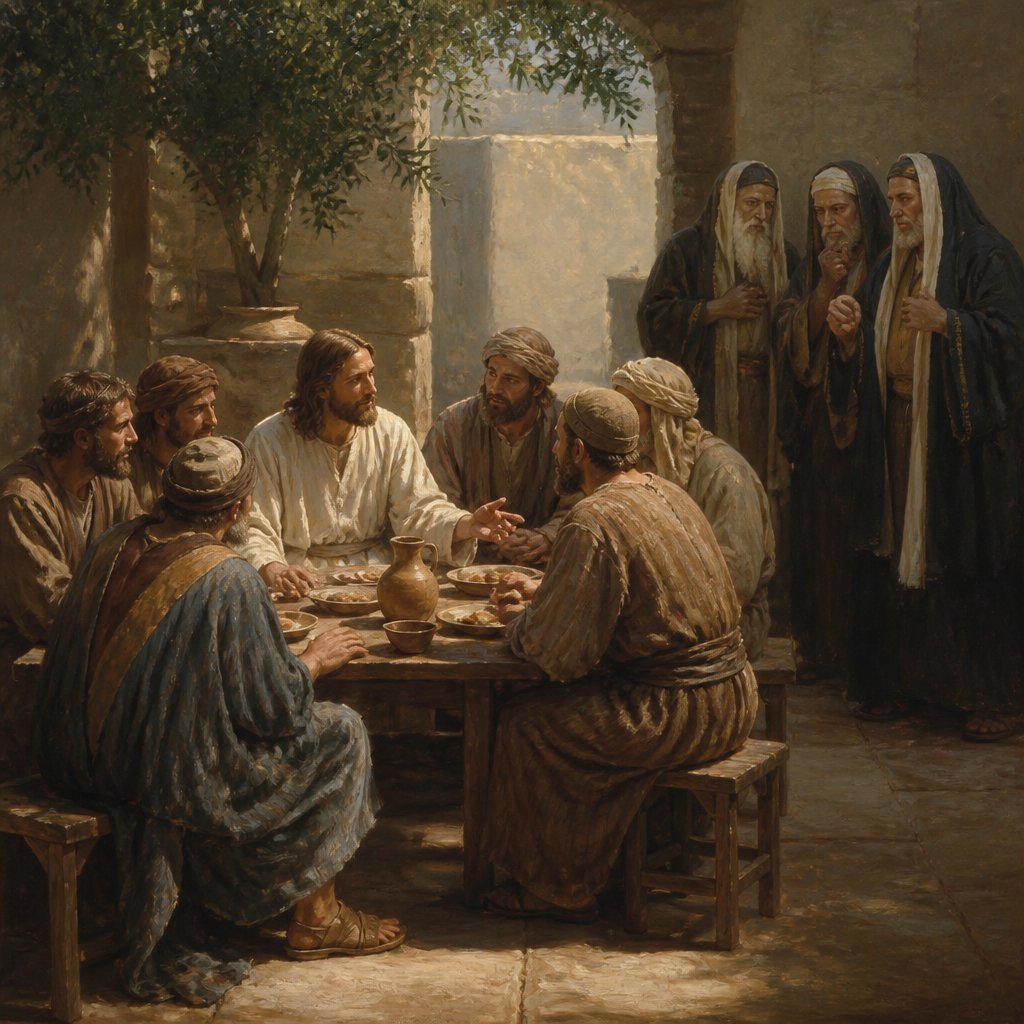
The verse Luke 5:30 from the King James Version of the Bible reads, "But their scribes and Pharisees murmured against his disciples, saying, Why do ye eat and drink with publicans and sinners?"
This verse is a part of a larger narrative in the Gospel of Luke that describes the calling of Levi, also known as Matthew, to be one of Jesus' disciples. Levi was a tax collector, a profession that was despised by the Jewish people of that time because the tax collectors were seen as collaborators with the oppressive Roman government and were often corrupt in their dealings with the people. When Jesus called Levi to follow him, Levi left everything behind and became a disciple of Jesus. In celebration, Levi hosted a great feast and invited Jesus and other tax collectors and sinners to his home. This gesture of hospitality and celebration with those who were considered to be sinners and outcasts by the religious leaders of the time led to the questioning and criticism by the scribes and Pharisees.
The scribes and Pharisees were the religious authorities of the time, responsible for upholding the Jewish law and traditions. They were scandalized by Jesus' association with tax collectors and sinners, as they believed that such association was defiling and against the moral and religious codes of the society. The scribes and Pharisees couldn't comprehend why Jesus would choose to eat and drink with those who were considered unclean and unworthy.
This verse highlights several important themes that are central to the message of Jesus and the broader story of the Gospel. First and foremost, it speaks to the inclusive nature of Jesus' ministry. Jesus consistently reached out to those on the margins of society, offering them love, acceptance, and forgiveness. In this particular instance, Jesus' actions challenged the religious and social norms of the time by breaking bread with tax collectors and sinners, showing that no one was beyond the reach of God's grace and love.
This passage also points to the concept of forgiveness and redemption. In the eyes of the scribes and Pharisees, tax collectors and sinners were beyond redemption and unworthy of association with religious leaders. However, Jesus' actions demonstrated that all people, regardless of their past sins or societal status, were worthy of God's love and forgiveness. The willingness of Jesus to dine with tax collectors and sinners was a powerful symbol of his mission to seek and save the lost, as he mentions in Luke 19:10.
Furthermore, this verse speaks to the overarching message of the Gospel of Luke, which emphasizes the radical nature of Jesus' ministry and the kingdom of God. Throughout the Gospel, Jesus challenges the established religious and social order, advocating for a new way of living that prioritizes love, justice, and compassion for all people. By associating with tax collectors and sinners, Jesus was demonstrating the transformative power of God's grace and the embodiment of the kingdom of God on earth.
The symbolism in this verse is profound and multi-layered. The act of eating and drinking together was highly significant in the cultural context of Jesus' time. It represented intimacy, fellowship, and mutual acceptance. By sharing a meal with tax collectors and sinners, Jesus was symbolically breaking down the barriers that separated them from the rest of society and treating them as equals. This act of hospitality and inclusion was a powerful symbol of the transformative and reconciling power of the gospel.
In conclusion, Luke 5:30 is a pivotal verse that encapsulates the radical nature of Jesus' ministry and the inclusive message of the gospel. It challenges us to examine our own attitudes towards those who are marginalized or deemed unworthy by society and to embody the love, acceptance, and grace that Jesus extended to all people. This verse serves as a reminder of the transformative power of God's love and the call to embody the kingdom of God by reaching out to those on the margins of society.
Have questions about Luke 5:30?
Dive deeper into this scripture with Bible Chat — an AI-powered tool for exploring God's Word through conversation. Ask questions, get context, and grow in your understanding of the Bible.
Get Our Apps


Luke 5:30 Artwork

Luke 5:30 - "But their scribes and Pharisees murmured against his disciples, saying, Why do ye eat and drink with publicans and sinners?"
"But their scribes and Pharisees murmured against his disciples, saying, Why do ye eat and drink with publicans and sinners?" - Luke 5:30

Luke 1:30

luke 9:30

luke 6:30

luke 9:29- 30

african american luke 10:30

Luke 14:30 - "Saying, This man began to build, and was not able to finish."

Luke 2:30 - "For mine eyes have seen thy salvation,"

Luke 20:30 - "And the second took her to wife, and he died childless."

Luke 1:30 Gabriel visits Mary

Matthew 5:30

Matthew 5:30

Luke 17:30 - "Even thus shall it be in the day when the Son of man is revealed."

Luke 4:30 - "But he passing through the midst of them went his way,"

luke 5:5

Luke 13:30 - "And, behold, there are last which shall be first, and there are first which shall be last."

Luke 23:30 - "Then shall they begin to say to the mountains, Fall on us; and to the hills, Cover us."

Luke 9:30 - "And, behold, there talked with him two men, which were Moses and Elias:"

Luke 7:30 - "But the Pharisees and lawyers rejected the counsel of God against themselves, being not baptized of him."

Luke 11:30 - "For as Jonas was a sign unto the Ninevites, so shall also the Son of man be to this generation."

Luke 10:5

Luke 10:5

Luke 1:30 - "And the angel said unto her, Fear not, Mary: for thou hast found favour with God."

Luke 18:30 - "Who shall not receive manifold more in this present time, and in the world to come life everlasting."

Jeremiah 5:30 - "¶ A wonderful and horrible thing is committed in the land;"

Luke 10:5

Daniel 5:30 - "¶ In that night was Belshazzar the king of the Chaldeans slain."

Genesis 30:5 - "And Bilhah conceived, and bare Jacob a son."

Luke 16:30 - "And he said, Nay, father Abraham: but if one went unto them from the dead, they will repent."