What does Luke 1:9 mean?
"According to the custom of the priest's office, his lot was to burn incense when he went into the temple of the Lord." - Luke 1:9
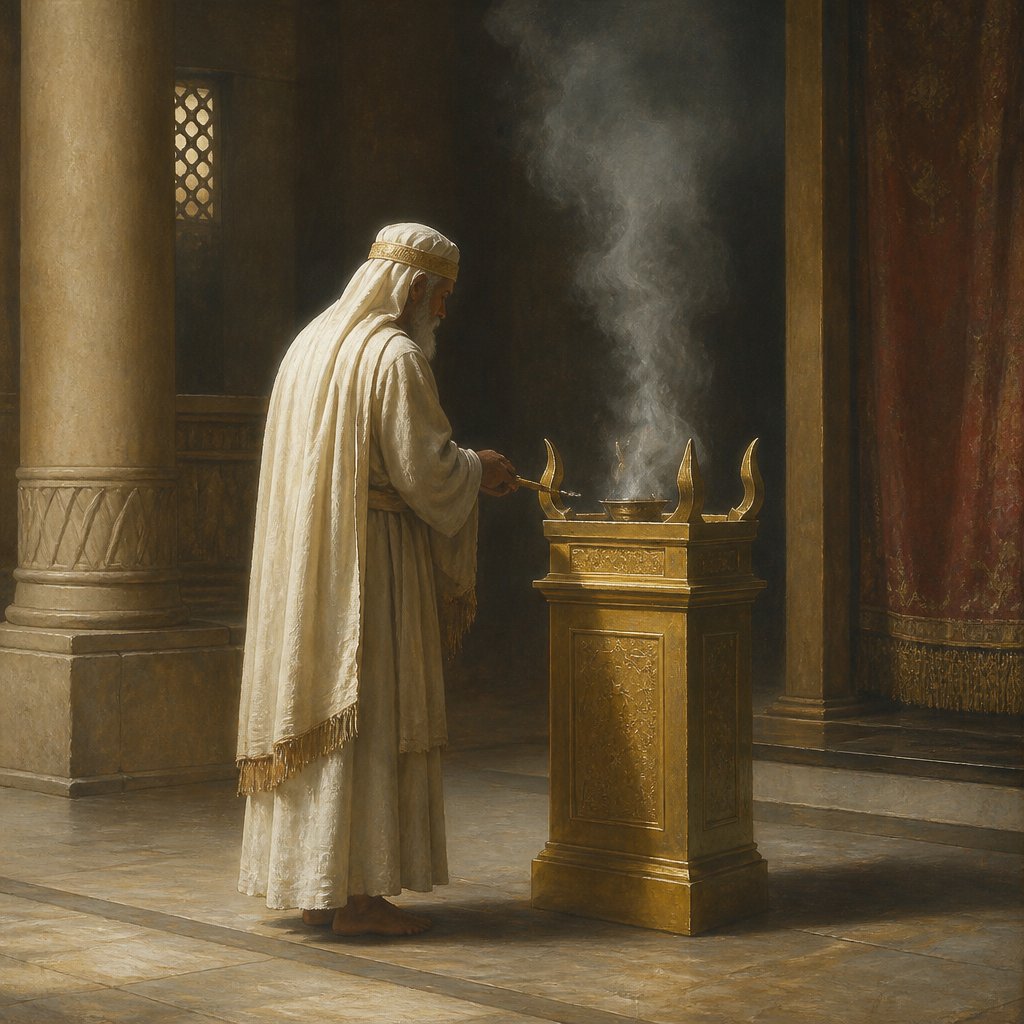
The verse Luke 1:9 from the King James Version (KJV) of the Bible reads: "According to the custom of the priest's office, his lot was to burn incense when he went into the temple of the Lord."
This verse is part of the narrative of the birth of John the Baptist, where the angel Gabriel appears to Zechariah, the father of John, to announce the coming birth. Zechariah is a priest who has been chosen by lot to enter the temple and offer incense. This event takes place in the context of the Old Testament Jewish religious practices, and it signifies the beginning of a new era in the history of God's people.
The custom of the priest's office mentioned in this verse refers to the practice in the Jewish religious tradition where priests were chosen by lot to perform specific duties in the temple. The burning of incense was an important part of the rituals performed in the temple, symbolizing the prayers of the people ascending to God. The assignment of this duty to Zechariah is a significant moment in his life, and it sets the stage for the miraculous events that are about to unfold.
The burning of incense in the temple was a physical act with spiritual significance. It represented the prayers and petitions of the people being lifted up to God, as well as the priest's intercession on behalf of the community. In this context, the act of burning incense becomes a symbol of worship, devotion, and communion with God. It is a reminder of the priest's role as a mediator between God and the people, and a representation of the people's desire for divine favor and blessing.
The fact that Zechariah was chosen by lot to perform this duty is also significant. In the Old Testament, the casting of lots was a common practice used to discern God's will or make decisions. It was a way of acknowledging God's sovereignty and seeking his guidance in matters of importance. By being chosen by lot, Zechariah is being set apart for a special purpose, and his encounter with the angel Gabriel in the temple further underscores the divine intervention and guidance at work in this situation.
The narrative of Zechariah's encounter with the angel and the announcement of John the Baptist's birth is filled with themes of God's faithfulness, the fulfillment of prophecy, and the coming of the Messiah. The burning of incense in the temple serves as a symbolic backdrop to these events, highlighting the spiritual significance of what is about to take place. It is a moment of divine revelation, where God's presence is palpable, and the boundaries between heaven and earth are momentarily blurred.
The verse can also be seen as a foreshadowing of the role that John the Baptist will play in preparing the way for the coming of Jesus. The burning of incense by Zechariah, and his subsequent encounter with the angel, signal the beginning of a new chapter in the history of God's people, one in which the old ways of worship and religious practice will give way to the dawning of a new era of salvation and redemption.
In conclusion, Luke 1:9 from the King James Version of the Bible carries deep significance within the broader context of the birth of John the Baptist and the announcement of the coming of Jesus. It serves as a poignant reminder of the spiritual and symbolic meanings embedded in the rituals and customs of the Old Testament, and it foreshadows the momentous events that are about to unfold. The burning of incense in the temple becomes a powerful metaphor for the prayers and longings of the people, and a symbol of the divine intervention and guidance that are at work in the unfolding of God's plan for salvation.
Have questions about Luke 1:9?
Dive deeper into this scripture with Bible Chat — an AI-powered tool for exploring God's Word through conversation. Ask questions, get context, and grow in your understanding of the Bible.
Get Our Apps


Luke 1:9 Artwork

Luke 1:9 - "According to the custom of the priest's office, his lot was to burn incense when he went into the temple of the Lord."
"According to the custom of the priest's office, his lot was to burn incense when he went into the temple of the Lord." - Luke 1:9

Luke 18:9-14

Luke 18: 9-14

Luke 9:1 - "Then he called his twelve disciples together, and gave them power and authority over all devils, and to cure diseases."
Luke 11:9

luke 9:30

luke 9:35

luke 9:35

Luke 9:51

Luke 11:9

Luke 9:54-55

Luke 9:28-45

Luke 11:9-10

Luke 13:6-9

luke 9:29- 30

Luke 9:1-2 - "Then he called his twelve disciples together, and gave them power and authority over all devils, and to cure diseases. And he sent them to preach the kingdom of God, and to heal the sick."

Luke 9:9 - "And Herod said, John have I beheaded: but who is this, of whom I hear such things? And he desired to see him."

Luke 9:4 - "And whatsoever house ye enter into, there abide, and thence depart."

Luke 9:15 - "And they did so, and made them all sit down."

Black and white illustration Luke 11:9

Black and white illustration Luke 11:9

Black and white illustration Luke 11:9

Luke 9:40 - "And I besought thy disciples to cast him out; and they could not."

Luke 9:2 - "And he sent them to preach the kingdom of God, and to heal the sick."

Luke 8:9 - "And his disciples asked him, saying, What might this parable be?"

Luke 22:9 - "And they said unto him, Where wilt thou that we prepare?"

Luke 13:9 - "And if it bear fruit, well: and if not, then after that thou shalt cut it down."

Luke 9:46 - "¶ Then there arose a reasoning among them, which of them should be greatest."

Luke 9:6 - "And they departed, and went through the towns, preaching the gospel, and healing every where."