What does Luke 13:8 mean?
"And he answering said unto him, Lord, let it alone this year also, till I shall dig about it, and dung it:" - Luke 13:8
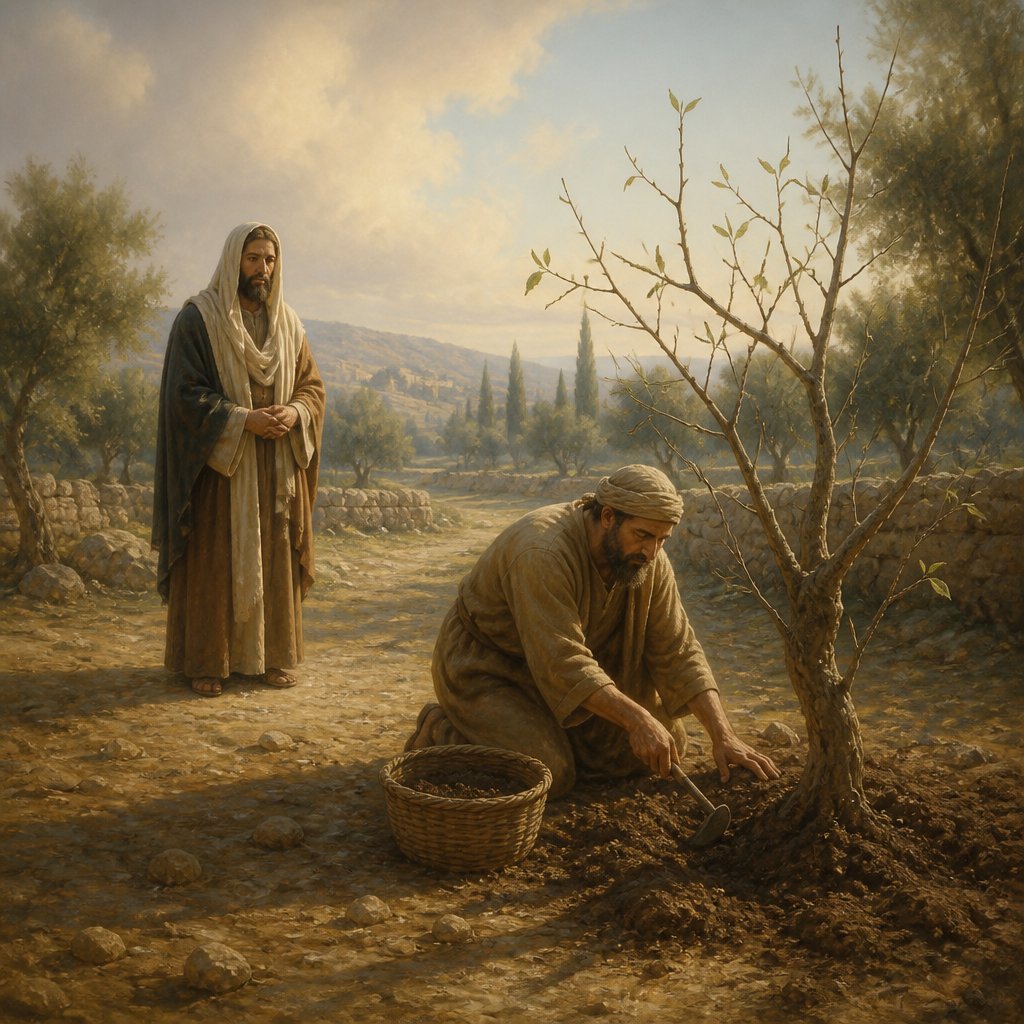
The Bible verse Luke 13:8 from the King James Version (KJV) reads, "And he answering said unto him, Lord, let it alone this year also, till I shall dig about it, and dung it." This passage is part of a larger parable that Jesus uses to teach about the need for repentance and the consequences of not bearing fruit in one's life.
In this parable, Jesus tells of a man who has a fig tree planted in his vineyard. For three years, the man has come seeking fruit on the fig tree but has found none. Frustrated, the man tells his vinedresser to cut down the fig tree, as it is taking up space and not producing any fruit. However, the vinedresser pleads with the man to give the fig tree one more year, during which time he will dig around it and fertilize it in hopes that it will bear fruit. If it does not bear fruit after this additional care, then it can be cut down.
There are several important themes and lessons that can be drawn from this passage. Firstly, the fig tree acts as a symbol for people who are called to bear fruit in their lives. In the Bible, bearing fruit is often used as a metaphor for living a life that is pleasing to God and producing the fruits of the Spirit, such as love, joy, peace, patience, kindness, goodness, faithfulness, gentleness, and self-control (Galatians 5:22-23). Just as the fig tree is expected to bear fruit, so are believers expected to live in a way that reflects the character of God.
Another key theme in this passage is the idea of repentance and the opportunity for second chances. The vinedresser's plea for more time and care for the fig tree reflects God's patience and mercy towards us. God is not quick to judge or condemn, but rather gives us opportunities to repent and turn from our sinful ways. This aligns with the overall message of the New Testament, which emphasizes God's grace and forgiveness for those who seek it.
The contextual significance of this passage is also important to consider. During Jesus' time, the Jewish religious leaders often prided themselves on their lineage and adherence to religious rituals, but many of them lacked true spiritual fruit in their lives. Jesus' use of the fig tree as a symbol in this parable may have been a direct challenge to the religious leaders, warning them that if they did not bear fruit in their lives, they would face judgement.
The vinedresser's promise to dig around the fig tree and fertilize it can also be seen as a reflection of God's work in our lives. God is actively involved in our growth and transformation, providing the necessary care and nourishment for us to produce fruit. The imagery of digging and fertilizing suggests that God is willing to get his hands dirty and put in the hard work to help us grow and develop.
Overall, Luke 13:8 carries a powerful message about the need for repentance, the patience of God, and the importance of bearing fruit in our lives. It serves as a reminder that God is continually working in our lives, offering us opportunities for growth and transformation. It also challenges us to examine our own lives and consider whether we are living in a way that reflects the character and values of God.
Have questions about Luke 13:8?
Dive deeper into this scripture with Bible Chat — an AI-powered tool for exploring God's Word through conversation. Ask questions, get context, and grow in your understanding of the Bible.
Get Our Apps


Luke 13:8 Artwork

Luke 13:8 - "And he answering said unto him, Lord, let it alone this year also, till I shall dig about it, and dung it:"
"And he answering said unto him, Lord, let it alone this year also, till I shall dig about it, and dung it:" - Luke 13:8

Luke 8:13

Luke 8:13

Luke 8:13

Luke 8:13 - "They on the rock are they, which, when they hear, receive the word with joy; and these have no root, which for a while believe, and in time of temptation fall away."

"They on the rock are they, which, when they hear, receive the word with joy; and these have no root, which for a while believe, and in time of temptation fall away." - Luke 8:13

Luke 8:5-8

Luke 13:18-19

Luke 13:20-21

Luke 13:18-19

Luke 13:20-21
Luke 13:20-21

Luke 13:20-21

Luke 13:20-21

Luke 1:13

Luke 1:13

Luke 13:24

Luke 1:13

Luke 1:13

Luke 1:13

Luke 2:13

Luke 1:13

Luke 8:16

Luke 8:11

Luke 8:17

Luke 13:13 - "And he laid his hands on her: and immediately she was made straight, and glorified God."

Luke 13:6-9

Luke 2:13-14

Luke 16:1-13