What does Luke 10:31 mean?
"And by chance there came down a certain priest that way: and when he saw him, he passed by on the other side." - Luke 10:31
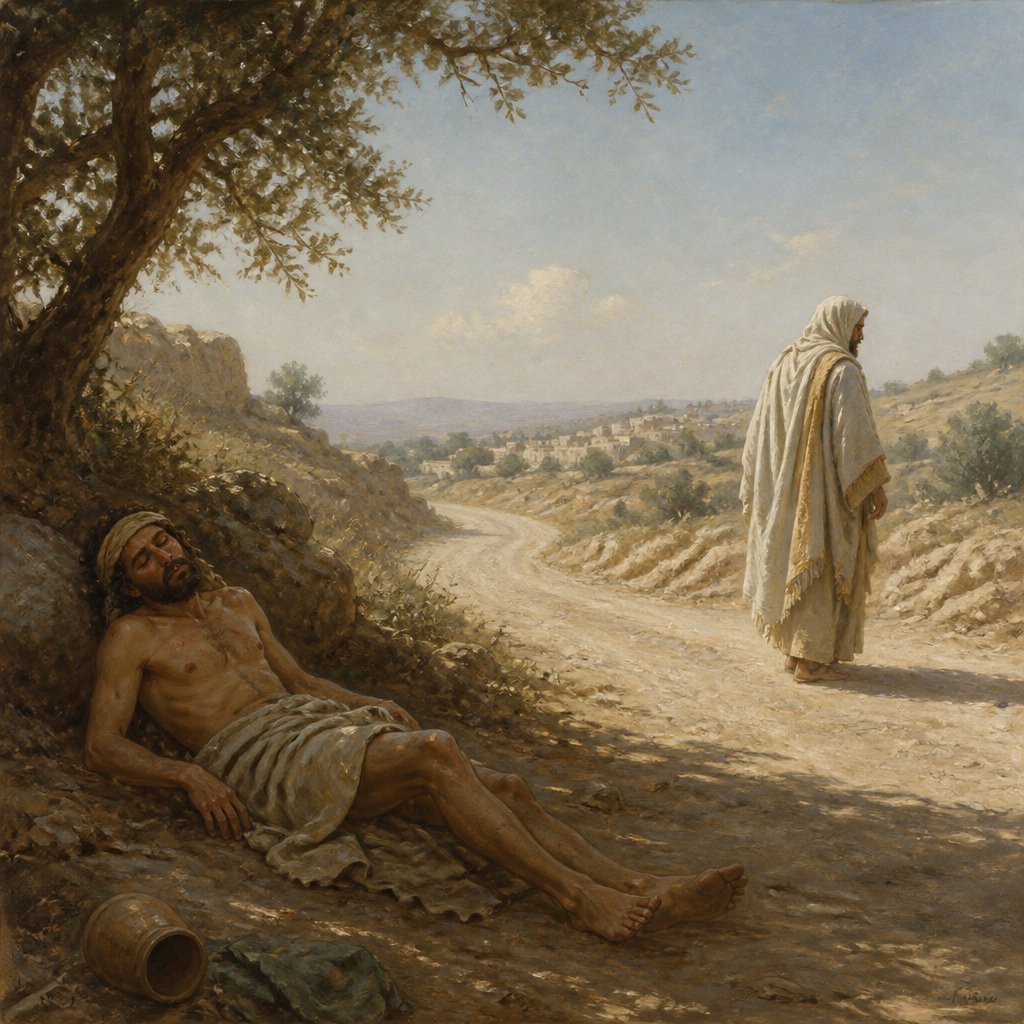
Luke 10:31 (KJV) reads, "And by chance there came down a certain priest that way: and when he saw him, he passed by on the other side."
This verse is a part of the parable of the Good Samaritan, which is found in the Gospel of Luke 10:25-37. In this parable, a man is traveling from Jerusalem to Jericho and is attacked by robbers who strip him, beat him, and leave him half dead.
The verse in question, Luke 10:31, introduces the second character in the parable, a certain priest, who comes upon the injured man as he is lying by the roadside. However, instead of stopping to help the victim, the priest chooses to pass by on the other side of the road. This action sets the stage for the introduction of the next character in the parable, a Levite, who also passes by without offering aid.
The parable of the Good Samaritan is a widely known and often quoted story. It is a story of compassion and love for others, regardless of their background or circumstances. The characters in the parable symbolize different attitudes and actions towards helping others in need. The priest and the Levite, who were considered religiously devout and socially respected individuals, are depicted as lacking compassion and failing in their moral duty to help a fellow human being.
The priest's decision to pass by on the other side of the road carries significant symbolism. It speaks to the idea of choosing to ignore the suffering of others, to avoid getting involved, or to prioritize one's own interests and comfort over the needs of others. The priest's action, or rather inaction, highlights the moral and spiritual failing in the face of human suffering.
The context of this verse within the broader narrative of the Gospel of Luke is essential for understanding its meaning. In the Gospel, Jesus uses this parable to teach the importance of showing mercy and compassion to others, even those who are different from ourselves. By contrasting the actions of the priest and the Levite with the Samaritan who stops to help the injured man, Jesus challenges his audience to examine their attitudes and behavior towards their fellow human beings.
The parable of the Good Samaritan has several themes, including love, compassion, and the universal nature of humanity. It calls for empathy and active care for others, regardless of their background, social status, or religious identity. The priest's decision to pass by the injured man symbolizes a lack of love and empathy, contrasting sharply with the Samaritan's selfless acts of mercy and compassion.
The parable also addresses the issue of religious and moral hypocrisy, highlighting the discrepancy between outward piety and genuine love for others. The priest's action is a cautionary tale about the dangers of self-righteousness and religious insincerity. It challenges readers to reflect on their own attitudes and actions, urging them to align their beliefs with compassionate deeds.
In conclusion, Luke 10:31 from the King James Version portrays a powerful message about the importance of compassion and empathy. It serves as a reminder to prioritize love and care for others, regardless of their background or circumstances. The priest's decision to pass by the injured man on the other side of the road symbolizes the failure to show mercy and highlights the moral and spiritual shortcomings that can occur when we prioritize our own interests over the needs of others. The parable of the Good Samaritan challenges readers to exemplify the selfless love and compassion demonstrated by the Samaritan, emphasizing the universal call to care for and show kindness to our fellow human beings.
Have questions about Luke 10:31?
Dive deeper into this scripture with Bible Chat — an AI-powered tool for exploring God's Word through conversation. Ask questions, get context, and grow in your understanding of the Bible.
Get Our Apps


Luke 10:31 Artwork

Luke 10:31 - "And by chance there came down a certain priest that way: and when he saw him, he passed by on the other side."
"And by chance there came down a certain priest that way: and when he saw him, he passed by on the other side." - Luke 10:31

Luke 1:31

Mark 10:31

Luke 22:31-32 - "Luke 22:31-32: And the Lord said, Simon, Simon, behold, Satan hath desired to have you, that he may sift you as wheat: But I have prayed for thee, that thy faith fail not: and when thou art converted, strengthen thy brethren."

Luke 23:31 - "For if they do these things in a green tree, what shall be done in the dry?"

Luke 2:31 - "Which thou hast prepared before the face of all people;"

Luke 24:31 - "And their eyes were opened, and they knew him; and he vanished out of their sight."

Luke 8:31 - "And they besought him that he would not command them to go out into the deep."

Luke 5:31 - "And Jesus answering said unto them, They that are whole need not a physician; but they that are sick."

Luke 4:31 - "And came down to Capernaum, a city of Galilee, and taught them on the sabbath days."

Luke 7:31 - "¶ And the Lord said, Whereunto then shall I liken the men of this generation? and to what are they like?"
Luke 20:31 - "And the third took her; and in like manner the seven also: and they left no children, and died."

Luke 6:31 - "And as ye would that men should do to you, do ye also to them likewise."

Luke 9:31 - "Who appeared in glory, and spake of his decease which he should accomplish at Jerusalem."

Luke 12:31 - "¶ But rather seek ye the kingdom of God; and all these things shall be added unto you."

Luke 10:5

Luke 10:5

Luke 10:5

Hebrews 10:31 - "It is a fearful thing to fall into the hands of the living God."

Mark 10:31 - "But many that are first shall be last; and the last first."

Luke 10:18-19

Luke 10:18-19

Luke 10:18-19

Luke 10:17-19

Luke 10:18-19

Luke 10:18-19

Luke 10:18-19

Luke 10:17-19

John 10:31 - "Then the Jews took up stones again to stone him."