What does Luke 10:30 mean?
"And Jesus answering said, A certain man went down from Jerusalem to Jericho, and fell among thieves, which stripped him of his raiment, and wounded him, and departed, leaving him half dead." - Luke 10:30
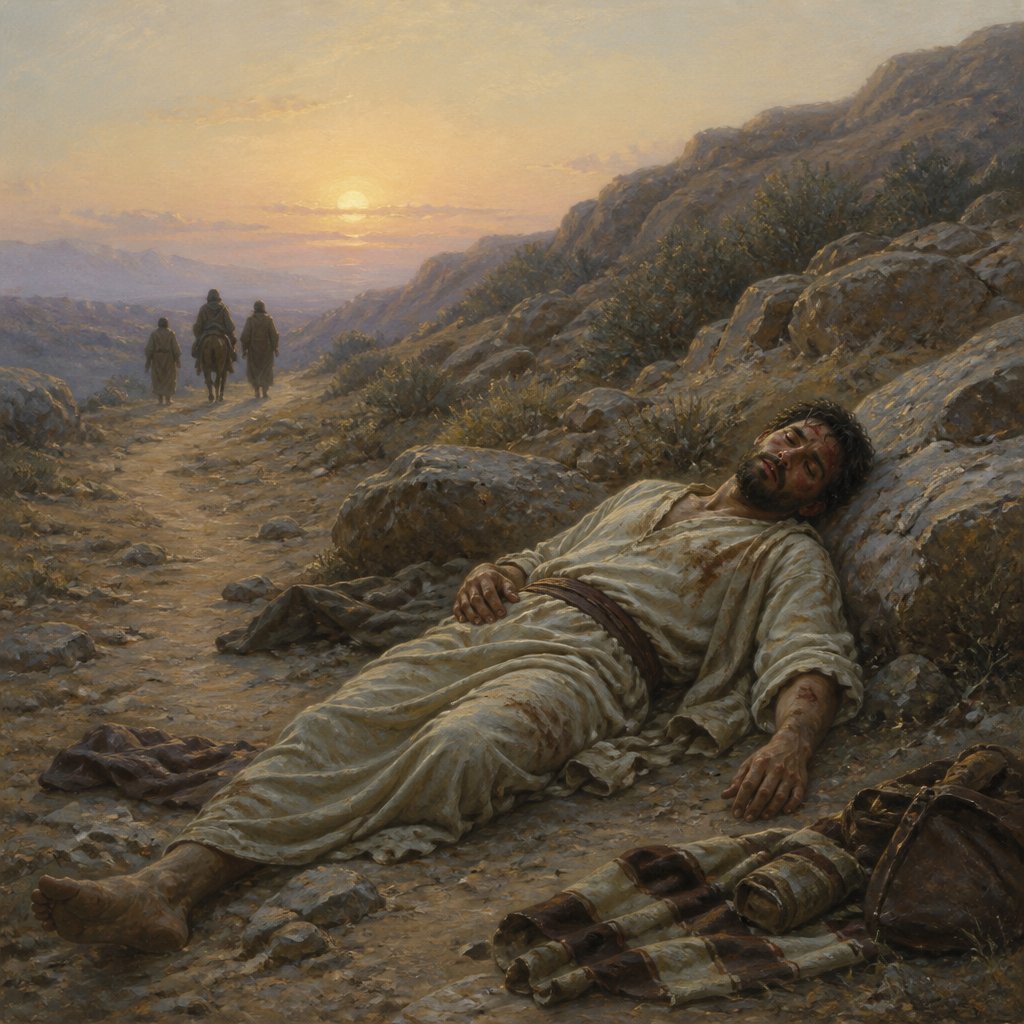
The Bible verse Luke 10:30 from the King James Version (KJV) reads: "And Jesus answering said, A certain man went down from Jerusalem to Jericho, and fell among thieves, which stripped him of his raiment, and wounded him, and departed, leaving him half dead." This verse is part of a parable told by Jesus in response to a question posed to him by a lawyer. The parable of the Good Samaritan, as it is commonly known, is a rich and powerful teaching with many layers of meaning and significance.
The setting of the parable is important to understand its full impact. Jerusalem and Jericho were both well-known to the people of Jesus' time. Jerusalem was the holy city, the center of religious life and the site of the Temple. Jericho, on the other hand, was located in the region known for its dangers and lawlessness. It was often associated with thieves and robbers. By mentioning these specific locations, Jesus sets the stage for a story that will resonate strongly with his audience.
The parable begins with a certain man traveling from Jerusalem to Jericho. This man's journey mirrors the journey of every person who seeks to live a life in alignment with God's will. The treacherous road represents the trials and challenges that we all face as we navigate the world. The man falling among thieves symbolizes the spiritual danger and oppression that can come upon us unexpectedly. The stripping of his raiment represents the loss of spiritual protection and dignity. The wounds he receives signify the damage that sin and evil can inflict upon our souls, leaving us metaphorically "half dead."
The actions of the priest and the Levite, who pass by the wounded man without offering help, highlight the themes of compassion and righteousness. These religious figures, who were expected to embody compassion and mercy, instead choose to prioritize their own agendas and concerns. Their failure to act serves as a warning against the dangers of hypocrisy and spiritual neglect. It also emphasizes the universal need for grace and forgiveness, regardless of one's social or religious status.
The entrance of the Samaritan into the story is a pivotal moment. The Samaritans were a group traditionally despised and rejected by the Jewish community. Yet, it is the Samaritan who shows true compassion and mercy by stopping to help the wounded man. He tends to the man's wounds, takes him to an inn, and pays for his care. This unexpected act of kindness challenges the prejudices and preconceptions of Jesus' audience. It also serves as a powerful illustration of the commandment to love one's neighbor as oneself.
The parable of the Good Samaritan speaks directly to the universal human experience of suffering, vulnerability, and the need for compassion. It also addresses the nature of true righteousness and the dangers of spiritual complacency. The story remains a powerful reminder of the call to act with love and kindness towards others, irrespective of social, cultural, or religious barriers.
In conclusion, Luke 10:30, part of the parable of the Good Samaritan, is a profound and timeless teaching that continues to resonate with people from all walks of life. Its themes of compassion, mercy, and the universal call to love one's neighbor make it a foundational text in Christian ethics and morality. The parable's relevance and power endure, challenging each generation to examine their own hearts and actions in light of its profound message.
Have questions about Luke 10:30?
Dive deeper into this scripture with Bible Chat — an AI-powered tool for exploring God's Word through conversation. Ask questions, get context, and grow in your understanding of the Bible.
Get Our Apps


Luke 10:30 Artwork

african american luke 10:30

Luke 10:30 - "And Jesus answering said, A certain man went down from Jerusalem to Jericho, and fell among thieves, which stripped him of his raiment, and wounded him, and departed, leaving him half dead."

Luke 10:30-37 - "Jesus replied, "A man was going down from Jerusalem to Jericho, when he was attacked by robbers. They stripped him of his clothes, beat him and went away, leaving him half dead. A priest happened to be going down the same road, and when he saw the man, he passed by on the other side. So too, a Levite, when he came to the place and saw him, passed by on the other side. But a Samaritan, as he traveled, came where the man was; and when he saw him, he took pity on him. He went to him and bandaged his wounds, pouring on oil and wine. Then he put the man on his own donkey, brought him to an inn and took care of him. The next day he took out two denarii and gave them to the innkeeper. 'Look after him,' he said, 'and when I return, I will reimburse you for any extra expense you may have.' Which of these three do you think was a neighbor to the man who fell into the hands of robbers?" The expert in the law replied, "The one who had mercy on him." Jesus told him, "Go and do likewise.""
"And Jesus answering said, A certain man went down from Jerusalem to Jericho, and fell among thieves, which stripped him of his raiment, and wounded him, and departed, leaving him half dead." - Luke 10:30
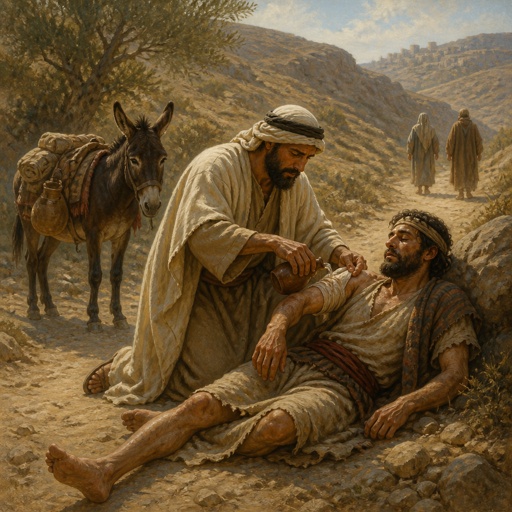
"Jesus replied, "A man was going down from Jerusalem to Jericho, when he was attacked by robbers. They stripped him of his clothes, beat him and went away, leaving him half dead. A priest happened to be going down the same road, and when he saw the man, he passed by on the other side. So too, a Levite, when he came to the place and saw him, passed by on the other side. But a Samaritan, as he traveled, came where the man was; and when he saw him, he took pity on him. He went to him and bandaged his wounds, pouring on oil and wine. Then he put the man on his own donkey, brought him to an inn and took care of him. The next day he took out two denarii and gave them to the innkeeper. 'Look after him,' he said, 'and when I return, I will reimburse you for any extra expense you may have.' Which of these three do you think was a neighbor to the man who fell into the hands of robbers?" The expert in the law replied, "The one who had mercy on him." Jesus told him, "Go and do likewise."" - Luke 10:30-37

Luke 6:10 30 Give to everyone who asks of you. Whoever takes away what is yours, do not demand it back.

Luke 6:10 30 Give to everyone who asks of you. Whoever takes away what is yours, do not demand it back.

Luke 1:30

luke 9:30

luke 6:30

luke 9:29- 30

Luke 14:30 - "Saying, This man began to build, and was not able to finish."

Luke 2:30 - "For mine eyes have seen thy salvation,"

John 10:30

John 10:30

Luke 20:30 - "And the second took her to wife, and he died childless."

Luke 1:30 Gabriel visits Mary

Luke 17:30 - "Even thus shall it be in the day when the Son of man is revealed."

Luke 4:30 - "But he passing through the midst of them went his way,"

Luke 13:30 - "And, behold, there are last which shall be first, and there are first which shall be last."

Luke 23:30 - "Then shall they begin to say to the mountains, Fall on us; and to the hills, Cover us."

Luke 9:30 - "And, behold, there talked with him two men, which were Moses and Elias:"

Mark 10:17-30

2 Chronicles 30:10

Mark 10:17-30

Genesis 30:10-11

John 10:30 - "I and my Father are one."

Luke 7:30 - "But the Pharisees and lawyers rejected the counsel of God against themselves, being not baptized of him."

Luke 11:30 - "For as Jonas was a sign unto the Ninevites, so shall also the Son of man be to this generation."

Luke 10:5