What does Leviticus 6:30 mean?
"And no sin offering, whereof any of the blood is brought into the tabernacle of the congregation to reconcile withal in the holy place, shall be eaten: it shall be burnt in the fire." - Leviticus 6:30

Leviticus 6:30 in the King James Version of the Bible states, "And no sin offering, whereof any of the blood is brought into the tabernacle of the congregation to reconcile withal in the holy place, shall be eaten: it shall be burnt in the fire."
This verse is part of a larger passage in the book of Leviticus that details the regulations and procedures for sin offerings in the Old Testament. Sin offerings were sacrifices made by the people of Israel to atone for their sins and seek reconciliation with God. The blood of the sin offering was brought into the tabernacle, the sacred place where God's presence resided among the Israelites, in order to make atonement for the people's transgressions.
The context of this verse is important to understand its significance. In the Old Testament, God established a system of sacrifices and offerings to provide a way for His people to seek forgiveness for their sins. The sin offering was a central aspect of this system, and it served as a means for the people to acknowledge their wrongdoing and seek reconciliation with God. The blood of the sin offering was considered to be the life force of the animal, and it was symbolically offered to God as a substitutionary atonement for the sins of the people.
In Leviticus 6:30, the specific instruction is given that no sin offering whose blood has been brought into the tabernacle of the congregation shall be eaten. Instead, it is to be burnt in the fire. This directive underscores the sacred nature of the sin offering and emphasizes the seriousness of the atonement process. The sin offering was not to be treated as common meat for consumption; rather, it was to be completely devoted to God and consumed by the fire as a symbol of the purification and reconciliation it provided for the people.
The theme of atonement and reconciliation with God is central to this verse. The sin offering, with its blood brought into the holy place, served as a means for the people to seek forgiveness and restoration of their relationship with God. It was a tangible expression of the people's desire to make amends for their offenses and to seek God's mercy and grace.
Another key theme in this verse is the concept of holiness. The tabernacle, as the dwelling place of God's presence, was a holy place that required reverence and respect. The sin offering, as a sacred ritual performed in the tabernacle, symbolized the sanctity of God's standards and the need for the people to approach Him with humility and contrition.
Symbolically, the burning of the sin offering in the fire represents the complete consecration of the offering to God. The fire was a purifying element, and by consuming the sin offering, it symbolized the removal of the people's sins and their purification before God. This act of burning the sin offering also served as a demonstration of the people's commitment to fully surrender to God and to seek His forgiveness and cleansing.
In summary, Leviticus 6:30 conveys the solemnity and significance of the sin offering in the Old Testament sacrificial system. It underscores the themes of atonement, holiness, and complete dedication to God. The verse serves as a reminder of the importance of seeking reconciliation with God and the need to approach Him with reverence and sincerity in the pursuit of forgiveness and restoration.
Have questions about Leviticus 6:30?
Dive deeper into this scripture with Bible Chat — an AI-powered tool for exploring God's Word through conversation. Ask questions, get context, and grow in your understanding of the Bible.
Get Our Apps


Leviticus 6:30 Artwork

Leviticus 6:30 - "And no sin offering, whereof any of the blood is brought into the tabernacle of the congregation to reconcile withal in the holy place, shall be eaten: it shall be burnt in the fire."

"And no sin offering, whereof any of the blood is brought into the tabernacle of the congregation to reconcile withal in the holy place, shall be eaten: it shall be burnt in the fire." - Leviticus 6:30

Leviticus 8:30

Leviticus 11:30 - "And the ferret, and the chameleon, and the lizard, and the snail, and the mole."

Leviticus 14:30 - "And he shall offer the one of the turtledoves, or of the young pigeons, such as he can get;"

Leviticus 19:30 - "¶ Ye shall keep my sabbaths, and reverence my sanctuary: I am the LORD."

Leviticus 27:30 - "And all the tithe of the land, whether of the seed of the land, or of the fruit of the tree, is the LORD'S: it is holy unto the LORD."

"And the ferret, and the chameleon, and the lizard, and the snail, and the mole." - Leviticus 11:30

Matthew 6:30

luke 6:30

Leviticus 22:30 - "On the same day it shall be eaten up; ye shall leave none of it until the morrow: I am the LORD."

Leviticus 26: 4-6

Leviticus 23:30 - "And whatsoever soul it be that doeth any work in that same day, the same soul will I destroy from among his people."
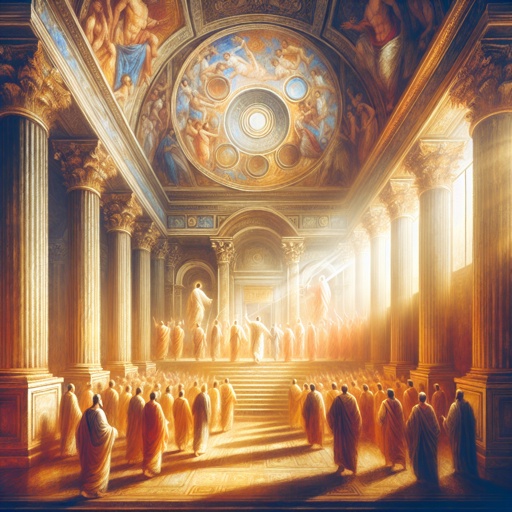
Leviticus 26: 4-6

Leviticus 26: 4-6

Leviticus 16:30 - "For on that day shall the priest make an atonement for you, to cleanse you, that ye may be clean from all your sins before the LORD."

Leviticus 6:24 - "¶ And the LORD spake unto Moses, saying,"

Leviticus 6:8 - "¶ And the LORD spake unto Moses, saying,"

Leviticus 6:19 - "¶ And the LORD spake unto Moses, saying,"

Leviticus 6:1 - "And the LORD spake unto Moses, saying,"

Job 30:6 - "To dwell in the clifts of the valleys, in caves of the earth, and in the rocks."

Leviticus 15:30 - "And the priest shall offer the one for a sin offering, and the other for a burnt offering; and the priest shall make an atonement for her before the LORD for the issue of her uncleanness."

Leviticus 25:30 - "And if it be not redeemed within the space of a full year, then the house that is in the walled city shall be established for ever to him that bought it throughout his generations: it shall not go out in the jubile."

Leviticus 1:6 - "And he shall flay the burnt offering, and cut it into his pieces."

Leviticus 4:30 - "And the priest shall take of the blood thereof with his finger, and put it upon the horns of the altar of burnt offering, and shall pour out all the blood thereof at the bottom of the altar."

Leviticus 26:30 - "And I will destroy your high places, and cut down your images, and cast your carcases upon the carcases of your idols, and my soul shall abhor you."

Leviticus 8:6 - "And Moses brought Aaron and his sons, and washed them with water."
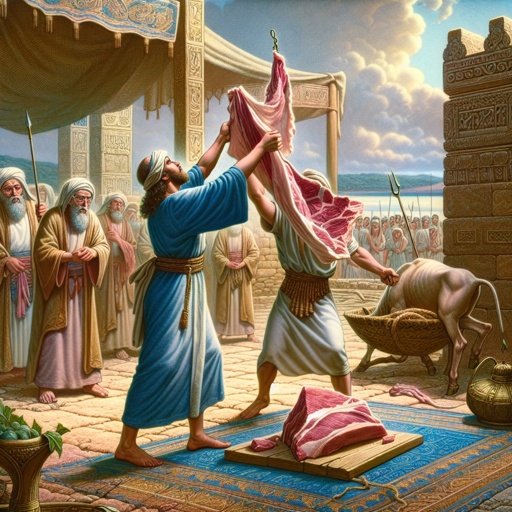
Leviticus 7:30 - "His own hands shall bring the offerings of the LORD made by fire, the fat with the breast, it shall he bring, that the breast may be waved for a wave offering before the LORD."

Leviticus 2:6 - "Thou shalt part it in pieces, and pour oil thereon: it is a meat offering."

1 Kings 6:30 - "And the floor of the house he overlaid with gold, within and without."