What does Judges 9:31 mean?
"And he sent messengers unto Abimelech privily, saying, Behold, Gaal the son of Ebed and his brethren be come to Shechem; and, behold, they fortify the city against thee." - Judges 9:31
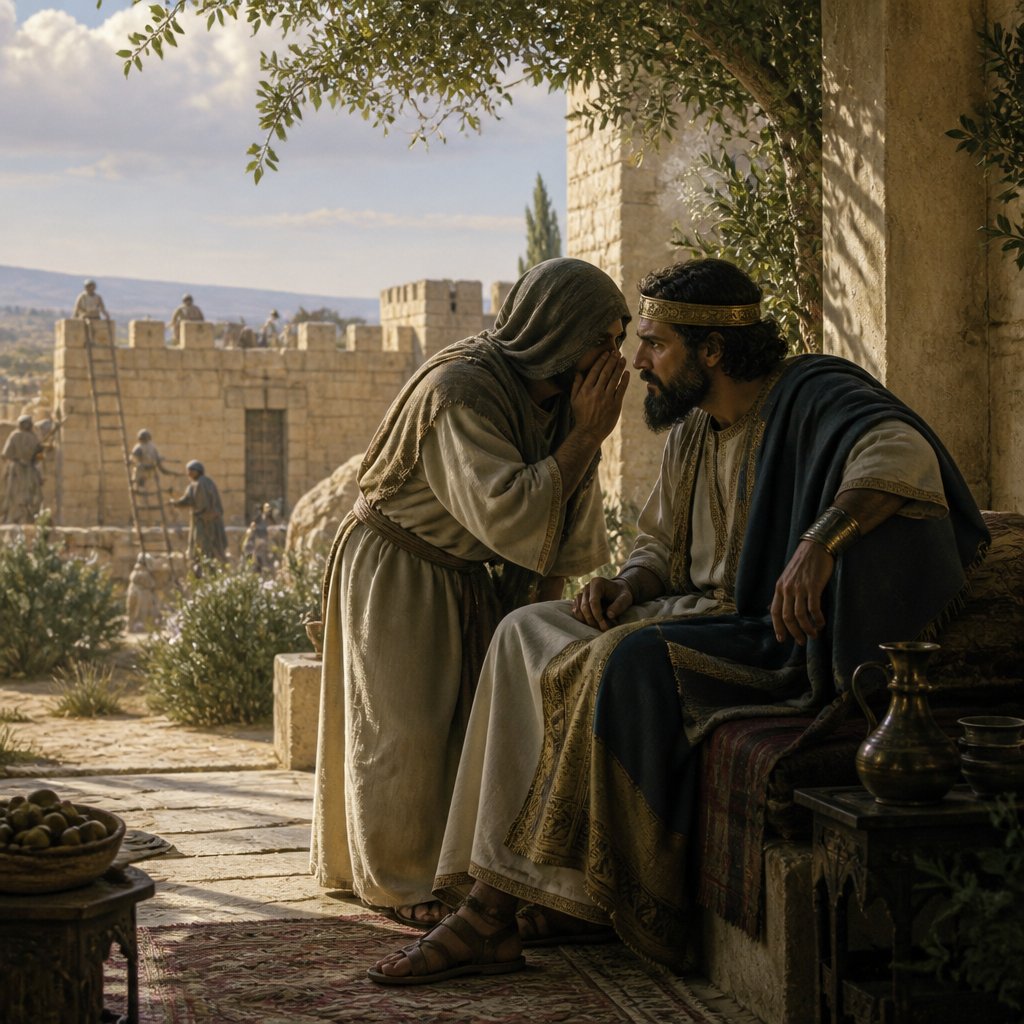
The Bible verse Judges 9:31 in the King James Version (KJV) states:
"And he sent messengers unto Abimelech privily, saying, Behold, Gaal the son of Ebed and his brethren be come to Shechem; and, behold, they fortify the city against thee."
This verse is found in the Book of Judges, which is the seventh book of the Old Testament. The Book of Judges tells the story of the Israelites' descent into moral and spiritual degradation, their oppression by hostile neighbors, and their deliverance by leaders whom they had chosen. The verse Judges 9:31 is part of a larger narrative that recounts the rise and fall of Abimelech, the son of Gideon, who sought to establish himself as the ruler of Israel.
In this particular verse, Abimelech receives a message from a secret informant informing him of a potential threat to his rule. The message reveals that Gaal, the son of Ebed, and his brothers have arrived in Shechem and have begun fortifying the city against Abimelech. This news puts Abimelech on high alert and prompts him to take action to defend his position of power.
The context of this verse is critical for understanding its significance within the larger narrative of the Book of Judges. At this point in the story, Abimelech has already seized power through violent means, killing his seventy brothers in order to secure his claim to the throne. He has also waged war against the city of Shechem, which initially supported him but later rebelled against his rule. The arrival of Gaal and his brothers in Shechem poses a new threat to Abimelech's authority and sets the stage for further conflict and bloodshed.
One of the key themes in this verse and the broader narrative of the Book of Judges is the recurring cycle of rebellion, oppression, and deliverance within the history of the Israelites. The story of Abimelech reflects the consequences of the Israelites' failure to follow God's commandments and their willingness to embrace ruthless and corrupt leaders. Abimelech's rise to power through treachery and violence is a stark example of the moral and spiritual decay that plagued the Israelites during this period.
The symbolism in this verse is also significant. The name Abimelech means "my father is king," reflecting his aspiration to royal power and his willingness to eliminate any perceived threats to his rule. In contrast, Gaal, whose name means "abhorrence" or "loathing," represents a challenge to Abimelech's authority and a potential source of upheaval and rebellion.
Overall, Judges 9:31 illuminates the complex dynamics of power, betrayal, and conflict that characterize the historical and moral landscape of the Book of Judges. It serves as a reminder of the destructive consequences of human ambition and moral compromise and underscores the importance of seeking righteousness and obedience to God's will. As readers engage with this verse and the larger narrative of the Book of Judges, they are confronted with the enduring relevance of its themes and the timeless implications of its moral lessons.
Have questions about Judges 9:31?
Dive deeper into this scripture with Bible Chat — an AI-powered tool for exploring God's Word through conversation. Ask questions, get context, and grow in your understanding of the Bible.
Get Our Apps


Judges 9:31 Artwork

Judges 9:31 - "And he sent messengers unto Abimelech privily, saying, Behold, Gaal the son of Ebed and his brethren be come to Shechem; and, behold, they fortify the city against thee."
"And he sent messengers unto Abimelech privily, saying, Behold, Gaal the son of Ebed and his brethren be come to Shechem; and, behold, they fortify the city against thee." - Judges 9:31

Proverbs 31:9 - "Open thy mouth, judge righteously, and plead the cause of the poor and needy."

Judges 3:31

Judges 2:31
"Open thy mouth, judge righteously, and plead the cause of the poor and needy." - Proverbs 31:9

Job 31:11 - "For this is an heinous crime; yea, it is an iniquity to be punished by the judges."

1 Corinthians 11:31 - "For if we would judge ourselves, we should not be judged."

Deuteronomy 32:31 - "For their rock is not as our Rock, even our enemies themselves being judges."

Judges 8:31 - "And his concubine that was in Shechem, she also bare him a son, whose name he called Abimelech."

"For this is an heinous crime; yea, it is an iniquity to be punished by the judges." - Job 31:11

Judges 18:31 - "And they set them up Micah's graven image, which he made, all the time that the house of God was in Shiloh."

"For if we would judge ourselves, we should not be judged." - 1 Corinthians 11:31

Judges 9:8-15

Judges 3:31 - "¶ And after him was Shamgar the son of Anath, which slew of the Philistines six hundred men with an ox goad: and he also delivered Israel."

Job 31:9-12 - "If my heart has been enticed by a woman, or if I have lurked at my neighbor's door, then may my wife grind another man's grain, and may other men sleep with her. For that would have been wicked, a sin to be judged. It is a fire that burns to Destruction; it would have uprooted my harvest."

Job 31:28 - "This also were an iniquity to be punished by the judge: for I should have denied the God that is above."

Judges 9:50 - "¶ Then went Abimelech to Thebez, and encamped against Thebez, and took it."

Judges 1:31 - "¶ Neither did Asher drive out the inhabitants of Accho, nor the inhabitants of Zidon, nor of Ahlab, nor of Achzib, nor of Helbah, nor of Aphik, nor of Rehob:"

Judges 9:22 - "¶ When Abimelech had reigned three years over Israel,"

Judges 15:9 - "¶ Then the Philistines went up, and pitched in Judah, and spread themselves in Lehi."

Judges 9:39 - "And Gaal went out before the men of Shechem, and fought with Abimelech."

"For their rock is not as our Rock, even our enemies themselves being judges." - Deuteronomy 32:31

Judges 16:31 - "Then his brethren and all the house of his father came down, and took him, and brought him up, and buried him between Zorah and Eshtaol in the buryingplace of Manoah his father. And he judged Israel twenty years."

Judges 21:9 - "For the people were numbered, and, behold, there were none of the inhabitants of Jabesh-gilead there."

2 Chronicles 31:9 - "Then Hezekiah questioned with the priests and the Levites concerning the heaps."

Exodus 9:31 - "And the flax and the barley was smitten: for the barley was in the ear, and the flax was bolled."

Judges 9:10 - "And the trees said to the fig tree, Come thou, and reign over us."

Judges 9:42 - "And it came to pass on the morrow, that the people went out into the field; and they told Abimelech."

Judges 9:12 - "Then said the trees unto the vine, Come thou, and reign over us."