What does Judges 4:17 mean?
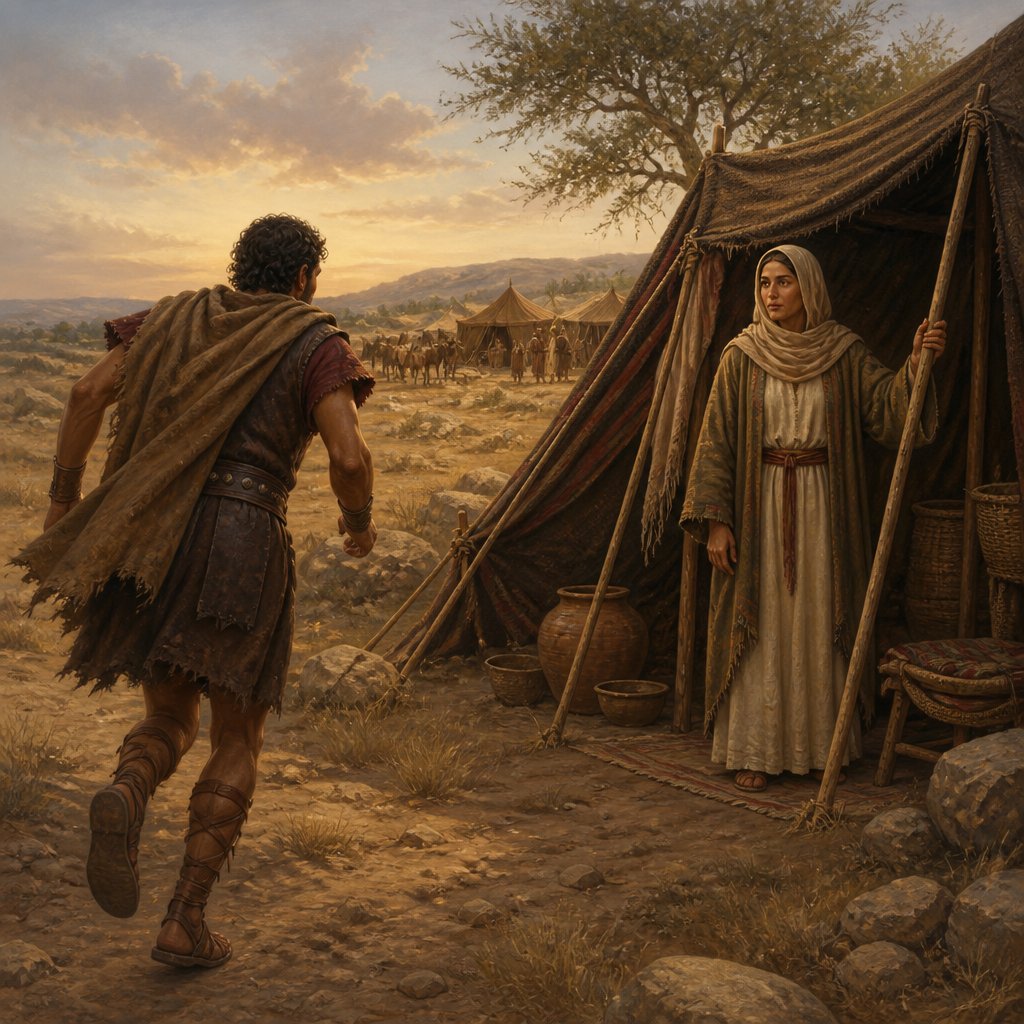
"Howbeit Sisera fled away on his feet to the tent of Jael the wife of Heber the Kenite: for there was peace between Jabin the king of Hazor and the house of Heber the Kenite." - Judges 4:17
The Bible verse Judges 4:17 from the King James Version (KJV) reads:
"Howbeit Sisera fled away on his feet to the tent of Jael the wife of Heber the Kenite: for there was peace between Jabin the king of Hazor and the house of Heber the Kenite."
This verse comes from the Old Testament book of Judges, which takes place in ancient Israel. The book follows the Israelites' journey from the period of the death of Joshua, their military leader, to the establishment of the monarchy under King Saul. The verse specifically recounts events surrounding a battle between the Israelites and their oppressors, the Canaanites, led by the commander Sisera.
The verse tells the story of Sisera fleeing from his defeat in battle to seek refuge in the tent of Jael, the wife of Heber the Kenite. Jael is described as the wife of Heber, who was a Kenite. There are several significant themes and symbols within this verse that can be explored in-depth.
One theme in this verse is the complex nature of alliances and loyalty. Sisera flees to the tent of Jael because there was peace between Jabin, the king of Hazor, and the house of Heber the Kenite. This indicates that there were political alliances and agreements between different groups and tribes in the region. The verse raises questions about the nature of these alliances and the loyalty of those involved. It also shows the transient nature of peace and alliances in a region marked by frequent conflicts and power struggles.
Another theme is the role of women in the biblical narrative. Jael’s actions in the following verses are significant as she ultimately brings about Sisera’s demise. Her character challenges traditional gender roles and expectations, as she demonstrates strength and agency in a male-dominated society. Her actions also highlight the unpredictability and complexity of human behavior.
The symbolism in this verse is also worth exploring. The act of Sisera seeking refuge in Jael’s tent and Jael’s subsequent actions bear symbolic weight. Jael’s tent represents a place of refuge and hospitality, which were highly valued in ancient Near Eastern cultures. However, Jael’s betrayal of Sisera within the safety of her tent underscores the vulnerability and deceit that can lurk beneath the surface of seemingly safe spaces.
The imagery of Sisera seeking refuge in a woman’s tent and later being killed by that same woman also carries symbolic weight. It underscores the unexpected and often subversive ways in which power dynamics can play out in the biblical narrative.
Moreover, this verse highlights the idea of divine retribution. As the story unfolds in the following verses, it becomes clear that Jael’s actions are part of God’s plan to deliver the Israelites from their oppressors. This theme of divine intervention and justice is a recurring motif in the book of Judges.
In conclusion, Judges 4:17 is a verse that encapsulates complex themes of alliances, loyalty, gender dynamics, and divine intervention. Through its rich symbolism and narrative, the verse invites readers to reflect on the often unpredictable and multifaceted nature of human behavior and the ways in which God’s plan unfolds in unexpected ways.
Have questions about Judges 4:17?
Dive deeper into this scripture with Bible Chat — an AI-powered tool for exploring God's Word through conversation. Ask questions, get context, and grow in your understanding of the Bible.
Get Our Apps


Judges 4:17 Artwork

Judges 4:17 - "Howbeit Sisera fled away on his feet to the tent of Jael the wife of Heber the Kenite: for there was peace between Jabin the king of Hazor and the house of Heber the Kenite."
"Howbeit Sisera fled away on his feet to the tent of Jael the wife of Heber the Kenite: for there was peace between Jabin the king of Hazor and the house of Heber the Kenite." - Judges 4:17

Judges 17:4 - "Yet he restored the money unto his mother; and his mother took two hundred shekels of silver, and gave them to the founder, who made thereof a graven image and a molten image: and they were in the house of Micah."

Judges 4:4

Judges 4:4 - "¶ And Deborah, a prophetess, the wife of Lapidoth, she judged Israel at that time."

Judges 17:1 - "And there was a man of mount Ephraim, whose name was Micah."

Job 12:17 - "He leadeth counsellors away spoiled, and maketh the judges fools."

Judges 8:17 - "And he beat down the tower of Penuel, and slew the men of the city."

Judges 21:17 - "And they said, There must be an inheritance for them that be escaped of Benjamin, that a tribe be not destroyed out of Israel."

Judges 17:12 - "And Micah consecrated the Levite; and the young man became his priest, and was in the house of Micah."

Judges 3:17 - "And he brought the present unto Eglon king of Moab: and Eglon was a very fat man."

Judges 17:11 - "And the Levite was content to dwell with the man; and the young man was unto him as one of his sons."

Judges 2:17 - "And yet they would not hearken unto their judges, but they went a whoring after other gods, and bowed themselves unto them: they turned quickly out of the way which their fathers walked in, obeying the commandments of the LORD; but they did not so."

Judges 4:4 - "¶ And Deborah, a prophetess, the wife of Lapidoth, she judged Israel at that time."

Judges 17:7 - "¶ And there was a young man out of Beth-lehem-judah of the family of Judah, who was a Levite, and he sojourned there."

Judges 17:6 - "In those days there was no king in Israel, but every man did that which was right in his own eyes."

"¶ And Deborah, a prophetess, the wife of Lapidoth, she judged Israel at that time." - Judges 4:4

James 2:4 - "Are ye not then partial in yourselves, and are become judges of evil thoughts?"

Judges 9:17 - "(For my father fought for you, and adventured his life far, and delivered you out of the hand of Midian:"

Judges 10:17 - "Then the children of Ammon were gathered together, and encamped in Gilead. And the children of Israel assembled themselves together, and encamped in Mizpeh."

"And there was a man of mount Ephraim, whose name was Micah." - Judges 17:1

Judges 4:15 – "The Lord routed Sisera and all his chariots and army by the sword."

Judges 1:17 - "And Judah went with Simeon his brother, and they slew the Canaanites that inhabited Zephath, and utterly destroyed it. And the name of the city was called Hormah."

Judges 17:13 - "Then said Micah, Now know I that the LORD will do me good, seeing I have a Levite to my priest."

Judges 4:12 - "And they shewed Sisera that Barak the son of Abinoam was gone up to mount Tabor."

Judges 17:5 - "And the man Micah had an house of gods, and made an ephod, and teraphim, and consecrated one of his sons, who became his priest."

Judges 5:17 - "Gilead abode beyond Jordan: and why did Dan remain in ships? Asher continued on the sea shore, and abode in his breaches."

Deuteronomy 19:17 - "Then both the men, between whom the controversy is, shall stand before the LORD, before the priests and the judges, which shall be in those days;"

Judges 20:17 - "And the men of Israel, beside Benjamin, were numbered four hundred thousand men that drew sword: all these were men of war."

Judges 11:4 - "¶ And it came to pass in process of time, that the children of Ammon made war against Israel."