What does Judges 3:22 mean?
"And the haft also went in after the blade; and the fat closed upon the blade, so that he could not draw the dagger out of his belly; and the dirt came out." - Judges 3:22
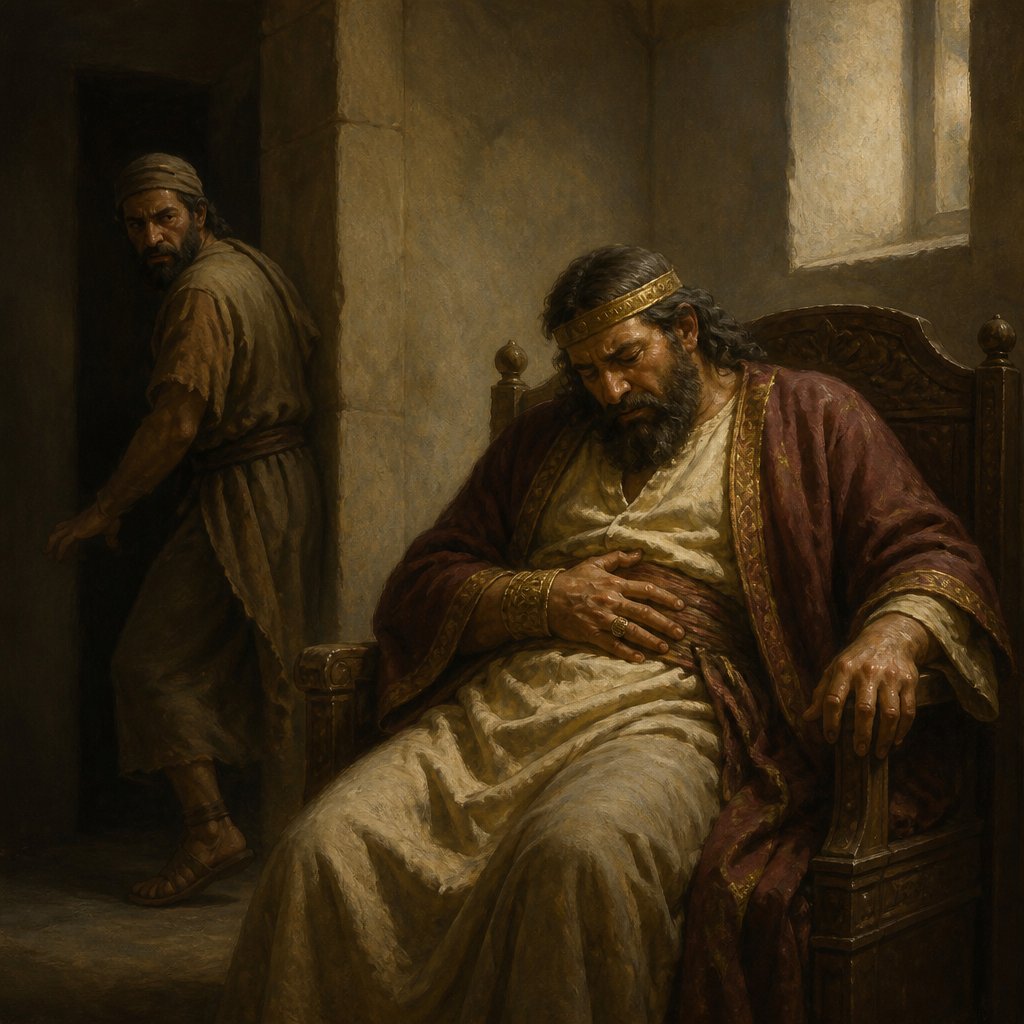
The Bible verse Judges 3:22 from the King James Version (KJV) reads, "And the haft also went in after the blade; and the fat closed upon the blade, so that he could not draw the dagger out of his belly; and the dirt came out." This verse is found in the Old Testament, specifically in the book of Judges, which is a historical account of Israel after the death of Joshua and before the establishment of the monarchy.
In order to understand the significance of this verse, it is important to consider the broader context in which it is found. The book of Judges recounts the cycle of apostasy, oppression, and deliverance that characterized Israel during this time. The Israelites repeatedly turn away from God, leading to their oppression by foreign nations, the raising up of judges to deliver them, and a period of peace before the cycle begins anew.
In Judges 3:22, the verse is set within the story of Ehud, who was a judge and deliverer of Israel. Ehud was left-handed, which made him a unique and unlikely savior in a culture that valued right-handedness. He was chosen by God to deliver the Israelites from Eglon, the Moabite king who had oppressed them for 18 years. Ehud devises a plan to assassinate Eglon by crafting a two-edged dagger and concealing it on his right thigh, where his adversaries would not suspect it due to his left-handedness.
The significance of Judges 3:22 lies in the striking imagery it presents. The verse describes the insertion of the dagger into the belly of Eglon, the fat closing over the blade, and the release of waste from his body. This vivid and graphic depiction serves to illustrate the brutal nature of Ehud's assassination of Eglon and the impact it had on the Moabite king. It also serves as a reminder of the harsh realities of war and the lengths to which God's chosen people were willing to go in order to secure their freedom from oppression.
The themes present in Judges 3:22 are emblematic of the larger themes found throughout the book of Judges. The verse speaks to the themes of deliverance, justice, and the power of God to use unexpected means and individuals to accomplish His purposes. Ehud's assassination of Eglon and the subsequent deliverance of Israel from Moabite oppression demonstrate God's faithfulness to His people, even in the midst of their disobedience and unfaithfulness. It also serves as a reminder of the consequences of sin and the ultimate victory of God over the forces of evil.
In addition to its thematic significance, Judges 3:22 also contains symbolic elements. The image of the dagger penetrating Eglon's belly and the fat closing over the blade can be seen as a symbol of the righteous judgment of God against the wicked. It serves as a visual representation of the defeat of evil and the triumph of God's justice. The release of waste from Eglon's body can be interpreted as a metaphor for the removal of impurity and corruption from the land of Israel, symbolizing the cleansing and restoration that comes with deliverance from oppression.
In conclusion, Judges 3:22 contains rich and multifaceted meaning that encompasses themes of deliverance, justice, and the power of God to use unexpected means to accomplish His purposes. It also contains symbolic elements that speak to the defeat of evil and the triumph of God's justice. The verse serves as a powerful and vivid depiction of the brutal nature of war and the lengths to which God's chosen people were willing to go in order to secure their freedom from oppression. Ultimately, Judges 3:22 serves as a reminder of the faithfulness of God and the consequences of sin, as well as a testament to the ultimate victory of God over the forces of evil.
Have questions about Judges 3:22?
Dive deeper into this scripture with Bible Chat — an AI-powered tool for exploring God's Word through conversation. Ask questions, get context, and grow in your understanding of the Bible.
Get Our Apps


Judges 3:22 Artwork

Judges 3:22 - "And the haft also went in after the blade; and the fat closed upon the blade, so that he could not draw the dagger out of his belly; and the dirt came out."
"And the haft also went in after the blade; and the fat closed upon the blade, so that he could not draw the dagger out of his belly; and the dirt came out." - Judges 3:22

Judges 9:22 - "¶ When Abimelech had reigned three years over Israel,"

Judges 5:22 - "Then were the horsehoofs broken by the means of the pransings, the pransings of their mighty ones."

Judges 3:31

Judges 1:22 - "¶ And the house of Joseph, they also went up against Beth-el: and the LORD was with them."

Judges 16:22 - "Howbeit the hair of his head began to grow again after he was shaven."
2 Kings 23:22 - "Surely there was not holden such a passover from the days of the judges that judged Israel, nor in all the days of the kings of Israel, nor of the kings of Judah;"

Judges 13:22 - "And Manoah said unto his wife, We shall surely die, because we have seen God."

Zephaniah 3:3 - "Her princes within her are roaring lions; her judges are evening wolves; they gnaw not the bones till the morrow."

Judges 11:22 - "And they possessed all the coasts of the Amorites, from Arnon even unto Jabbok, and from the wilderness even unto Jordan."

Judges 10:3 - "¶ And after him arose Jair, a Gileadite, and judged Israel twenty and two years."

Ezekiel 22:2 - "Now, thou son of man, wilt thou judge, wilt thou judge the bloody city? yea, thou shalt shew her all her abominations."

Judges 2:22 - "That through them I may prove Israel, whether they will keep the way of the LORD to walk therein, as their fathers did keep it, or not."

Judges 3:6 - "And they took their daughters to be their wives, and gave their daughters to their sons, and served their gods."

Exodus 22:9 - "For all manner of trespass, whether it be for ox, for ass, for sheep, for raiment, or for any manner of lost thing, which another challengeth to be his, the cause of both parties shall come before the judges; and whom the judges shall condemn, he shall pay double unto his neighbour."

Judges 20:22 - "And the people the men of Israel encouraged themselves, and set their battle again in array in the place where they put themselves in array the first day."

Judges 3:11 - "And the land had rest forty years. And Othniel the son of Kenaz died."

Judges 3:14 - "So the children of Israel served Eglon the king of Moab eighteen years."

Judges 13:3 make the Angel of the Lord male

Judges 3:3 - "Namely, five lords of the Philistines, and all the Canaanites, and the Sidonians, and the Hivites that dwelt in mount Lebanon, from mount Baal-hermon unto the entering in of Hamath."

Judges 3:5 - "¶ And the children of Israel dwelt among the Canaanites, Hittites, and Amorites, and Perizzites, and Hivites, and Jebusites:"

Judges 3:26 - "And Ehud escaped while they tarried, and passed beyond the quarries, and escaped unto Seirath."

"Then were the horsehoofs broken by the means of the pransings, the pransings of their mighty ones." - Judges 5:22

"¶ When Abimelech had reigned three years over Israel," - Judges 9:22

Jeremiah 22:16 - "He judged the cause of the poor and needy; then it was well with him: was not this to know me? saith the LORD."

Judges 3:17 - "And he brought the present unto Eglon king of Moab: and Eglon was a very fat man."

Judges 18:22 - "¶ And when they were a good way from the house of Micah, the men that were in the houses near to Micah's house were gathered together, and overtook the children of Dan."

Exodus 22:8 - "If the thief be not found, then the master of the house shall be brought unto the judges, to see whether he have put his hand unto his neighbour's goods."

Job 22:13 - "And thou sayest, How doth God know? can he judge through the dark cloud?"