What does Judges 19:5 mean?
"¶ And it came to pass on the fourth day, when they arose early in the morning, that he rose up to depart: and the damsel's father said unto his son in law, Comfort thine heart with a morsel of bread, and afterward go your way." - Judges 19:5
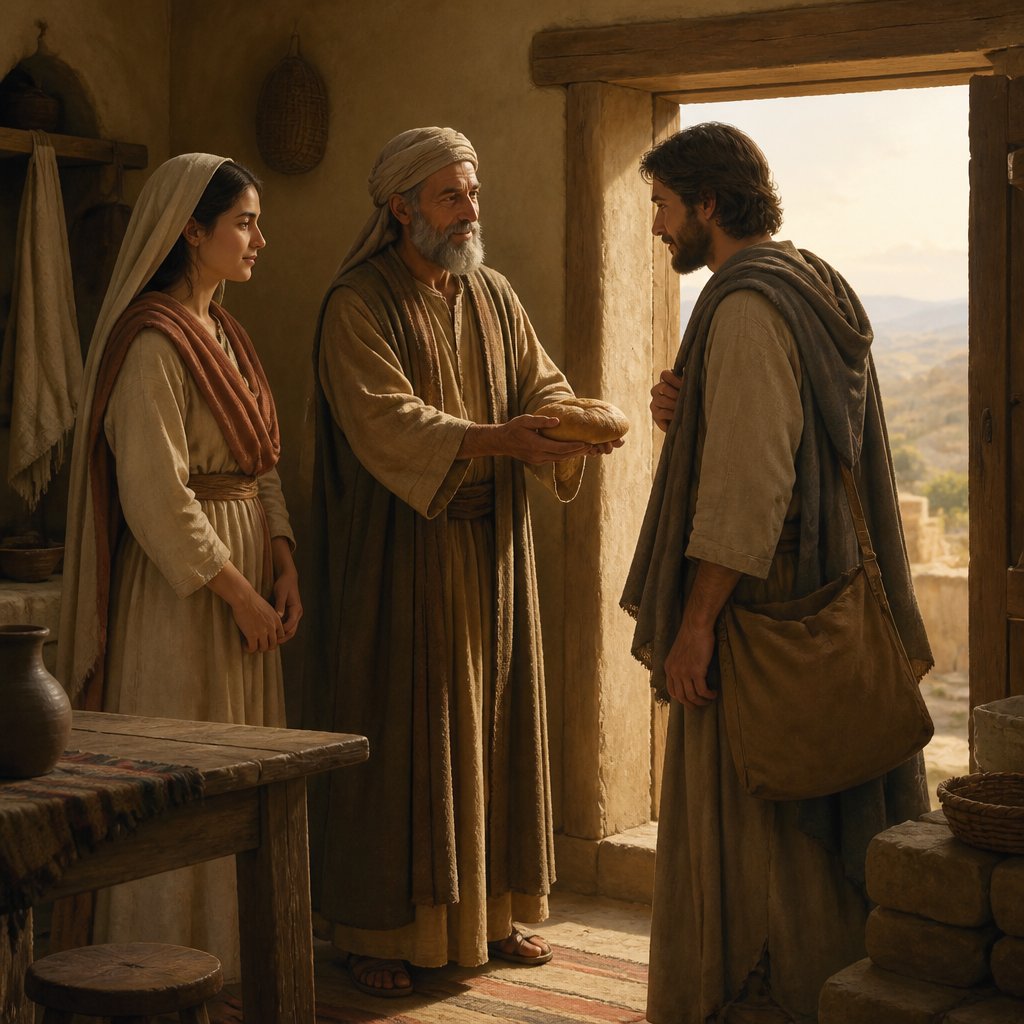
The verse Judges 19:5 from the King James Version of the Bible reads, "And it came to pass on the fourth day, when they arose early in the morning, that he rose up to depart: and the damsel's father said unto his son in law, Comfort thine heart with a morsel of bread, and afterward go your way."
This verse is part of a larger narrative found in the book of Judges, which tells the story of the Israelites during a time of moral and political chaos. The book of Judges follows a cyclical pattern of sin, oppression, repentance, and deliverance, and this verse comes in the midst of one of the darkest and most morally repugnant episodes in the book.
In this particular passage, a Levite traveler and his concubine are on their way home when they stop to rest in the city of Gibeah. The men of the city, driven by their own depravity, demand to have sex with the Levite, but instead, the Levite offers them his concubine, who is brutally raped and abused all night. The next morning, the Levite finds her lying at the door of the house and coldly tells her to get up so they can continue their journey. This verse follows this horrifying event, as the Levite and his concubine prepare to leave Gibeah.
The larger context of this verse is crucial for understanding its full meaning and impact. The story of the Levite and his concubine is a stark reflection of the moral decay and spiritual darkness that had gripped Israel during this period. The lack of hospitality, the sexual violence, and the callous treatment of the concubine all point to a society that had turned its back on God and had descended into horrific sin.
The verse Judges 19:5, in particular, reveals the callous attitude of the Levite towards his concubine. Despite the atrocities she had suffered, he is only concerned with leaving the city and shows little to no compassion or care for her well-being. The command of the concubine's father to "Comfort thine heart with a morsel of bread, and afterward go your way" highlights the lack of empathy and humanity exhibited by the men in this story.
The themes present in this verse are numerous and significant. The most prominent theme is the depravity of humanity and the consequences of turning away from God. The men of Gibeah's actions showcase the depth of moral decay and the dire consequences of forsaking God's moral law. The lack of hospitality and the heinous treatment of the concubine illustrate the breakdown of social norms and the prevalence of violence and immorality.
Furthermore, the verse also speaks to the theme of the mistreatment of women. The callousness of the Levite towards his concubine and her father's willingness to offer her up as a means of placating the men of Gibeah reflects the low status and lack of agency that women had in this society.
The symbolism in Judges 19:5 is also profound. The act of offering a "morsel of bread" to comfort the Levite before his departure can be seen as a metaphor for the superficial attempts at comfort and reconciliation in the face of unspeakable evil. The bread represents a token gesture of comfort and sustenance, but it ultimately falls short in addressing the deep wounds and trauma inflicted on the concubine.
In conclusion, Judges 19:5 is a powerful and disturbing verse that sheds light on the moral degradation and depravity that had taken hold of Israel during the time of the Judges. It serves as a somber reminder of the consequences of turning away from God and the dire effects of unchecked sin and immorality. The verse also serves as a call to action, challenging readers to stand against injustice and to show compassion and empathy towards those who have been victimized and marginalized.
Have questions about Judges 19:5?
Dive deeper into this scripture with Bible Chat — an AI-powered tool for exploring God's Word through conversation. Ask questions, get context, and grow in your understanding of the Bible.
Get Our Apps


Judges 19:5 Artwork

Judges 19:5 - "¶ And it came to pass on the fourth day, when they arose early in the morning, that he rose up to depart: and the damsel's father said unto his son in law, Comfort thine heart with a morsel of bread, and afterward go your way."
"¶ And it came to pass on the fourth day, when they arose early in the morning, that he rose up to depart: and the damsel's father said unto his son in law, Comfort thine heart with a morsel of bread, and afterward go your way." - Judges 19:5

2 Chronicles 19:5 - "¶ And he set judges in the land throughout all the fenced cities of Judah, city by city,"

Judges 5:19 - "The kings came and fought, then fought the kings of Canaan in Taanach by the waters of Megiddo; they took no gain of money."

"¶ And he set judges in the land throughout all the fenced cities of Judah, city by city," - 2 Chronicles 19:5

"The kings came and fought, then fought the kings of Canaan in Taanach by the waters of Megiddo; they took no gain of money." - Judges 5:19

Judges 5:7

Judges 20:19 - "And the children of Israel rose up in the morning, and encamped against Gibeah."

Judges 10:5 - "And Jair died, and was buried in Camon."

Judges 5:5 - "The mountains melted from before the LORD, even that Sinai from before the LORD God of Israel."

Judges 19:19 - "Yet there is both straw and provender for our asses; and there is bread and wine also for me, and for thy handmaid, and for the young man which is with thy servants: there is no want of any thing."

2 Chronicles 19:6 - "And said to the judges, Take heed what ye do: for ye judge not for man, but for the LORD, who is with you in the judgment."

Judges 5:1 - "Then sang Deborah and Barak the son of Abinoam on that day, saying,"

Judges 2:5 - "And they called the name of that place Bochim: and they sacrificed there unto the LORD."

"A false witness shall not be unpunished, and he that speaketh lies shall not escape." - Proverbs 19:5

Judges 5:20 - "They fought from heaven; the stars in their courses fought against Sisera."

Judges 5:22 - "Then were the horsehoofs broken by the means of the pransings, the pransings of their mighty ones."

Judges 19:14 - "And they passed on and went their way; and the sun went down upon them when they were by Gibeah, which belongeth to Benjamin."

Judges 19:7 - "And when the man rose up to depart, his father in law urged him: therefore he lodged there again."

Judges 19:26 - "Then came the woman in the dawning of the day, and fell down at the door of the man's house where her lord was, till it was light."

"And Jair died, and was buried in Camon." - Judges 10:5

Judges 5:29 - "Her wise ladies answered her, yea, she returned answer to herself,"

Judges 5:10 - "Speak, ye that ride on white asses, ye that sit in judgment, and walk by the way."

Judges 5:2 - "Praise ye the LORD for the avenging of Israel, when the people willingly offered themselves."

Judges 1:5 - "And they found Adoni-bezek in Bezek: and they fought against him, and they slew the Canaanites and the Perizzites."

Deuteronomy 19:18 - "And the judges shall make diligent inquisition: and, behold, if the witness be a false witness, and hath testified falsely against his brother;"

1 Corinthians 5:12 - "For what have I to do to judge them also that are without? do not ye judge them that are within?"

Judges 3:5 - "¶ And the children of Israel dwelt among the Canaanites, Hittites, and Amorites, and Perizzites, and Hivites, and Jebusites:"

Judges 19:21 - "So he brought him into his house, and gave provender unto the asses: and they washed their feet, and did eat and drink."

Judges 5:18 - "Zebulun and Naphtali were a people that jeoparded their lives unto the death in the high places of the field."