What does Judges 11:34 mean?
"¶ And Jephthah came to Mizpeh unto his house, and, behold, his daughter came out to meet him with timbrels and with dances: and she was his only child; beside her he had neither son nor daughter." - Judges 11:34
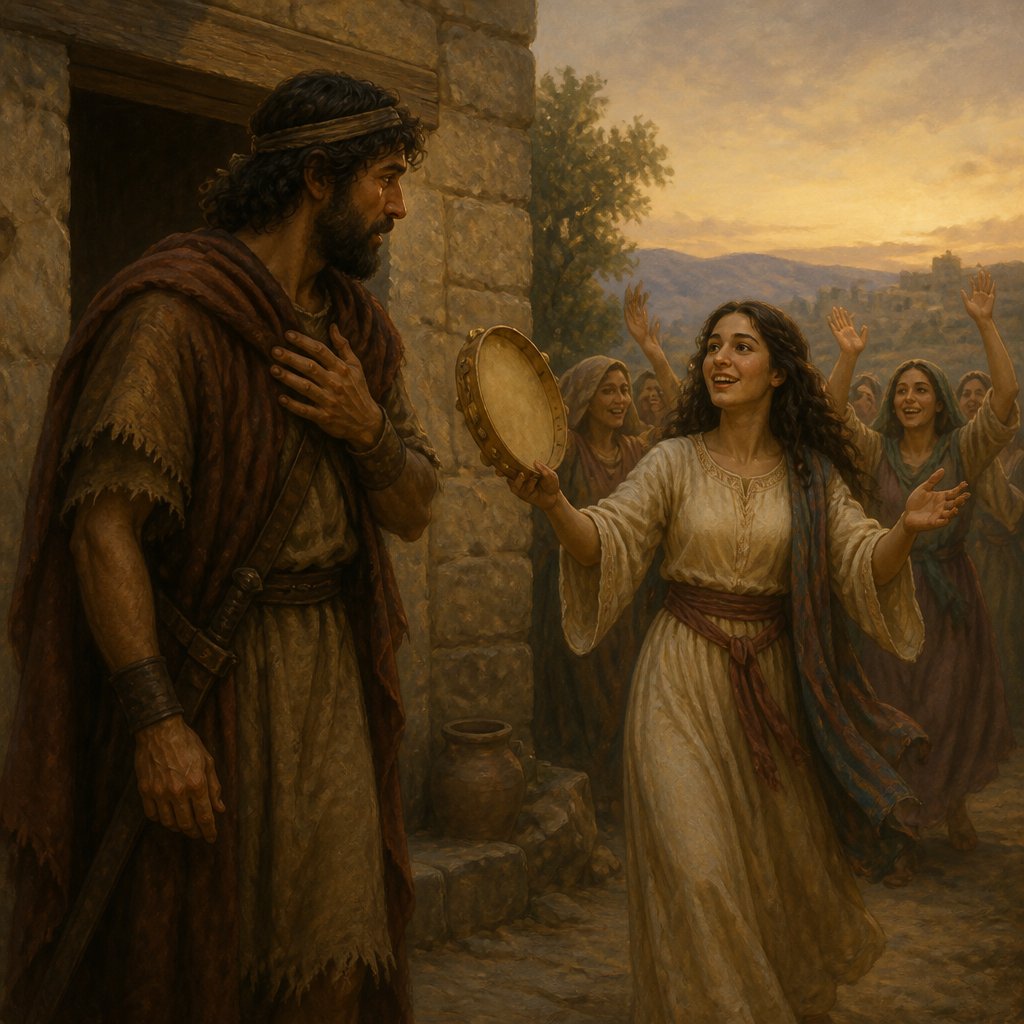
The Bible verse Judges 11:34 (KJV) reads, "And Jephthah came to Mizpeh unto his house, and, behold, his daughter came out to meet him with timbrels and with dances: and she was his only child; beside her he had neither son nor daughter."
This verse is a poignant moment in the story of Jephthah, a judge of Israel who made a tragic vow to the Lord and ultimately had to sacrifice his own daughter. The verse encapsulates the heart-wrenching scene of Jephthah's return home to his daughter, who joyfully comes out to greet him with timbrels and dances, only to face a fate that no father should ever have to endure.
The story of Jephthah as a judge of Israel is found in the book of Judges, which portrays a tumultuous period in Israel's history characterized by the cyclical pattern of disobedience, oppression, repentance, and deliverance. Jephthah, the son of a prostitute, was initially rejected by his half-brothers and driven away from his home. However, when the nation of Ammon waged war against Israel, the elders of Gilead sought out Jephthah's help, recognizing his prowess as a warrior.
In his desperation for victory, Jephthah made a rash vow to the Lord, promising to sacrifice the first thing that greeted him upon his return home if he emerged victorious from battle. Unfortunately, the first to come out to meet him was his beloved daughter, who he had not seen since he went off to war. Despite his anguish, Jephthah kept his vow, and his daughter willingly submitted to her fate, asking only for a brief respite to mourn her virginity before fulfilling her father's vow.
The verse Judges 11:34 (KJV) is a haunting portrayal of the aftermath of Jephthah's ill-considered vow. The mention of his daughter's joyful welcome with timbrels and dances intensifies the tragedy of her impending sacrifice. It emphasizes the stark contrast between her innocence and the grim fate that awaits her, as well as the depth of her father's sorrow and regret.
One of the central themes of this verse and the broader narrative of Jephthah is the weight of vows and the consequences of impulsive promises made to God. Jephthah's vow reflects his desperation and desire for victory, but it ultimately leads to a devastating outcome. It serves as a cautionary tale about the dangers of making hasty vows and the need for careful consideration before making commitments, especially to God.
The story of Jephthah and his daughter also raises profound questions about faith, obedience, and the nature of sacrifice. While Jephthah's commitment to fulfill his vow may be seen as an act of obedience to God, the tragedy of his daughter's sacrifice prompts reflection on the ethical and moral implications of such actions. It challenges the reader to grapple with the tension between religious devotion and human compassion, as well as the complexities of determining what constitutes true faithfulness to God.
Furthermore, the symbolism of Jephthah's daughter as his "only child" serves to underscore the irrevocable nature of the sacrifice. She represents not only his offspring but also the hope for continued legacy and posterity. Her untimely death signifies the abrupt end of her lineage and the agonizing loss for Jephthah, highlighting the profound and enduring consequences of his ill-fated vow.
In conclusion, Judges 11:34 (KJV) presents a poignant and thought-provoking moment in the biblical narrative of Jephthah, showcasing the tragic and far-reaching implications of his vow to the Lord. The verse serves as a powerful reminder of the importance of careful discernment in making commitments and the ethical complexities of faith and obedience. It challenges readers to consider the weight of their words and actions, as well as the delicate balance between devotion to God and the imperative of human compassion.
Have questions about Judges 11:34?
Dive deeper into this scripture with Bible Chat — an AI-powered tool for exploring God's Word through conversation. Ask questions, get context, and grow in your understanding of the Bible.
Get Our Apps


Judges 11:34 Artwork

Judges 11:34 - "¶ And Jephthah came to Mizpeh unto his house, and, behold, his daughter came out to meet him with timbrels and with dances: and she was his only child; beside her he had neither son nor daughter."
"¶ And Jephthah came to Mizpeh unto his house, and, behold, his daughter came out to meet him with timbrels and with dances: and she was his only child; beside her he had neither son nor daughter." - Judges 11:34

Judges 1:34 - "And the Amorites forced the children of Dan into the mountain: for they would not suffer them to come down to the valley:"

Judges 6:34 - "But the Spirit of the LORD came upon Gideon, and he blew a trumpet; and Abiezer was gathered after him."

Judges 9:34 - "¶ And Abimelech rose up, and all the people that were with him, by night, and they laid wait against Shechem in four companies."

Judges 8:34 - "And the children of Israel remembered not the LORD their God, who had delivered them out of the hands of all their enemies on every side:"

Judges 20:34 - "And there came against Gibeah ten thousand chosen men out of all Israel, and the battle was sore: but they knew not that evil was near them."

Nehemiah 11:34 - "Hadid, Zeboim, Neballat,"

Judges 12:11 - "¶ And after him Elon, a Zebulonite, judged Israel; and he judged Israel ten years."

1 Corinthians 11:31 - "For if we would judge ourselves, we should not be judged."

Job 31:11 - "For this is an heinous crime; yea, it is an iniquity to be punished by the judges."

"Hadid, Zeboim, Neballat," - Nehemiah 11:34

Ezekiel 34:22 - "Therefore will I save my flock, and they shall no more be a prey; and I will judge between cattle and cattle."

1 Chronicles 11:34 - "The sons of Hashem the Gizonite, Jonathan the son of Shage the Hararite,"

Psalms 148:11 - "Kings of the earth, and all people; princes, and all judges of the earth:"

Judges 2:11 - "¶ And the children of Israel did evil in the sight of the LORD, and served Baalim:"

Judges 11:14 - "And Jephthah sent messengers again unto the king of the children of Ammon:"

Numbers 11:34 - "And he called the name of that place Kibroth-hattaavah: because there they buried the people that lusted."

Judges 3:11 - "And the land had rest forty years. And Othniel the son of Kenaz died."

Judges 14:11 - "And it came to pass, when they saw him, that they brought thirty companions to be with him."

Images that depicts the verse Matthew 27:11-34

Romans 11:34 - "For who hath known the mind of the Lord? or who hath been his counsellor?"

Judges 11:11 - "Then Jephthah went with the elders of Gilead, and the people made him head and captain over them: and Jephthah uttered all his words before the LORD in Mizpeh."

Judges 11:4 - "¶ And it came to pass in process of time, that the children of Ammon made war against Israel."

Judges 11:27 - "Wherefore I have not sinned against thee, but thou doest me wrong to war against me: the LORD the Judge be judge this day between the children of Israel and the children of Ammon."

"And the Amorites forced the children of Dan into the mountain: for they would not suffer them to come down to the valley:" - Judges 1:34

Psalms 34:11 - "Come, ye children, hearken unto me: I will teach you the fear of the LORD."

Ezekiel 34:20 - "¶ Therefore thus saith the Lord GOD unto them; Behold, I, even I, will judge between the fat cattle and between the lean cattle."

Ezekiel 34:17 - "And as for you, O my flock, thus saith the Lord GOD; Behold, I judge between cattle and cattle, between the rams and the he goats."

Judges 17:11 - "And the Levite was content to dwell with the man; and the young man was unto him as one of his sons."