What does Jonah 2:3 mean?
"For thou hadst cast me into the deep, in the midst of the seas; and the floods compassed me about: all thy billows and thy waves passed over me." - Jonah 2:3
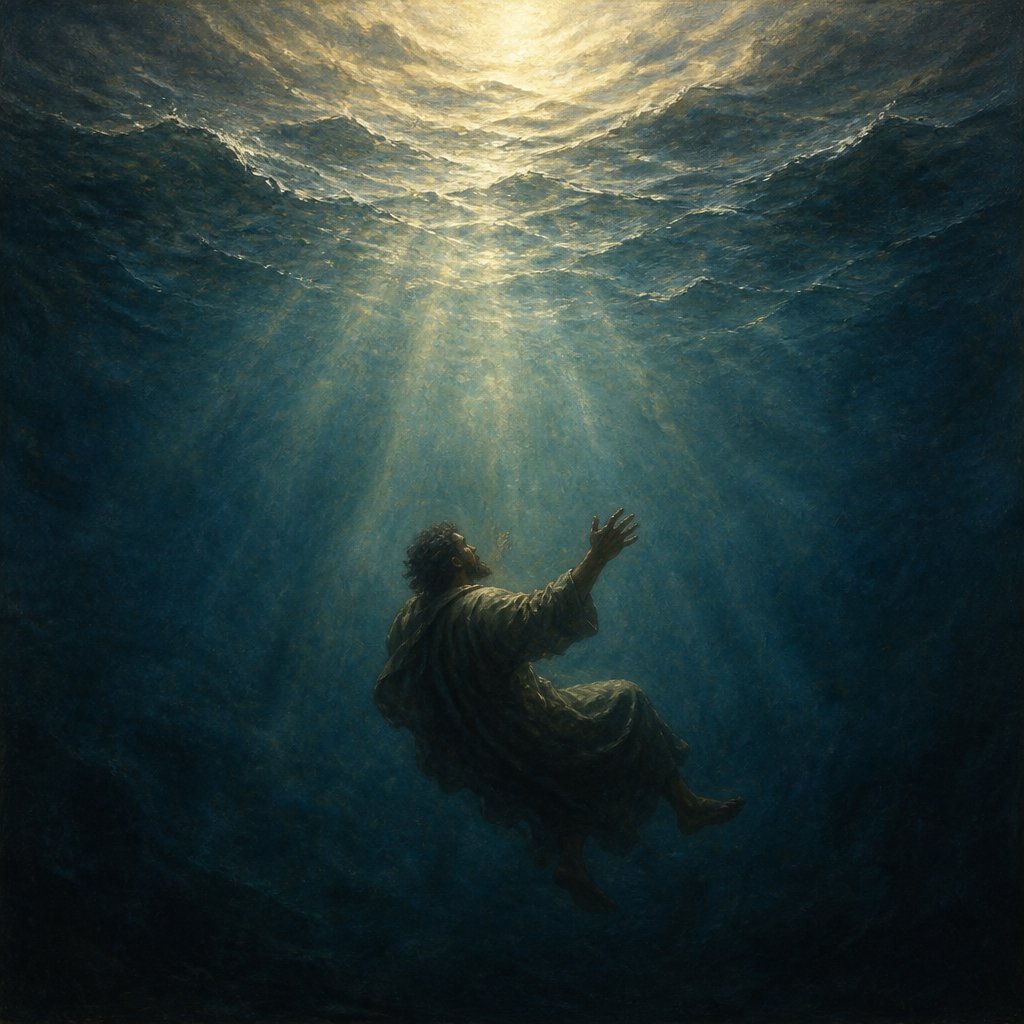
Jonah 2:3 in the King James Version reads, “For thou hadst cast me into the deep, in the midst of the seas; and the floods compassed me about: all thy billows and thy waves passed over me.” It comes from Jonah’s prayer “out of the fish’s belly,” after he has fled from the LORD’s command to preach against Nineveh, has been overtaken by a God-sent storm, and has been cast into the sea at his own request so the sailors might live. Chapter 2 is not a travelogue about marine survival so much as a spiritual testimony: Jonah is interpreting his near-death as the LORD’s direct dealing with him, and he speaks to God in the language of worship, confession, and Scripture-shaped lament.
The first great significance of the verse is its insistence on divine agency. Jonah does not say merely that the sailors threw him overboard or that the storm drove him down; he says to the LORD, “thou hadst cast me into the deep.” This is not Jonah accusing God of cruelty, but Jonah acknowledging sovereignty. The storm, the sailors’ decision, the sea itself—these are secondary means. Jonah recognizes the hand of God behind what happened, and in that recognition the prayer turns from panic into repentance. The same God Jonah tried to evade is the God Jonah must address, and Jonah’s choice of words shows that he now understands he cannot interpret his circumstances apart from the LORD’s rule. The verse therefore functions as a turning point: Jonah is no longer arguing with Providence by running from it; he is submitting to Providence by naming it.
At the same time, the verse is steeped in the Bible’s symbolic world of “the deep” and “the seas.” In Scripture, the sea regularly carries the sense of uncontrollable power, threat, and human helplessness. Jonah says he has been thrown “into the deep, in the midst of the seas,” a phrase that paints him as far from shore, beyond human rescue, swallowed by forces he cannot master. The “floods compassed me about” intensifies the image: he is surrounded, encircled, besieged. This is not merely wetness; it is captivity. Waters in biblical imagery can signify judgment and death, as in the Flood, and they can signify chaos that only God can restrain. Jonah’s language evokes both. He is being brought to the end of himself.
The line “all thy billows and thy waves passed over me” adds another layer: the waters are not random; they belong to God. Jonah calls them “thy billows” and “thy waves.” The sea becomes a kind of instrument in God’s hand. This is important because Jonah’s earlier flight was an attempt to preserve control—control over where he would go, whom he would speak to, and what kind of mercy God might show to Israel’s enemies. Now the sea strips that illusion away. If the waves are God’s waves, Jonah cannot negotiate with them; he must plead with their Owner. The verse thus presents chastening not as an accident but as purposeful discipline, and it portrays God’s judgment in a way that is personal and moral: Jonah is not simply in danger; he is being dealt with.
The verse also draws on the language and emotional cadence of the Psalms, where the righteous sufferer often describes trouble as drowning, being overwhelmed, or having waters go over the soul. Jonah’s prayer reads like a tapestry woven from Israel’s worship vocabulary, as though, in the moment of extremity, the only adequate speech he can find is the speech God has already given his people. That matters for interpretation because Jonah is not delivering a cold report; he is voicing a liturgical lament. He is confessing that he is overwhelmed, but he is doing so in faith, speaking to God rather than into the void. Even in describing judgment, the verse implies relationship: Jonah is close enough to God to call the waves “thy,” and honest enough to admit he is being overrun.
In context, Jonah 2:3 also highlights the paradox that runs through the whole book: God’s severe mercy. Jonah’s descent into “the deep” is real judgment, yet it is also the path by which Jonah is preserved. Being cast into the sea is what stops the storm for the sailors, and it is what leads to Jonah being appointed a strange refuge—the great fish. The imagery of drowning and being overwhelmed points to death, yet the chapter itself is a prayer of one who has not been abandoned. That tension is central to Jonah: God confronts sin, but God also pursues the sinner; God brings low, but God does so in order to restore and to send again.
Symbolically, Jonah’s being submerged under “billows” and “waves” is a picture of being overwhelmed by consequences and by the weight of God’s dealing, but it also foreshadows a kind of burial and return. Jonah’s three days and three nights in the fish (spoken of later in the book) has often been read, within the wider biblical storyline, as a sign of deliverance out of deathlike depths. Without leaving the KJV text of Jonah itself, the verse still functions as a “descent” motif: Jonah goes down into the sea, down into confinement, down to the place where life is not sustainable, and from there the LORD brings him up. Jonah 2:3 is therefore the verbal snapshot of that descent, the moment when the prophet admits he is under the waves.
Finally, the verse’s spiritual theme is the movement from self-will to surrendered truth. Jonah had tried to outrun God’s command; now he admits God’s hand in his crisis. He had resisted God’s compassion toward others; now he experiences God’s mercy toward himself in the very midst of judgment. Jonah 2:3 teaches that God’s sovereignty extends into the stormiest places, that human rebellion can lead to being overwhelmed, and that the proper response in the depths is not denial or bitterness but prayer that names God as God. In this way, the verse is not only about Jonah’s watery peril; it is about the LORD’s relentless governance and redemptive purpose working through the deep.
Have questions about Jonah 2:3?
Dive deeper into this scripture with Bible Chat — an AI-powered tool for exploring God's Word through conversation. Ask questions, get context, and grow in your understanding of the Bible.
Get Our Apps


Jonah 2:3 Artwork

Jonah 2:3 - "For thou hadst cast me into the deep, in the midst of the seas; and the floods compassed me about: all thy billows and thy waves passed over me."

"For thou hadst cast me into the deep, in the midst of the seas; and the floods compassed me about: all thy billows and thy waves passed over me." - Jonah 2:3
"For thou hadst cast me into the deep, in the midst of the seas; and the floods compassed me about: all thy billows and thy waves passed over me." - Jonah 2:3

Jonah 3:2 - "Arise, go unto Nineveh, that great city, and preach unto it the preaching that I bid thee."

Jonah 3:1 - "And the word of the LORD came unto Jonah the second time, saying,"

Jonah 3:3 - "So Jonah arose, and went unto Nineveh, according to the word of the LORD. Now Nineveh was an exceeding great city of three days' journey."

Jonah 2:2-9 Jonah praying in the belly of the fish.

Jonah 3:4 - "And Jonah began to enter into the city a day's journey, and he cried, and said, Yet forty days, and Nineveh shall be overthrown."

Jonah walking through the ancient city of Nineveh, preaching to the Assyrians. Jonah 3:4

Jonah 2:1 - "Then Jonah prayed unto the LORD his God out of the fish's belly,"

Jonah 2:10 - "¶ And the LORD spake unto the fish, and it vomited out Jonah upon the dry land."

Jonah 2:2

"And the word of the LORD came unto Jonah the second time, saying," - Jonah 3:1

Jonah 2:2-6 Jonah sinking down in the deep blue water, with the whale about to swallow him.

Jonah 2:2-8 Jonah praying in the belly if the fish - myst be realistic, no skeletons, weird teeth, etc.

Jonah 2:8

jonah 2:10 abstract

"Then Jonah prayed unto the LORD his God out of the fish's belly," - Jonah 2:1

"So Jonah arose, and went unto Nineveh, according to the word of the LORD. Now Nineveh was an exceeding great city of three days' journey." - Jonah 3:3

Jonah 2:4 Ship fit for the period in which Jonah lived. In daytime, great tempest, big waves, strong winds

"Arise, go unto Nineveh, that great city, and preach unto it the preaching that I bid thee." - Jonah 3:2

"¶ And the LORD spake unto the fish, and it vomited out Jonah upon the dry land." - Jonah 2:10

Jonah 1:3 - "But Jonah rose up to flee unto Tarshish from the presence of the LORD, and went down to Joppa; and he found a ship going to Tarshish: so he paid the fare thereof, and went down into it, to go with them unto Tarshish from the presence of the LORD."

Jonah 2:8 - "They that observe lying vanities forsake their own mercy."

"And Jonah began to enter into the city a day's journey, and he cried, and said, Yet forty days, and Nineveh shall be overthrown." - Jonah 3:4

Jonah 3:9 - "Who can tell if God will turn and repent, and turn away from his fierce anger, that we perish not?"

Jonah 3:5 - "¶ So the people of Nineveh believed God, and proclaimed a fast, and put on sackcloth, from the greatest of them even to the least of them."

Jonah 4:3 - "Therefore now, O LORD, take, I beseech thee, my life from me; for it is better for me to die than to live."

Jonah 1:2 - "Arise, go to Nineveh, that great city, and cry against it; for their wickedness is come up before me."

Jonah 2:9 - "But I will sacrifice unto thee with the voice of thanksgiving; I will pay that that I have vowed. Salvation is of the LORD."