What does John 9:37 mean?
"And Jesus said unto him, Thou hast both seen him, and it is he that talketh with thee." - John 9:37
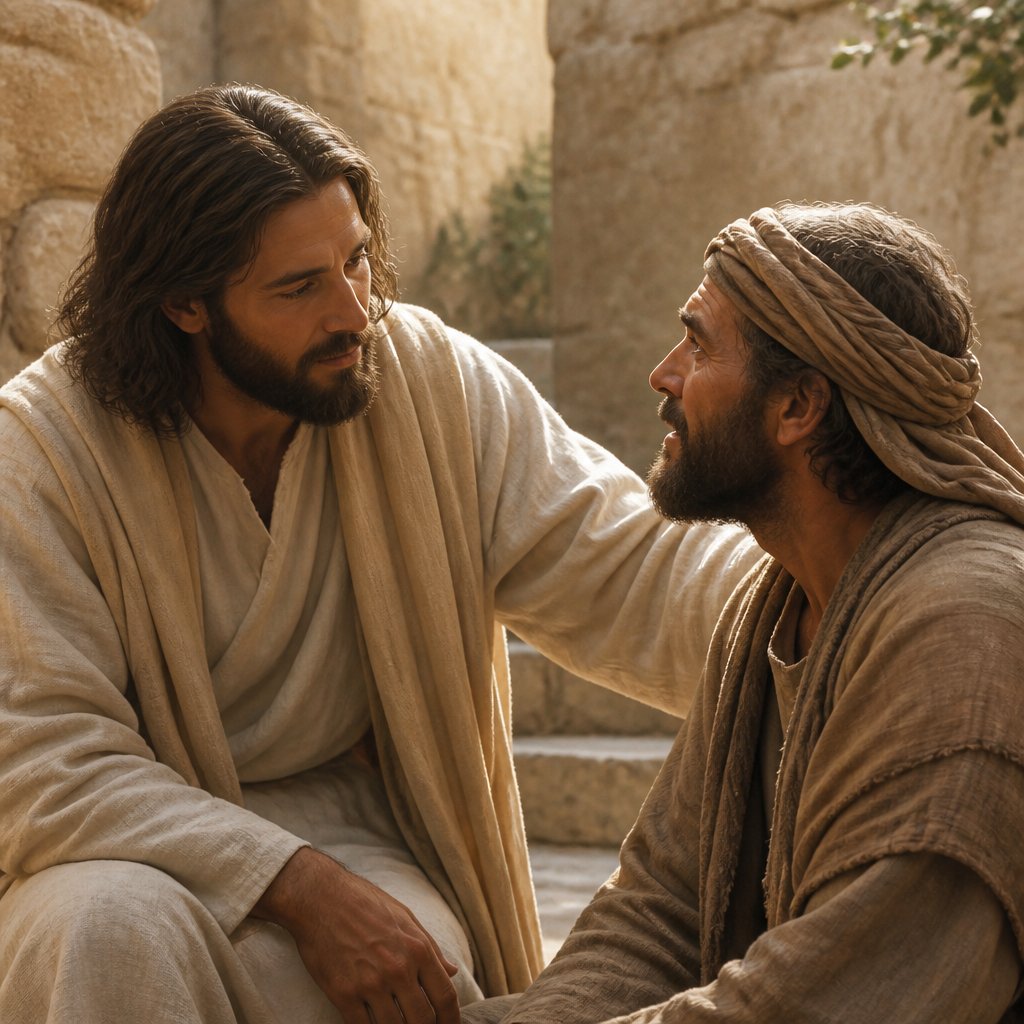
John 9:37 in the King James Version of the Bible reads, "And Jesus said unto him, Thou hast both seen him, and it is he that talketh with thee." This verse is part of a larger narrative in the Gospel of John, which recounts the story of Jesus healing a man who was born blind.
The healing of the blind man in John 9 is a powerful and significant miracle in the New Testament. The blind man's encounter with Jesus is an allegory for spiritual blindness and the transformative power of faith. The verse in question, Jesus' response to the blind man after he has been healed, holds profound meaning in the context of the story.
The blind man had been begging on the streets when Jesus and his disciples passed by. The disciples asked Jesus who had sinned for the man to be born blind - his parents or himself. Jesus replied that it was neither, but that the works of God should be made manifest in him. Jesus then proceeded to heal the blind man by spitting on the ground, making clay with the spit, and anointing the man's eyes with the clay. He then instructed the man to go wash in the pool of Siloam. The man did as Jesus commanded and was healed, thus gaining his sight for the first time in his life.
Upon being questioned by the Pharisees about his healing, the man proclaimed Jesus as a prophet. The Pharisees were divided on the matter and questioned the man again, leading to the man's bold and unwavering declaration of belief in Jesus as the Son of God. It is in this moment that Jesus responds to the man, saying, "Thou hast both seen him, and it is he that talketh with thee."
This verse holds several layers of symbolism and meaning. Firstly, it speaks to the physical healing of the blind man and his newfound ability to see. This healing can be interpreted as a metaphor for the spiritual healing and enlightenment that Jesus offers to all believers. The blind man's encounter with Jesus represents the journey from spiritual darkness to light, from ignorance to knowledge, and from unbelief to faith.
Furthermore, Jesus' response to the man underscores the significance of the man's newfound sight. Not only had he physically gained the ability to see, but he had also gained insight into the true nature of Jesus. In declaring his belief in Jesus as the Son of God, the blind man demonstrates profound spiritual insight and understanding. Jesus' words affirm the man's newfound faith and direct connection with the divine.
The larger context of the story and the verse also speaks to the theme of opposition and persecution. The blind man faced skepticism, interrogation, and even expulsion from the synagogue because of his faith in Jesus. This reflects the broader theme of conflict and division that runs throughout the Gospel of John, as Jesus' teachings and miracles often sparked controversy and opposition.
In conclusion, John 9:37 is a pivotal verse in the story of the healing of the blind man in the Gospel of John. It holds deep spiritual and symbolic meaning, serving as a powerful allegory for spiritual enlightenment, faith, and the transformative power of encountering Jesus. This verse underscores the profound impact of encountering Jesus and the significance of faith in the face of opposition and doubt. It serves as a reminder of the powerful and life-changing effects of encountering Christ and the impact of believing in Him.
Have questions about John 9:37?
Dive deeper into this scripture with Bible Chat — an AI-powered tool for exploring God's Word through conversation. Ask questions, get context, and grow in your understanding of the Bible.
Get Our Apps


John 9:37 Artwork

John 9:37 - "And Jesus said unto him, Thou hast both seen him, and it is he that talketh with thee."
"And Jesus said unto him, Thou hast both seen him, and it is he that talketh with thee." - John 9:37

John 7:37-39

John 7:37-39

John 6:37

john 1:37

john 1:37 come and see

john 1:37 come and see

John 4:37 - "And herein is that saying true, One soweth, and another reapeth."

John 1:37 - "And the two disciples heard him speak, and they followed Jesus."

John 10:37 - "If I do not the works of my Father, believe me not."

Acts 15:37 - "And Barnabas determined to take with them John, whose surname was Mark."

Mark 9:36-37

Matthew 9:37-38

John 19:37 - "And again another scripture saith, They shall look on him whom they pierced."

1 Chronicles 9:37 - "And Gedor, and Ahio, and Zechariah, and Mikloth."

Mark 5:37 - "And he suffered no man to follow him, save Peter, and James, and John the brother of James."

Job 37:9 - "Out of the south cometh the whirlwind: and cold out of the north."

John 12:37 - "¶ But though he had done so many miracles before them, yet they believed not on him:"

John 6:37 - "All that the Father giveth me shall come to me; and him that cometh to me I will in no wise cast out."

John 8:37 - "I know that ye are Abraham's seed; but ye seek to kill me, because my word hath no place in you."

Matthew 9:37 - "Then saith he unto his disciples, The harvest truly is plenteous, but the labourers are few;"

"If I do not the works of my Father, believe me not." - John 10:37

"And the two disciples heard him speak, and they followed Jesus." - John 1:37

John 11:37 - "And some of them said, Could not this man, which opened the eyes of the blind, have caused that even this man should not have died?"

"And herein is that saying true, One soweth, and another reapeth." - John 4:37

Psalms 37:9 - "For evildoers shall be cut off: but those that wait upon the LORD, they shall inherit the earth."

"And Gedor, and Ahio, and Zechariah, and Mikloth." - 1 Chronicles 9:37

John 7:37 - "In the last day, that great day of the feast, Jesus stood and cried, saying, If any man thirst, let him come unto me, and drink."

Acts 10:37 - "That word, I say, ye know, which was published throughout all Judaea, and began from Galilee, after the baptism which John preached;"