What does John 6:40 mean?
"And this is the will of him that sent me, that every one which seeth the Son, and believeth on him, may have everlasting life: and I will raise him up at the last day." - John 6:40
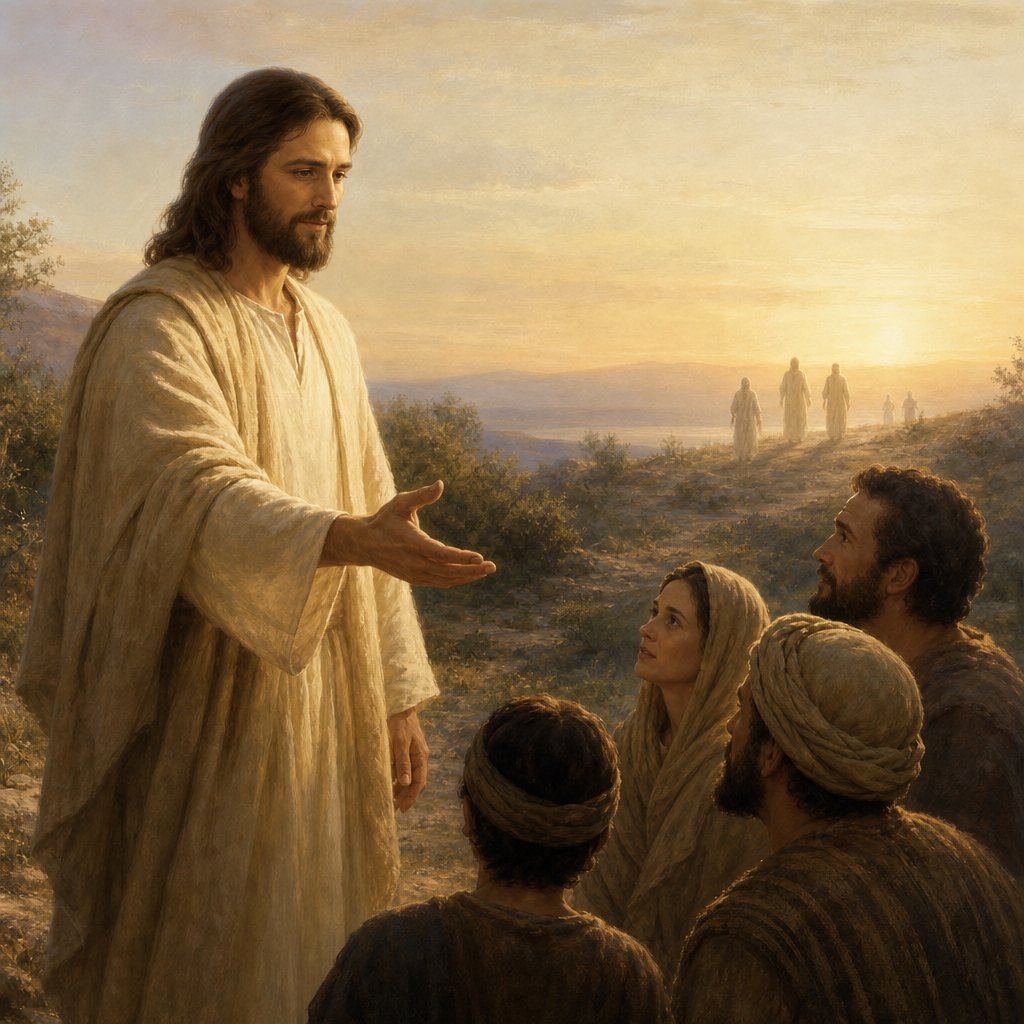
John 6:40 in the King James Version reads, “And this is the will of him that sent me, that every one which seeth the Son, and believeth on him, may have everlasting life: and I will raise him up at the last day.” In plain terms, Jesus declares what the Father’s will is: that the person who truly “seeth the Son” and “believeth on him” is granted “everlasting life,” and that Jesus himself will “raise him up at the last day.” The verse is not presented as a private spiritual insight but as a stated purpose, a divine intention, tied to both present faith and future resurrection.
The immediate context of John 6 matters. The chapter opens with the feeding of the five thousand and then Jesus walking on the sea. Those signs draw a crowd that follows him, but their interest is tangled with appetite and expectation. They ask for bread, they recall Moses and the manna, and Jesus answers by shifting the entire conversation from temporary food to the true “bread of life.” The argument of the chapter presses on the difference between seeking Christ for what he gives and coming to Christ for who he is. John 6:40 stands inside Jesus’ explanation of why people must come to him in faith, and why that faith is not merely a momentary enthusiasm but a God-directed response that carries into eternity. He is answering not only hunger, but misunderstanding: the crowd wants a sign they can manage and measure, and Jesus points them to the Father’s will and to the Son as the object of saving faith.
When Jesus says, “this is the will of him that sent me,” he is speaking as the One commissioned by the Father. The phrase “him that sent me” is a hallmark of John’s Gospel and emphasizes that Jesus is not acting independently, as though offering a private religious scheme, but carrying out the Father’s saving purpose. This provides a framework for assurance: salvation is not rooted in human inventiveness or fluctuating religious performance, but in the expressed will of God. The verse is shaped like a promise anchored in divine intent: it is God’s will that believers have everlasting life, and it is Christ’s commitment to raise them.
The key words “every one” widen the scope. Jesus does not restrict the promise to a social class, a nationality, or a spiritual elite. The reach is universal in invitation, even if the response is personal. Yet the universality is not vague; it is attached to a specific object of faith: “the Son.” In John, the identity of Jesus is not merely that of a teacher but the unique Son, the one in whom God is made known. So the verse is not saying that any general religious optimism results in life, but that life is tied to seeing and believing in the Son whom the Father sent.
The expression “seeth the Son” is rich in Johannine symbolism. In John, “seeing” is often more than physical sight; it is perception, recognition, and spiritual apprehension. Many in the chapter physically see Jesus, hear his voice, and yet do not truly “see” him in the sense meant here. To “see the Son” is to behold him as he is revealed: the Bread of life, the One sent from heaven, the giver of life. The verse therefore speaks to revelation. Faith is not blind in the sense of having no object; it is a response to the Son made known. “Seeth” also suggests encounter. Christianity in John is not first a system of ideas but a meeting with a person. Yet it is a meeting that requires the eyes of the heart, because the crowd that saw miracles could still miss the meaning of the Miracle-worker.
“Believeth on him” continues that idea. In the KJV phrasing, believing “on” Christ conveys not just agreement with statements about him, but reliance and trust placed into him. John’s Gospel repeatedly presents belief as the dividing line between life and condemnation, light and darkness, receiving and rejecting. Here belief is the means by which the Father’s will is fulfilled in the individual: the believer is the one who comes to Christ as the true source of life, not merely the provider of loaves.
The promise attached to seeing and believing is “everlasting life.” In John, everlasting life is both a present possession and a future hope. It begins now as a quality of life rooted in knowing God through Christ, and it continues beyond death without end. John 6 repeatedly joins life language to Jesus as bread, meaning that Christ is not only the gateway to life but the sustaining nourishment of it. The crowd’s concern is daily bread; Jesus answers with life that does not spoil, a life that death cannot cancel. “Everlasting” also confronts the temporary nature of miracles and material provision. The loaves are eaten and gone. Everlasting life is of a different order.
Then Jesus adds, “and I will raise him up at the last day.” This clause gives the verse a strong eschatological horizon. The Christian hope is not only the survival of the soul but the resurrection. John 6 repeats this refrain several times, emphasizing that the destiny of the believer is bodily restoration and final vindication at God’s appointed time. The phrase “the last day” ties personal faith to the great concluding act of history when God’s purposes are brought to completion. It also makes Christ’s authority unmistakable: Jesus does not say merely that the Father will raise, but “I will raise him up.” In the setting of the chapter, this claim is part of Jesus’ self-revelation as the One who gives life, the One upon whom final destiny depends. The promise is not generic; it is personal and active: Christ pledges his own action toward the believer at the end.
This resurrection promise also balances the present experience of faith. Believers may still face hunger, suffering, and death in this world; John 6:40 does not deny that. Instead, it locates the believer’s life within a larger story: present trust in the Son leads to a life that cannot ultimately be taken away, and the final answer to death is resurrection. The verse therefore carries pastoral weight. It provides assurance that faith is not wasted, that death is not the final word, and that Christ’s commitment extends beyond the grave.
Symbolically, John 6 as a whole is saturated with Passover overtones. The feeding sign occurs near the Passover, and the discussion of bread evokes Israel’s wilderness manna. Against that background, “seeth the Son” can be heard as the counterpart to Israel seeing God’s provision in the wilderness, yet now the provision is not a thing but a person. Where manna sustained life for a day, the Son gives everlasting life. Where the wilderness generation still died, the believer is raised at the last day. The symbolism moves from shadow to substance: bread that perishes to bread that endures, a deliverance from Egypt to a deliverance from death, a prophet like Moses to the Son sent by the Father.
The significance of John 6:40, then, is that it condenses the Gospel in one sentence: God’s will is saving, Christ is the revealed object of faith, faith is the human response to divine revelation, everlasting life is the gift, and resurrection at the last day is the promised completion. It shows that Christianity is not merely moral improvement or religious ceremony, but a God-willed salvation centered on the Son, granting life that begins in believing and ends in being raised by Christ himself.
Have questions about John 6:40?
Dive deeper into this scripture with Bible Chat — an AI-powered tool for exploring God's Word through conversation. Ask questions, get context, and grow in your understanding of the Bible.
Get Our Apps


John 6:40 Artwork

John 6:40

John 6:40

John 6:40 - "And this is the will of him that sent me, that every one which seeth the Son, and believeth on him, may have everlasting life: and I will raise him up at the last day."
"And this is the will of him that sent me, that every one which seeth the Son, and believeth on him, may have everlasting life: and I will raise him up at the last day." - John 6:40

John 1:40 - "One of the two which heard John speak, and followed him, was Andrew, Simon Peter's brother."

John 10:40 - "And went away again beyond Jordan into the place where John at first baptized; and there he abode."

John 5:40 - "And ye will not come to me, that ye might have life."

Psalm 40:6

John 7:40 - "¶ Many of the people therefore, when they heard this saying, said, Of a truth this is the Prophet."

John 18:40 - "Then cried they all again, saying, Not this man, but Barabbas. Now Barabbas was a robber."

John 19:40 - "Then took they the body of Jesus, and wound it in linen clothes with the spices, as the manner of the Jews is to bury."

John 6:39-40 - "And this is the will of him who sent me, that I shall lose none of all those he has given me, but raise them up at the last day. For my Father’s will is that everyone who looks to the Son and believes in him shall have eternal life, and I will raise them up at the last day."

Mark 6:40 - "And they sat down in ranks, by hundreds, and by fifties."

John 9:40 - "And some of the Pharisees which were with him heard these words, and said unto him, Are we blind also?"

Job 40:6 - "¶ Then answered the LORD unto Job out of the whirlwind, and said,"

1 Chronicles 6:40 - "The son of Michael, the son of Baaseiah, the son of Malchiah,"

"And went away again beyond Jordan into the place where John at first baptized; and there he abode." - John 10:40

Judges 6:36-40 – Gideon’s fleece test for dew.

"And ye will not come to me, that ye might have life." - John 5:40

John 11:40 - "Jesus saith unto her, Said I not unto thee, that, if thou wouldest believe, thou shouldest see the glory of God?"

Luke 6:40 - "The disciple is not above his master: but every one that is perfect shall be as his master."

"One of the two which heard John speak, and followed him, was Andrew, Simon Peter's brother." - John 1:40

Judges 6:40 - "And God did so that night: for it was dry upon the fleece only, and there was dew on all the ground."

Exodus 40:6 - "And thou shalt set the altar of the burnt offering before the door of the tabernacle of the tent of the congregation."

John 4:40 - "So when the Samaritans were come unto him, they besought him that he would tarry with them: and he abode there two days."

John 8:40 - "But now ye seek to kill me, a man that hath told you the truth, which I have heard of God: this did not Abraham."

John 12:40 - "He hath blinded their eyes, and hardened their heart; that they should not see with their eyes, nor understand with their heart, and be converted, and I should heal them."

Genesis 40:6 - "And Joseph came in unto them in the morning, and looked upon them, and, behold, they were sad."

"And they sat down in ranks, by hundreds, and by fifties." - Mark 6:40
John 1:6 - "¶ There was a man sent from God, whose name was John."