What does John 6:12 mean?
"When they were filled, he said unto his disciples, Gather up the fragments that remain, that nothing be lost." - John 6:12

John 6:12 (KJV) states, "When they were filled, he said unto his disciples, Gather up the fragments that remain, that nothing be lost." This verse is part of the narrative of Jesus feeding the five thousand, one of the most well-known miracles in the New Testament. This verse occurs after Jesus has miraculously multiplied five loaves and two fishes to feed the great crowd that had gathered to hear him speak. After everyone had eaten their fill, Jesus instructs his disciples to gather up the leftover fragments so that nothing goes to waste.
This verse carries several important themes and messages that are relevant to both the immediate context of the story and the broader Christian tradition. First and foremost, it demonstrates the compassion and concern for others that Jesus consistently displayed throughout his ministry. Despite having just performed a miraculous feeding, Jesus is still conscientious about not wasting any of the food that has been provided. This illustrates a sense of stewardship and responsibility that aligns with the idea of caring for others and being mindful of the resources that have been given to us.
The idea of not wasting resources ties into a broader theme of stewardship and God's provision. Throughout the Bible, believers are called to be good stewards of the gifts and resources that God has given to them. This includes not only material possessions, but also our time, talents, and relationships. In the context of the feeding of the five thousand, the leftover food serves as a reminder of God's abundant provision and the importance of using those provisions wisely.
Additionally, this verse also serves as a metaphor for the spiritual nourishment that Jesus provides. The gathering of the remaining fragments can be seen as a symbol of gathering and spreading the teachings and miracles of Jesus. Just as the physical food sustained the crowd, the spiritual teachings of Jesus provide sustenance for the soul. The idea of not letting anything be lost can be viewed as a call to preserve and pass on the message of Christ to future generations, ensuring that nothing of value is wasted or forgotten.
Furthermore, this verse can also be interpreted as a call to unity and community. The act of gathering the fragments together underscores the idea of working together and leaving no one behind. Just as the disciples were instructed to gather the leftover food, Christians are called to care for one another and work towards the common good. This message of unity and inclusivity is a central aspect of Jesus' teachings and is echoed throughout the New Testament.
In a broader theological sense, this verse also points towards the idea of restoration and redemption. In a world filled with brokenness and decay, the image of gathering up the fragments that remain can be seen as a symbol of God's ability to bring order out of chaos and to redeem that which is lost. This ties into the broader theme of God's redemptive work through Jesus Christ, bringing hope and renewal to a fallen world.
In conclusion, John 6:12 from the King James Version of the Bible carries deep and multifaceted meanings that resonate with both the immediate context of the story and the broader themes of Christian faith. It speaks to the compassion and stewardship that Jesus embodied, the spiritual nourishment and unity that he provides, and the broader theological themes of restoration and redemption. This verse serves as a powerful reminder of the transformative power of God's love and provision, and the responsibility that believers carry to embody those values in their own lives.
Have questions about John 6:12?
Dive deeper into this scripture with Bible Chat — an AI-powered tool for exploring God's Word through conversation. Ask questions, get context, and grow in your understanding of the Bible.
Get Our Apps


John 6:12 Artwork
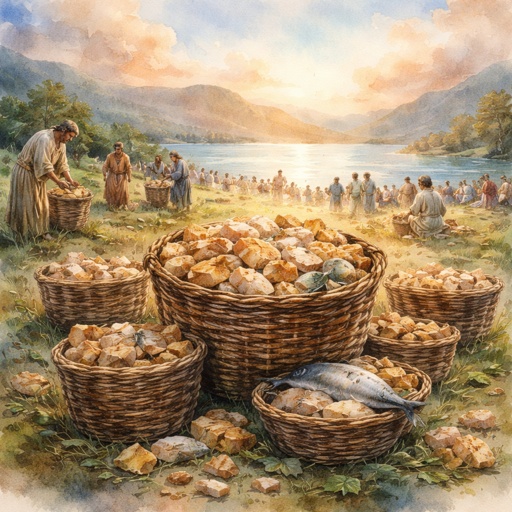
John 6:12

John 6:12 - "When they were filled, he said unto his disciples, Gather up the fragments that remain, that nothing be lost."

"When they were filled, he said unto his disciples, Gather up the fragments that remain, that nothing be lost." - John 6:12

John 12:6 - "This he said, not that he cared for the poor; but because he was a thief, and had the bag, and bare what was put therein."

John 1:6 - "¶ There was a man sent from God, whose name was John."

John 6:63

John 6:63

John 8:12

John 6:63

John 6:63

"This he said, not that he cared for the poor; but because he was a thief, and had the bag, and bare what was put therein." - John 12:6

John 12:25

John 8:12

John 8:12

John 12:3

John 8:12

John 6:40

John 21:6

John 14:6

John 20:11-12

John 21:6

John 6:16

John 6:37

John 21:6

John 6:40

John 21:6

John 12:12 - "¶ On the next day much people that were come to the feast, when they heard that Jesus was coming to Jerusalem,"

John 6:8-9

JOHN 6:11-13

John 6:6 - "And this he said to prove him: for he himself knew what he would do."