What does John 4:28 mean?
"The woman then left her waterpot, and went her way into the city, and saith to the men," - John 4:28
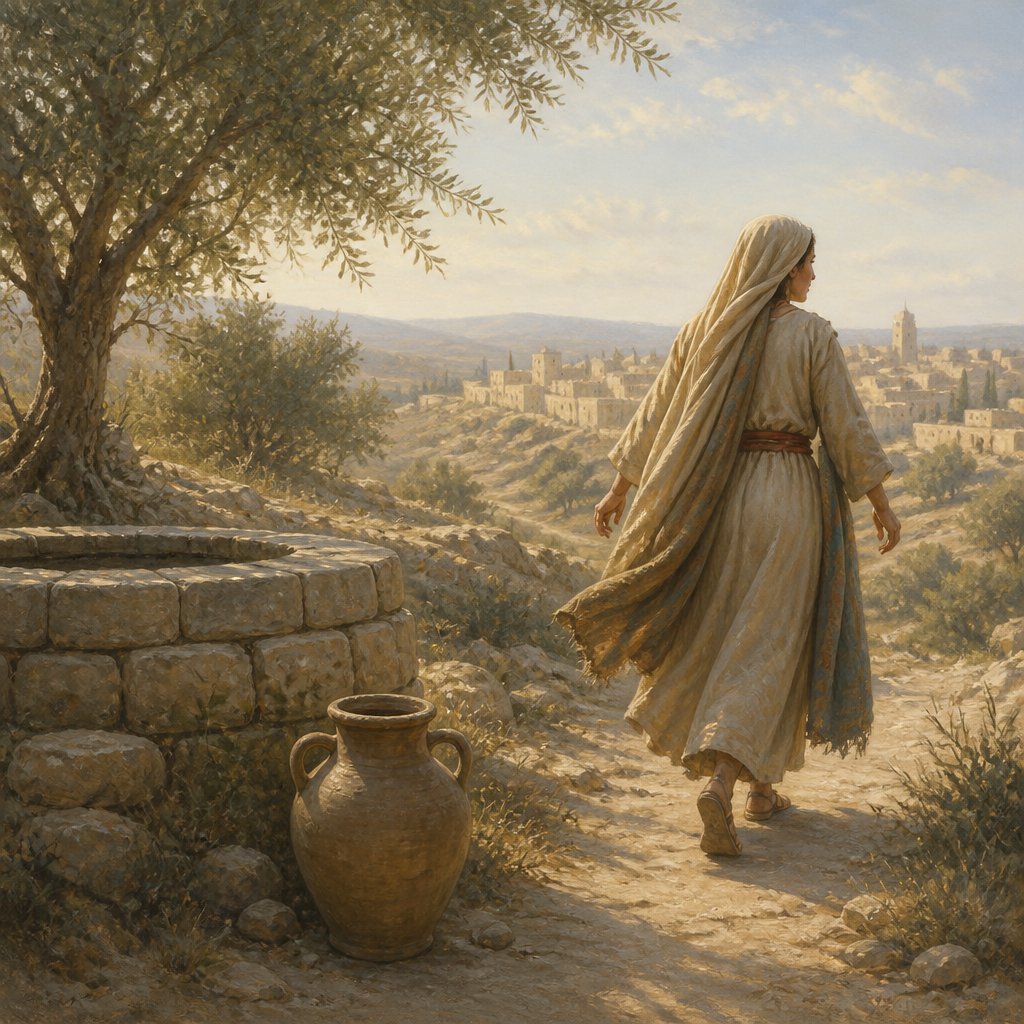
John 4:28 (KJV) reads, "The woman then left her waterpot, and went her way into the city, and saith to the men."
This verse is part of the story of Jesus and the Samaritan woman, found in John 4:1-42. In this story, Jesus and his disciples are traveling through Samaria, and they stop at a well. Jesus is tired and thirsty, so he sits by the well while his disciples go to buy food. While Jesus is sitting there, a Samaritan woman comes to draw water from the well. Jesus asks her for a drink, and they begin to have a conversation. This is a significant interaction because Samaritans and Jews were not supposed to have any contact with each other. The woman is surprised that Jesus, a Jew, would talk to her, a Samaritan, and she asks him why he would do so. Jesus responds by telling her that if she knew who he was, she would ask him for living water, which would satisfy her thirst forever.
The woman then asked for this living water, and Jesus told her to go get her husband. She admitted that she did not have a husband, and Jesus revealed that he knew she had had five husbands and was currently living with a man who was not her husband. The woman was amazed by Jesus' knowledge of her life and recognized him as a prophet.
This brings us to our verse, John 4:28. After her encounter with Jesus, the woman left her waterpot and went back to the city to tell the men about Jesus. This action symbolizes her leaving behind her old way of life and her immediate priorities in order to share the good news she had received. She was so moved by her encounter with Jesus that she felt compelled to tell others about him.
One of the key themes of this verse and the surrounding story is the idea of transformation. The Samaritan woman started out as an outcast in her society, looked down upon by others because of her lifestyle. But after encountering Jesus, she was transformed. She left her old life behind and became an evangelist, spreading the news of Jesus to those around her. This speaks to the transformative power of Jesus' love and grace, and how encountering him can change a person's life in profound ways.
Another important theme in this passage is the idea of reaching out to those who are different from us. Jesus defied the social norms of his time by engaging in a conversation with a Samaritan woman. This challenges us to consider how we interact with those who may be different from us, and to recognize the value and worth of every individual, regardless of their background or circumstances.
The symbolism in this verse is also significant. The woman leaving her waterpot represents her leaving behind her old way of life and priorities. The waterpot was a necessary tool for her daily life, but after encountering Jesus, it paled in comparison to the message she had received. This is a powerful illustration of the transformative power of the gospel and how it can cause us to leave behind our old ways and embrace a new life in Christ.
In conclusion, John 4:28 is a verse that is rich in meaning and depth. It tells the story of a woman whose life was transformed by encountering Jesus, and who was so moved by this experience that she felt compelled to share it with others. This verse challenges us to consider the transformative power of the gospel and the importance of reaching out to those who are different from us. It also serves as a reminder of the value and worth of every individual, and how encountering Jesus can change a person's life in profound ways.
Have questions about John 4:28?
Dive deeper into this scripture with Bible Chat — an AI-powered tool for exploring God's Word through conversation. Ask questions, get context, and grow in your understanding of the Bible.
Get Our Apps


John 4:28 Artwork

John 4:28 - "The woman then left her waterpot, and went her way into the city, and saith to the men,"
"The woman then left her waterpot, and went her way into the city, and saith to the men," - John 4:28

John 14:28

John 5:28

John 5:28

John 5:28

John 1:28 - "These things were done in Bethabara beyond Jordan, where John was baptizing."

Mark 8:28 - "And they answered, John the Baptist: but some say, Elias; and others, One of the prophets."

"These things were done in Bethabara beyond Jordan, where John was baptizing." - John 1:28

Exodus 28:4

Exodus 28:4

John 20:28 - "And Thomas answered and said unto him, My Lord and my God."

John 5:28 - "Marvel not at this: for the hour is coming, in the which all that are in the graves shall hear his voice,"

John 13:28 - "Now no man at the table knew for what intent he spake this unto him."

John 9:28 - "Then they reviled him, and said, Thou art his disciple; but we are Moses' disciples."

Exodus 28:4

Exodus 28:4

John 6:28 - "Then said they unto him, What shall we do, that we might work the works of God?"

John 4:4 - "And he must needs go through Samaria."

Ezekiel 1:4-28

John 4:16

John 3:4

John 4:16

John 4:16

John 4:16

John 4:16

John 16:28 - "I came forth from the Father, and am come into the world: again, I leave the world, and go to the Father."

Daniel 4:28 - "¶ All this came upon the king Nebuchadnezzar."

Ezekiel 1:4-28 – The vision of the four living creatures and the wheels.

John 19:28 - "¶ After this, Jesus knowing that all things were now accomplished, that the scripture might be fulfilled, saith, I thirst."