What does John 19:21 mean?
"Then said the chief priests of the Jews to Pilate, Write not, The King of the Jews; but that he said, I am King of the Jews." - John 19:21
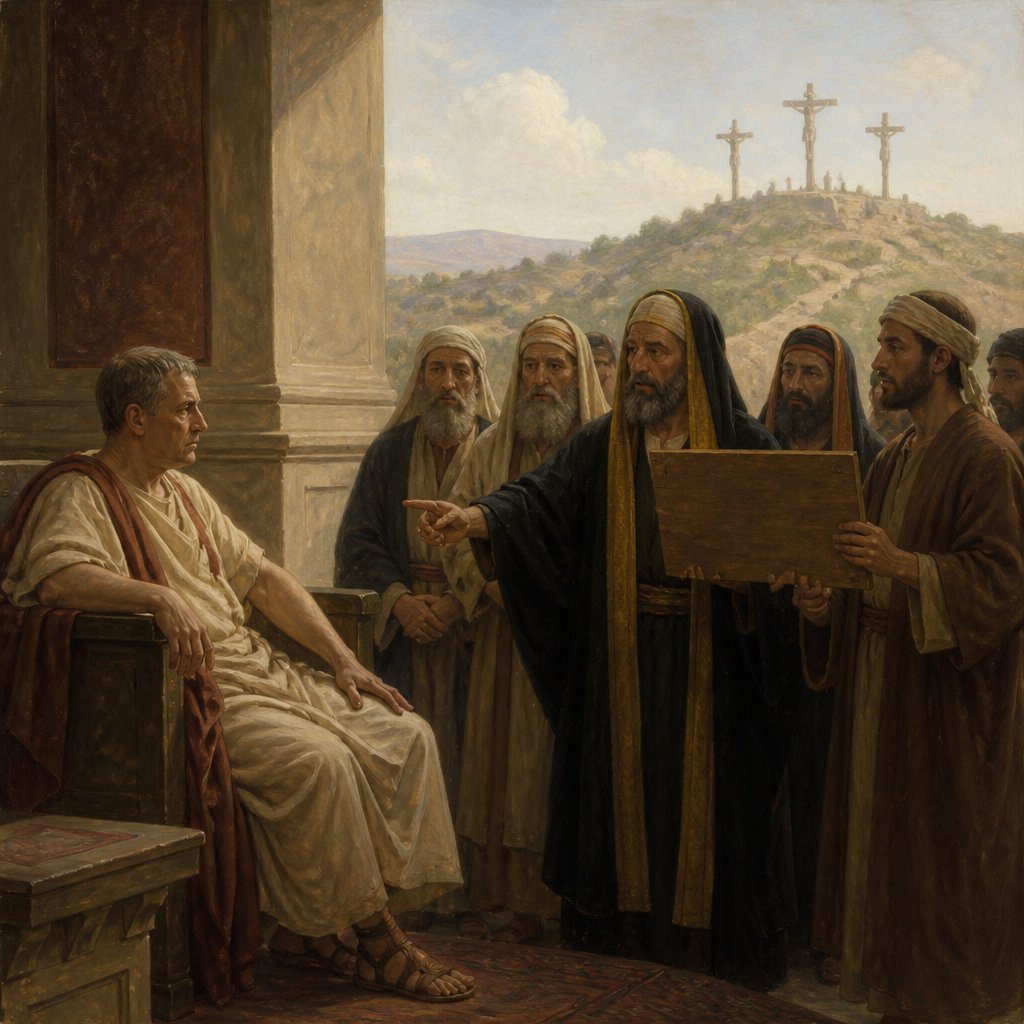
John 19:21 (KJV) states, "Then said the chief priests of the Jews to Pilate, Write not, The King of the Jews; but that he said, I am King of the Jews."
This verse comes from the Gospel of John, which is the fourth book of the New Testament. It is part of the account of Jesus' crucifixion, and it specifically relates to the conversation between the chief priests of the Jews and Pontius Pilate, the Roman governor, during the events leading up to Jesus' death on the cross.
In this context, the chief priests of the Jews are pressuring Pilate to change the inscription that will be placed above Jesus' head on the cross. They request that instead of stating "The King of the Jews," it should read "He said, I am King of the Jews." The reason for this is that the chief priests did not recognize Jesus as their king and did not want to acknowledge him as such. However, Pilate stands firm and refuses to change the wording, affirming Jesus' identity as the King of the Jews.
The verse conveys a powerful message about the conflicting perceptions of Jesus' identity. While the religious authorities reject him as their king, Pilate, a secular ruler, recognizes and affirms his kingship. This highlights the spiritual blindness and refusal to accept Jesus' true nature on the part of the Jewish leaders.
From a broader thematic perspective, this verse speaks to the sovereignty and kingship of Jesus. Throughout the Gospels, Jesus is proclaimed as the long-awaited Messiah and the King of Kings. His crucifixion, while appearing to be a defeat, is actually the ultimate display of his kingship. By willingly laying down his life for humanity, Jesus shows his authority and power as the true King, who ultimately triumphs over sin and death.
The interaction between the chief priests and Pilate also reveals the political dynamics at play during Jesus' time. The tension between the Jewish religious leaders and the Roman authorities reflects the complex and volatile atmosphere in Jerusalem. It also foreshadows the larger conflict between the Jewish people and the Roman Empire, which would eventually lead to the destruction of the Temple and the city of Jerusalem in 70 AD.
Symbolically, the inscription on the cross serves as a profound statement about Jesus' identity and mission. The title "King of the Jews" not only signifies Jesus' royal lineage as a descendant of David but also points to his universal reign as the Savior of all humanity. His crucifixion is the ultimate act of selfless love and sacrifice, demonstrating his kingship as one of service and redemption.
In conclusion, John 19:21 holds deep theological, historical, and symbolic significance within the larger narrative of Jesus' crucifixion. It illuminates the conflicting perceptions of Jesus' kingship, the political dynamics of the time, and the profound truth of Jesus' ultimate reign as the King of Kings. This verse serves as a powerful reminder of Jesus' sacrificial love and his sovereignty over all creation.
Have questions about John 19:21?
Dive deeper into this scripture with Bible Chat — an AI-powered tool for exploring God's Word through conversation. Ask questions, get context, and grow in your understanding of the Bible.
Get Our Apps


John 19:21 Artwork

John 19:21 - "Then said the chief priests of the Jews to Pilate, Write not, The King of the Jews; but that he said, I am King of the Jews."
"Then said the chief priests of the Jews to Pilate, Write not, The King of the Jews; but that he said, I am King of the Jews." - John 19:21

John 21:15-19

John 21:19 - "This spake he, signifying by what death he should glorify God. And when he had spoken this, he saith unto him, Follow me."

Revelation 19:19-21

Revelation 19:19-21

Revelation 19:19-21

John 2:19-21 - "Jesus answered them, "Destroy this temple, and I will raise it again in three days." They replied, "It has taken forty-six years to build this temple, and you are going to raise it in three days?" But the temple he had spoken of was his body."

John 20:21

john 21:9

John 21:6

John 19:38

John 19:1

John 21:21 - "Peter seeing him saith to Jesus, Lord, and what shall this man do?"

John 21:6

John 21:17

John 21:25

John 21:6

John 21:6

John 19:19 - "¶ And Pilate wrote a title, and put it on the cross. And the writing was, JESUS OF NAZARETH THE KING OF THE JEWS."

John 17.6-19

John 14:15-21

John 19:1-3

John 19:25-27

Genesis 21-19

Genesis 19-21

John 1:19 - "¶ And this is the record of John, when the Jews sent priests and Levites from Jerusalem to ask him, Who art thou?"

John 2:21 - "But he spake of the temple of his body."

John 19:25-27

John 19:26-27