What does John 19:20 mean?
"This title then read many of the Jews: for the place where Jesus was crucified was nigh to the city: and it was written in Hebrew, and Greek, and Latin." - John 19:20
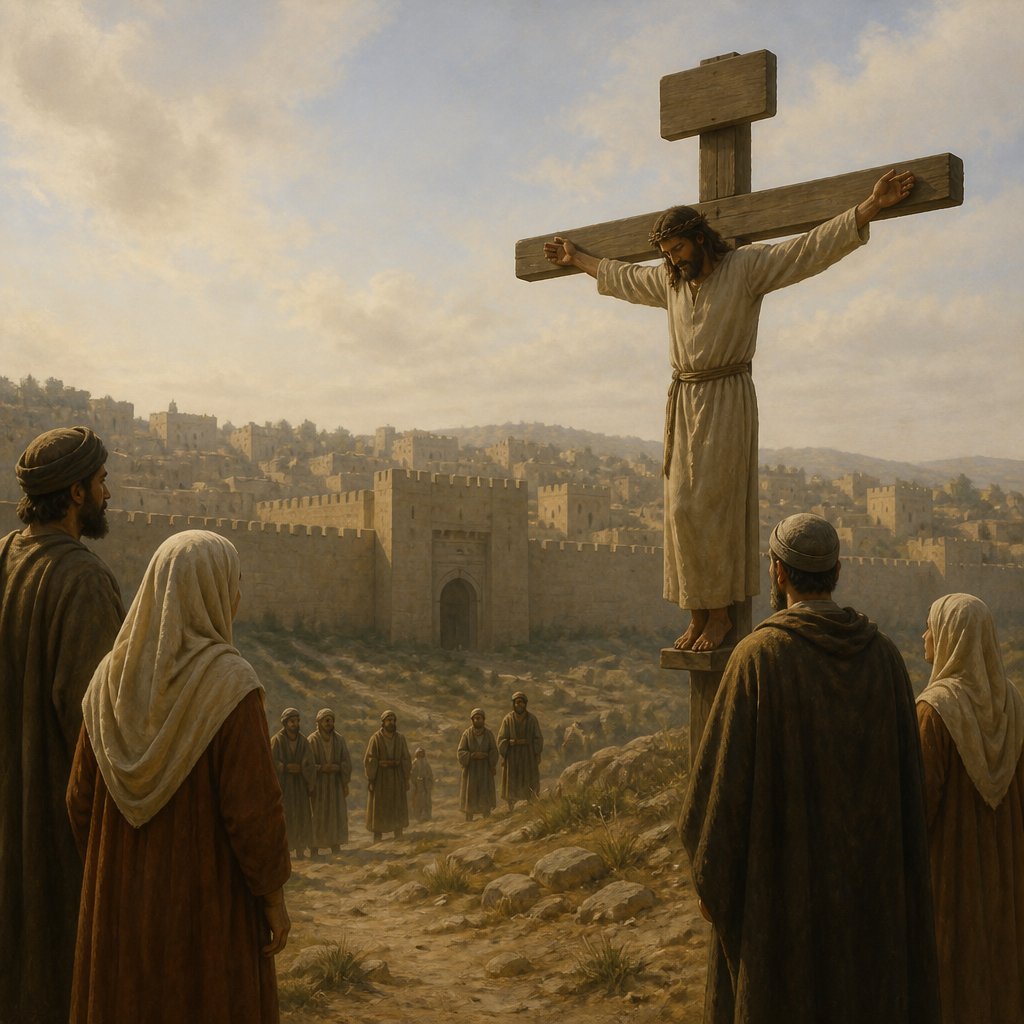
John 19:20 (KJV): "This title then read many of the Jews: for the place where Jesus was crucified was nigh to the city: and it was written in Hebrew, and Greek, and Latin."
In this verse, we are presented with a significant moment in the crucifixion of Jesus Christ. To fully understand the meaning and commentary of this verse, it is important to explore the context, themes, and symbolism within the broader narrative of the New Testament.
First, let's consider the context of John 19:20. At this point in the Gospel of John, Jesus has been arrested, tried, and condemned to death by crucifixion. He has been mocked, beaten, and forced to carry his own cross to Golgotha, the place of crucifixion. The Roman soldiers have divided his garments and cast lots for his seamless robe. As Jesus is crucified, a sign is placed above his head, bearing the inscription of his crime: "This is Jesus the King of the Jews" (Matt. 27:37). This sign is written in three languages: Hebrew, Greek, and Latin, so that all who pass by may understand the accusation against Jesus.
The theme of this verse revolves around the kingship of Jesus Christ. The sign above his head, declaring him as the King of the Jews, is a significant statement of Jesus' identity and purpose. Throughout the New Testament, Jesus is portrayed as the long-awaited Messiah, the one who would come to establish the kingdom of God on earth. However, his kingship is not of this world, as he himself declares to Pilate in John 18:36: "My kingdom is not of this world." Nevertheless, the inscription on the cross serves as a powerful declaration of Jesus' true identity and the fulfillment of the prophecies regarding the promised Messiah.
Furthermore, the use of three languages in the inscription holds symbolic significance. Hebrew was the language of the Jewish people, representing their religious and cultural heritage. Greek was the language of the wider Mediterranean world, serving as the lingua franca of the Hellenistic period. Latin was the official language of the Roman Empire, symbolizing political power and authority. By inscribing the sign in these three languages, the universal and timeless message of Jesus' kingship is emphasized. It signifies that Jesus' lordship transcends cultural and linguistic boundaries, and that his rule extends to all people, regardless of their background or nationality.
The placement of the sign at the site of Jesus' crucifixion is also noteworthy. The text states that the place where Jesus was crucified was near the city, suggesting that the inscription was intended to be seen and understood by a large audience. This public declaration of Jesus' kingship serves as a testament to his sovereignty and authority, even in the face of his apparent defeat and humiliation on the cross. It is a reminder that the crucifixion, far from being a moment of weakness, is actually the pinnacle of Jesus' victory over sin and death, as the Son of God willingly lays down his life for the salvation of humanity.
In conclusion, John 19:20 is a crucial verse in the narrative of Jesus' crucifixion, conveying the profound truth of his kingship and ultimate sacrifice. The inscription on the cross, written in three languages and placed in a prominent location, bears witness to the universal and timeless significance of Jesus' lordship. It is a powerful affirmation of his role as the long-awaited Messiah, and a reminder of the redemptive purpose behind his suffering and death. As believers, we are called to reflect on the profound implications of the inscription on the cross and to embrace Jesus as our King and Savior.
Have questions about John 19:20?
Dive deeper into this scripture with Bible Chat — an AI-powered tool for exploring God's Word through conversation. Ask questions, get context, and grow in your understanding of the Bible.
Get Our Apps


John 19:20 Artwork

John 19:20 - "This title then read many of the Jews: for the place where Jesus was crucified was nigh to the city: and it was written in Hebrew, and Greek, and Latin."
"This title then read many of the Jews: for the place where Jesus was crucified was nigh to the city: and it was written in Hebrew, and Greek, and Latin." - John 19:20

1 John 3:19-20 - "By this we know that we are of the truth, and shall assure our hearts before Him. For if our heart condemns us, God is greater than our heart, and knows all things."

John 20:19-20 - "On the evening of that first day of the week, when the disciples were together, with the doors locked for fear of the Jewish leaders, Jesus came and stood among them and said, “Peace be with you!” After he said this, he showed them his hands and side. The disciples were overjoyed when they saw the Lord."

John 20:19 - "¶ Then the same day at evening, being the first day of the week, when the doors were shut where the disciples were assembled for fear of the Jews, came Jesus and stood in the midst, and saith unto them, Peace be unto you."

John 3:19-20 - "And this is the condemnation, that light is come into the world, and men loved darkness rather than light, because their deeds were evil. For every one that doeth evil hateth the light, neither cometh to the light, lest his deeds should be reproved."

John 19:38

John 19:1

John 20:21

John 20:14

John 20:27

John 20:27

John 19:19 - "¶ And Pilate wrote a title, and put it on the cross. And the writing was, JESUS OF NAZARETH THE KING OF THE JEWS."

John 17.6-19

John 19:1-3

John 19:25-27

John 20:11-12

John 20:11-13

Genesis 19-20

Genesis 20-19

John 20:30-31

John 1:19 - "¶ And this is the record of John, when the Jews sent priests and Levites from Jerusalem to ask him, Who art thou?"

John 19:25-27

John 19:26-27

John 21:15-19
Luke 20:4 - "The baptism of John, was it from heaven, or of men?"

Joshua 19:20 - "And Rabbith, and Kishion, and Abez,"

Exodus 27:19-20

Wisdom 8:19-20

Matthew 28:19-20