What does John 18:29 mean?
"Pilate then went out unto them, and said, What accusation bring ye against this man?" - John 18:29
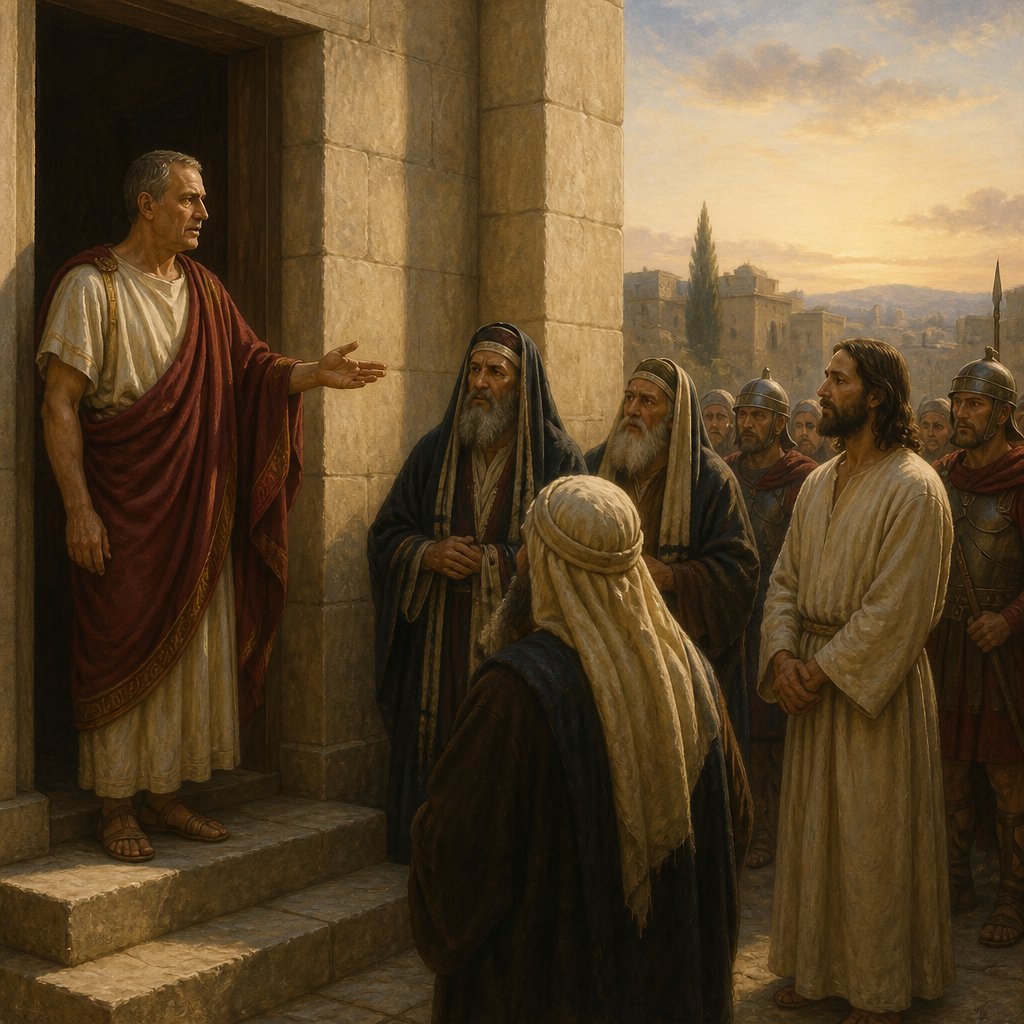
John 18:29 (KJV) reads, "Pilate then went out unto them, and said, What accusation bring ye against this man?" This verse comes from the account of Jesus' trial before Pontius Pilate, the Roman governor of Judea. In this verse, Pilate is addressing the Jewish religious leaders who had brought Jesus to him for judgment.
To fully understand the meaning and significance of this verse, it is important to consider the broader context in which it is situated. The events leading up to this moment include Jesus' betrayal by Judas, his arrest in the Garden of Gethsemane, and his initial trial before the Jewish religious leaders, who found him guilty of blasphemy and sought to have him put to death. However, because the Jewish leaders did not have the authority to carry out a death sentence, they brought Jesus to Pilate, the Roman governor, seeking his approval to execute Jesus.
The question Pilate poses in this verse, "What accusation bring ye against this man?" is a critical moment in the trial of Jesus. Pilate, as the Roman authority, needed to be presented with a specific charge in order to proceed with a trial. This question demonstrates Pilate's commitment to upholding Roman law and ensuring that justice is carried out in accordance with proper legal procedures. It also reflects Pilate's initial skepticism and reluctance to condemn Jesus without clear evidence of wrongdoing.
The response from the Jewish religious leaders to Pilate's question reveals their determination to see Jesus put to death. In the following verses, they assert that Jesus is a criminal and a threat to Roman authority, which prompts Pilate to further question Jesus and ultimately leads to his crucifixion. This interaction underscores the political and religious tensions at play in the trial of Jesus, as well as the collusion between the Jewish leaders and the Roman authorities in the crucifixion of Jesus.
Symbolically, this verse can be seen as a representation of the clash between divine justice and human law. Pilate's question highlights the tension between the moral and legal implications of Jesus' trial. On one hand, there is the demand for justice and a fair trial, as represented by Pilate's question. On the other hand, there is the subversion of justice and the manipulation of legal processes for the purpose of eliminating a perceived threat, as demonstrated by the actions of the Jewish leaders and the eventual condemnation of Jesus.
This verse also speaks to the broader themes of truth, innocence, and the nature of authority. Pilate's question challenges the accusers to provide concrete evidence and coherent reasoning for their accusations against Jesus. It raises the question of what constitutes true justice and the proper exercise of authority. It also highlights the tension between the temporal authority of the Roman governor and the spiritual authority claimed by Jesus and the Jewish religious leaders. In this sense, the verse serves as a point of reflection on the complexities of human judgment and the divine will.
In conclusion, John 18:29 is a pivotal moment in the trial of Jesus, encapsulating the political, legal, and spiritual dynamics at play. It serves as a focal point for the examination of the clash between divine justice and human law, as well as the broader themes of truth, innocence, and the exercise of authority. This verse invites readers to consider the implications of Pilate's question and the events that follow, prompting reflection on the complexities of justice, power, and the divine purpose.
Have questions about John 18:29?
Dive deeper into this scripture with Bible Chat — an AI-powered tool for exploring God's Word through conversation. Ask questions, get context, and grow in your understanding of the Bible.
Get Our Apps


John 18:29 Artwork

John 18:29 - "Pilate then went out unto them, and said, What accusation bring ye against this man?"
"Pilate then went out unto them, and said, What accusation bring ye against this man?" - John 18:29

John 14.23-29

John 14:23-29

John 1 29-42

John 1 29-42

John 14:23-29

Isaiah 29:18

Genesis 18-29

John 14:23-29

John 1 29-42

John 1 29-42

John 7:17-18

John 7:17-18

John 1:29 - "¶ The next day John seeth Jesus coming unto him, and saith, Behold the Lamb of God, which taketh away the sin of the world."

John 7:17-18

John 7:17-18

John 18:25

john 18:36

John 1:John 1:29 The Next Day John Saw Jesus Coming Toward Him, And Said, “Behold! The Lamb Of God Who Takes Away The Sin Of The World!

John 1:John 1:29 The Next Day John Saw Jesus Coming Toward Him, And Said, “Behold! The Lamb Of God Who Takes Away The Sin Of The World!

John 1:John 1:29 The Next Day John Saw Jesus Coming Toward Him, And Said, “Behold! The Lamb Of God Who Takes Away The Sin Of The World!

John 11:29 - "As soon as she heard that, she arose quickly, and came unto him."

Proverbs 29:18 - "Where there is no vision, the people perish: but he that keepeth the law, happy is he."

John 7:29 - "But I know him: for I am from him, and he hath sent me."

John 12:29 - "The people therefore, that stood by, and heard it, said that it thundered: others said, An angel spake to him."

Luke 7:29 - "And all the people that heard him, and the publicans, justified God, being baptized with the baptism of John."

1 John 5:18

1 John 4:18

1 John 4:18