What does John 18:26 mean?
"One of the servants of the high priest, being his kinsman whose ear Peter cut off, saith, Did not I see thee in the garden with him?" - John 18:26
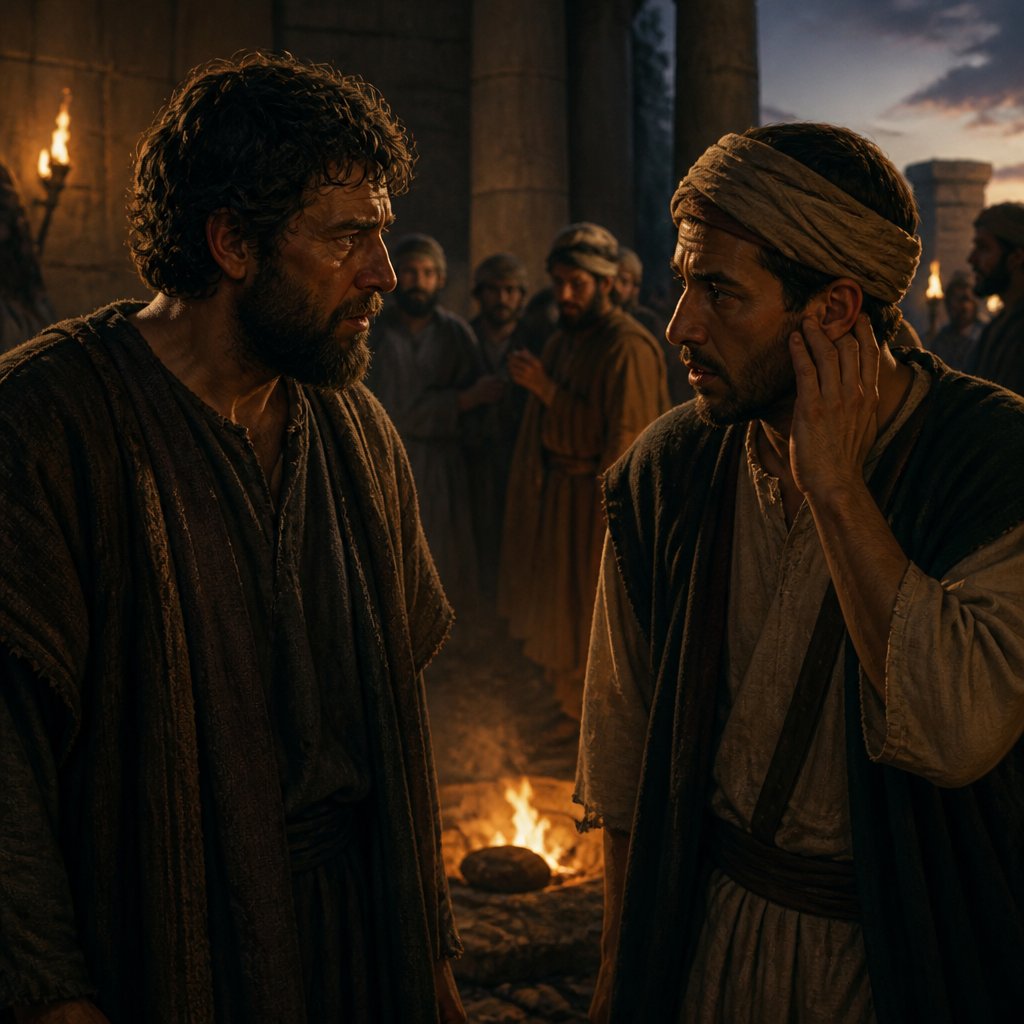
John 18:26 (KJV) states, "One of the servants of the high priest, being his kinsman whose ear Peter cut off, saith, Did not I see thee in the garden with him?"
This verse occurs in the context of Jesus' arrest in the Garden of Gethsemane. Peter, one of Jesus' disciples, had attempted to defend his master when the soldiers came to arrest him. In his zeal, Peter took out a sword and cut off the ear of Malchus, a servant of the high priest, who is here identified as the kinsman of the high priest. In the book of Matthew 26:51, Jesus intervened to prevent further violence, healing the servant's ear before he was taken into custody. The high priest's servant, in John 18:26, confronts Peter, recognizing him as one of Jesus' followers and questioning his involvement in the events that had just unfolded.
This passage is significant for several reasons. First, it emphasizes the humanity and fallibility of the disciples, particularly in the face of impending persecution. Despite their close relationship with Jesus and their fervent commitment to him, they were still susceptible to fear and doubt. Peter's impulsive act of violence, followed by his denial of knowing Jesus (John 18:25), serves as a poignant reminder of the disciples' vulnerability and the challenges they faced in standing up for their faith.
Moreover, this verse underscores the theme of loyalty and betrayal. The tension between Peter's desire to protect Jesus and his subsequent denial of knowing him reflects the internal struggle between his devotion to Jesus and the fear of facing persecution himself. This inner conflict is a recurring motif throughout the biblical narrative, as the disciples grapple with the demands of discipleship and the harsh realities of the world around them.
Another important aspect of this passage is the theme of providence and divine intervention. In Matthew 26:53, Jesus reminds Peter that he could have called on his Father to send legions of angels to defend him, indicating that the events unfolding were part of a larger divine plan. The healing of Malchus' ear further emphasizes the miraculous power of Jesus, who demonstrates compassion and mercy even in the midst of conflict and hostility.
Symbolically, the servant's question to Peter serves as a challenge to his allegiance to Jesus. It also foreshadows the impending trials and persecution that Jesus' followers would face in the days to come. The confrontation between Peter and the high priest's servant serves as a microcosm of the broader conflict between the forces of darkness and the followers of Christ, highlighting the spiritual and moral struggles inherent in the Christian journey.
In conclusion, John 18:26 encapsulates a complex blend of emotions and themes, including loyalty, betrayal, divine providence, and the inherent tensions of human nature. Through the interaction between Peter and the high priest's servant, the verse conveys profound insights into the challenges of discipleship and the spiritual conflicts that believers continue to grapple with today. It serves as a poignant reminder of the complexities of faith and the need for steadfastness in the face of adversity.
Have questions about John 18:26?
Dive deeper into this scripture with Bible Chat — an AI-powered tool for exploring God's Word through conversation. Ask questions, get context, and grow in your understanding of the Bible.
Get Our Apps


John 18:26 Artwork

John 18:26 - "One of the servants of the high priest, being his kinsman whose ear Peter cut off, saith, Did not I see thee in the garden with him?"
"One of the servants of the high priest, being his kinsman whose ear Peter cut off, saith, Did not I see thee in the garden with him?" - John 18:26

John 15:26 NLT

Genesis 18-26

Genesis 26:18

John 19:26-27

John 7:17-18

John 7:17-18

John 1:26 - "John answered them, saying, I baptize with water: but there standeth one among you, whom ye know not;"

John 7:17-18

John 7:17-18

John 18:25

john 18:36

Joshua 18:26 - "And Mizpeh, and Chephirah, and Mozah,"

Luke 18:26 - "And they that heard it said, Who then can be saved?"

1 John 5:18

1 John 4:18

1 John 4:18

John 11:26 - "And whosoever liveth and believeth in me shall never die. Believest thou this?"

Proverbs 26:18 - "As a mad man who casteth firebrands, arrows, and death,"

1 Chronicles 26:18 - "At Parbar westward, four at the causeway, and two at Parbar."

"And Mizpeh, and Chephirah, and Mozah," - Joshua 18:26

John 4:26 - "Jesus saith unto her, I that speak unto thee am he."

John 10:26 - "But ye believe not, because ye are not of my sheep, as I said unto you."

John 18:27 - "Peter then denied again: and immediately the cock crew."

John 6:18 - "And the sea arose by reason of a great wind that blew."

John 3:26 - "And they came unto John, and said unto him, Rabbi, he that was with thee beyond Jordan, to whom thou barest witness, behold, the same baptizeth, and all men come to him."

1 John 2:26 - "These things have I written unto you concerning them that seduce you."

Matthew 21:26 - "But if we shall say, Of men; we fear the people; for all hold John as a prophet."

Mark 2:18 - "And the disciples of John and of the Pharisees used to fast: and they come and say unto him, Why do the disciples of John and of the Pharisees fast, but thy disciples fast not?"