What does John 11:44 mean?
"And he that was dead came forth, bound hand and foot with graveclothes: and his face was bound about with a napkin. Jesus saith unto them, Loose him, and let him go." - John 11:44
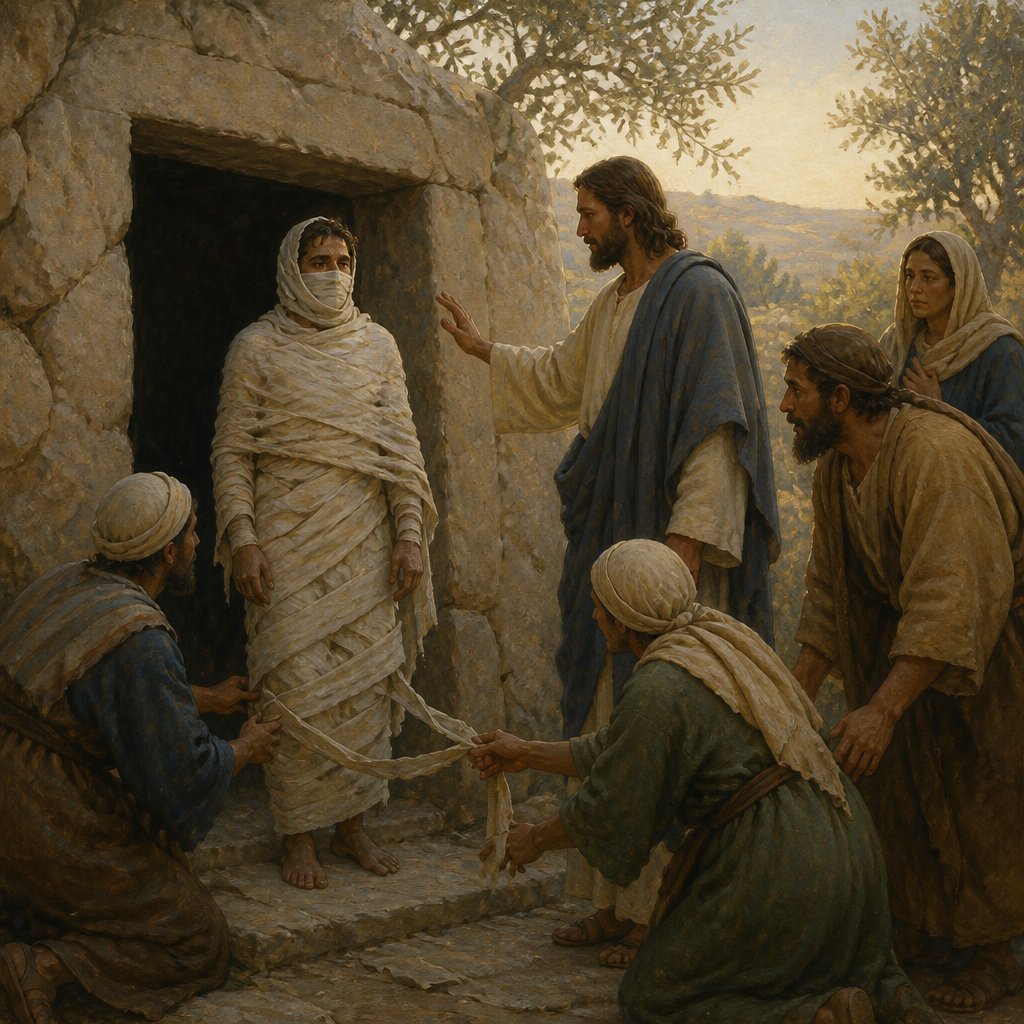
The Bible verse John 11:44, King James Version (KJV) reads: "And he that was dead came forth, bound hand and foot with graveclothes: and his face was bound about with a napkin. Jesus saith unto them, Loose him, and let him go."
This verse is found within the larger context of the story of Jesus raising Lazarus from the dead. In John 11, we find Jesus arriving in Bethany, where Lazarus, the brother of Mary and Martha, has died. Jesus has a deep emotional response to the death of Lazarus, and we are told in John 11:35 that Jesus wept. This shows the depth of Jesus' love and compassion for his friends, and it also serves as a powerful example of his humanity.
As Jesus approaches the tomb where Lazarus has been laid, he asks for the stone to be removed from the entrance. Despite Martha's concern that the body will smell due to decomposition, Jesus persists, and then prays to God, thanking Him for hearing His prayer and affirming his belief that God always hears Him. Then, in a moment of incredible power and divine authority, Jesus calls out with a loud voice, "Lazarus, come forth!" The dead man then emerges from the tomb, still bound in his grave clothes.
The specific verse, John 11:44, captures the dramatic moment when Lazarus, who had been dead for four days, emerges from the tomb, bound hand and foot with grave clothes. This miraculous event is not only a testament to Jesus' divine power, but also serves as a foreshadowing of His own resurrection, which would happen just a short time later.
The themes in this verse are profound and impactful. The primary theme is the power of Jesus over death and His authority as the Son of God. By raising Lazarus from the dead, Jesus demonstrates that he has power over physical death, and as we see in the larger context of the New Testament, this foreshadows His own resurrection and the hope of eternal life for all who believe in Him.
Another theme in this verse is the compassionate and personal nature of Jesus. His tears at the death of Lazarus and his deep emotional response to the suffering of his friends show us the love and empathy that Jesus has for humanity. This is a powerful reassurance that no matter what we may be facing, Jesus understands and cares for us deeply.
The symbolism in John 11:44 is also significant. The fact that Lazarus emerges from the tomb still bound in his grave clothes serves as a visual representation of the bondage of sin and death from which Jesus has the power to set us free. Jesus commands those around him to "loose him, and let him go," which can also be interpreted as a call to the followers of Christ to help one another find freedom from the bondage of sin and death through the power of Jesus.
In terms of the cultural and historical context, it's important to note that the raising of Lazarus from the dead was a pivotal moment in Jesus' ministry. It was a public and undeniable display of His divine authority, and it served to further divide those who believed in Him from those who rejected Him. The religious leaders who witnessed this miracle were so threatened by Jesus' growing influence that they began to conspire to put Him to death (John 11:53).
In conclusion, John 11:44 captures a powerful and transformative moment in the life and ministry of Jesus Christ. It is a reminder of His divine power, His deep compassion for humanity, and His ultimate victory over sin and death. This verse continues to inspire and encourage believers to this day, reminding us that Jesus has the power to set us free from the bondage of sin and to bring new life and hope to all who believe in Him.
Have questions about John 11:44?
Dive deeper into this scripture with Bible Chat — an AI-powered tool for exploring God's Word through conversation. Ask questions, get context, and grow in your understanding of the Bible.
Get Our Apps


John 11:44 Artwork

John 11:44 - "And he that was dead came forth, bound hand and foot with graveclothes: and his face was bound about with a napkin. Jesus saith unto them, Loose him, and let him go."
"And he that was dead came forth, bound hand and foot with graveclothes: and his face was bound about with a napkin. Jesus saith unto them, Loose him, and let him go." - John 11:44

John 11:43-44 – "When he had said this, Jesus called in a loud voice, 'Lazarus, come out!'"

John 11,43, 44

John 8:44

John 8:44

John 8:44

John 1:44 - "Now Philip was of Bethsaida, the city of Andrew and Peter."

John 4:44 - "For Jesus himself testified, that a prophet hath no honour in his own country."

John 7:44 - "And some of them would have taken him; but no man laid hands on him."

John 12:44 - "¶ Jesus cried and said, He that believeth on me, believeth not on me, but on him that sent me."

1 Chronicles 11:44 - "Uzzia the Ashterathite, Shama and Jehiel the sons of Hothan the Aroerite,"

"Now Philip was of Bethsaida, the city of Andrew and Peter." - John 1:44

John 5:44 - "How can ye believe, which receive honour one of another, and seek not the honour that cometh from God only?"

Psalms 44:11 - "Thou hast given us like sheep appointed for meat; and hast scattered us among the heathen."

John 6:44 - "No man can come to me, except the Father which hath sent me draw him: and I will raise him up at the last day."

Genesis 44:11 - "Then they speedily took down every man his sack to the ground, and opened every man his sack."

philippians 4:4

Judges 4:4

philippians 4:4

"For Jesus himself testified, that a prophet hath no honour in his own country." - John 4:44

philippians 4:4

Philippians 4:4

Luke 11:44 - "Woe unto you, scribes and Pharisees, hypocrites! for ye are as graves which appear not, and the men that walk over them are not aware of them."

"And some of them would have taken him; but no man laid hands on him." - John 7:44

Jeremiah 44:11 - "¶ Therefore thus saith the LORD of hosts, the God of Israel; Behold, I will set my face against you for evil, and to cut off all Judah."

John (11:35) Jesus wept.
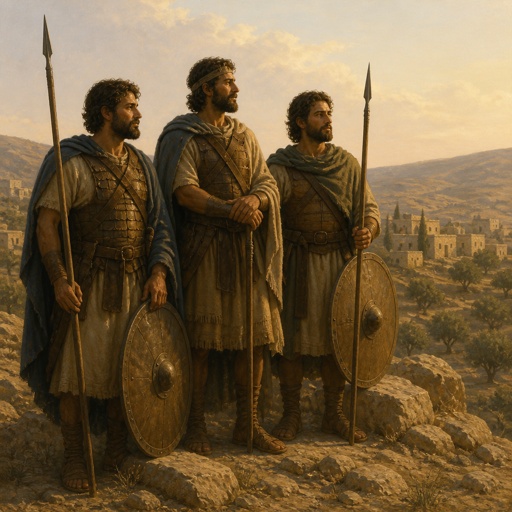
"Uzzia the Ashterathite, Shama and Jehiel the sons of Hothan the Aroerite," - 1 Chronicles 11:44

"¶ Jesus cried and said, He that believeth on me, believeth not on me, but on him that sent me." - John 12:44
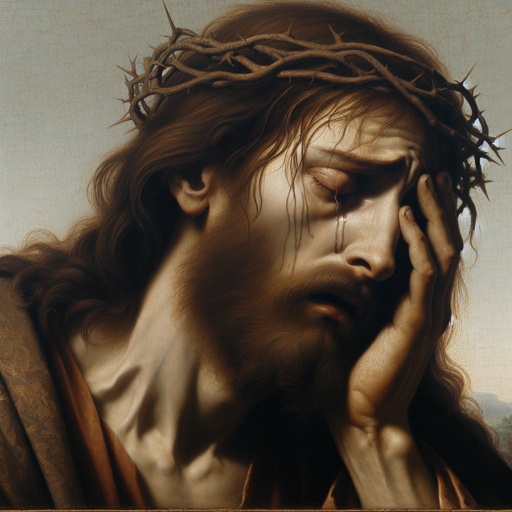
John (11:35) Jesus wept.