What does John 11:39 mean?
"Jesus said, Take ye away the stone. Martha, the sister of him that was dead, saith unto him, Lord, by this time he stinketh: for he hath been dead four days." - John 11:39
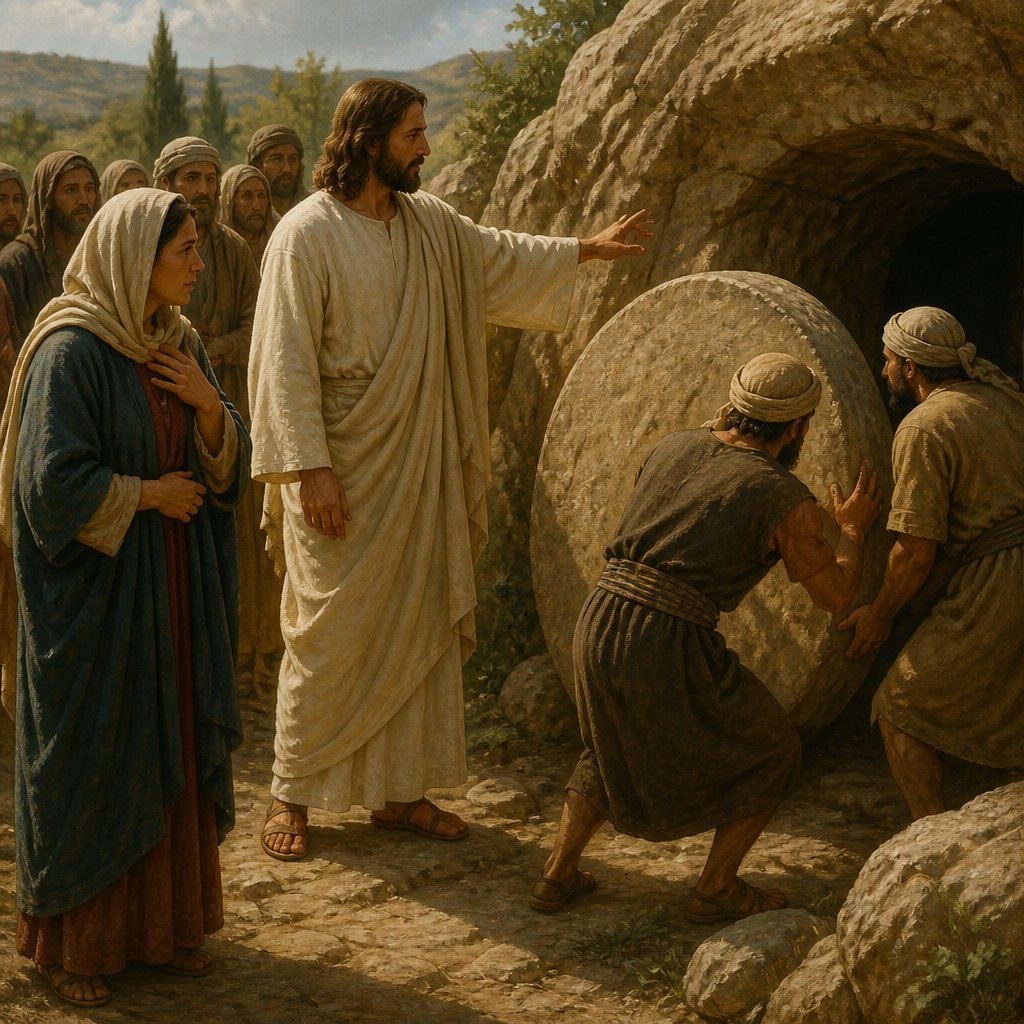
The Bible verse John 11:39 from the King James Version (KJV) reads: "Jesus said, Take ye away the stone. Martha, the sister of him that was dead, saith unto him, Lord, by this time he stinketh: for he hath been dead four days."
This verse comes from the story of the raising of Lazarus from the dead, which is one of the most powerful and well-known miracles of Jesus Christ. In this verse, we see Martha expressing her concerns about removing the stone from Lazarus' tomb, as it has been four days since he died and she is worried about the stench that might come from the decaying body.
The context of this verse is important to understand its full meaning. Prior to this verse, we see that Lazarus, the brother of Mary and Martha, had fallen ill and eventually died. Jesus, who was a close friend of Lazarus and his sisters, arrived in their town of Bethany after Lazarus had been in the tomb for four days. Upon his arrival, both Mary and Martha express to Jesus their belief that if he had been present, their brother would not have died. This sets the stage for Jesus to perform one of his most dramatic miracles.
In this verse, Jesus commands that the stone be removed from the entrance to the tomb. Martha, however, hesitates, expressing concern about the stench that might come from the decaying body. This shows the very human side of Martha, who is not only grieving for her brother, but also worried about the practicalities of his body's condition after four days in the tomb.
The themes present in this verse include faith, doubt, and the power of God to overcome death. Martha's initial hesitation to remove the stone reflects a common human response to death and decay, as she is focused on the physical reality of Lazarus' body. However, Jesus' response to Martha's concern serves to illustrate a deeper spiritual truth. He is about to perform a miracle that defies the limitations of human understanding and demonstrates the power of God to bring life and wholeness even in the face of death.
The symbolism in this verse is rich and multifaceted. The stone that covers the tomb represents the barrier between life and death, and the removal of the stone symbolizes the breaking down of that barrier by the power of God. Martha's concern about the stench coming from the tomb represents the fear and doubt that often accompany death and the decay of the physical body. However, Jesus' command to remove the stone and his subsequent raising of Lazarus from the dead point to the victory of life over death, and the ability of God to overcome even the most seemingly impossible situations.
Overall, John 11:39 is a powerful and evocative verse that captures the emotional and spiritual tension surrounding the raising of Lazarus from the dead. It serves as a poignant reminder of the power of God to bring life and hope even in the face of death and decay, and the need for faith to overcome doubt and fear. The removal of the stone and the raising of Lazarus are powerful symbols of the victory of life over death, and the profound truth that with God, all things are possible.
Have questions about John 11:39?
Dive deeper into this scripture with Bible Chat — an AI-powered tool for exploring God's Word through conversation. Ask questions, get context, and grow in your understanding of the Bible.
Get Our Apps


John 11:39 Artwork

John 11:39 - "Jesus said, Take ye away the stone. Martha, the sister of him that was dead, saith unto him, Lord, by this time he stinketh: for he hath been dead four days."
"Jesus said, Take ye away the stone. Martha, the sister of him that was dead, saith unto him, Lord, by this time he stinketh: for he hath been dead four days." - John 11:39

John 7:37-39

John 7:37-39

Ezekiel 39:11

Ezekiel 39:11

John 12:39 - "Therefore they could not believe, because that Esaias said again,"

John 10:39 - "Therefore they sought again to take him: but he escaped out of their hand,"

Exodus 39:11 - "And the second row, an emerald, a sapphire, and a diamond."

1 Kings 11:39 - "And I will for this afflict the seed of David, but not for ever."

John 5:39 - "¶ Search the scriptures; for in them ye think ye have eternal life: and they are they which testify of me."

1 Chronicles 11:39 - "Zelek the Ammonite, Naharai the Berothite, the armourbearer of Joab the son of Zeruiah,"

Hebrews 11:39 - "And these all, having obtained a good report through faith, received not the promise:"

"Therefore they could not believe, because that Esaias said again," - John 12:39

John 4:39 - "¶ And many of the Samaritans of that city believed on him for the saying of the woman, which testified, He told me all that ever I did."

John 1:39 - "He saith unto them, Come and see. They came and saw where he dwelt, and abode with him that day: for it was about the tenth hour."

John 9:39 - "¶ And Jesus said, For judgment I am come into this world, that they which see not might see; and that they which see might be made blind."

John 7:39 - "(But this spake he of the Spirit, which they that believe on him should receive: for the Holy Ghost was not yet given; because that Jesus was not yet glorified.)"

John 19:39 - "And there came also Nicodemus, which at the first came to Jesus by night, and brought a mixture of myrrh and aloes, about an hundred pound weight."

"And the second row, an emerald, a sapphire, and a diamond." - Exodus 39:11

Jeremiah 39:11 - "¶ Now Nebuchadrezzar king of Babylon gave charge concerning Jeremiah to Nebuzar-adan the captain of the guard, saying,"

Revelation 12:3-9

John 18:39 - "But ye have a custom, that I should release unto you one at the passover: will ye therefore that I release unto you the King of the Jews?"

Ezekiel 39:11 Valley of Hamongog east of the dead sea in Israel

Job 39:11 - "Wilt thou trust him, because his strength is great? or wilt thou leave thy labour to him?"

Genesis 39:11 - "And it came to pass about this time, that Joseph went into the house to do his business; and there was none of the men of the house there within."

"And I will for this afflict the seed of David, but not for ever." - 1 Kings 11:39

John 8:39 - "They answered and said unto him, Abraham is our father. Jesus saith unto them, If ye were Abraham's children, ye would do the works of Abraham."

Leviticus 11:39 - "And if any beast, of which ye may eat, die; he that toucheth the carcase thereof shall be unclean until the even."

John 6:39 - "And this is the Father's will which hath sent me, that of all which he hath given me I should lose nothing, but should raise it up again at the last day."