What does Job 6:6 mean?
"Can that which is unsavoury be eaten without salt? or is there any taste in the white of an egg?" - Job 6:6

Job 6:6 in the King James Version states, "Can that which is unsavoury be eaten without salt? or is there any taste in the white of an egg?" This verse is part of a larger passage in the book of Job, which is known for its deep and profound exploration of suffering and the search for meaning in the midst of hardship.
In this particular verse, Job is expressing his deep sense of dissatisfaction and despair in the midst of his suffering. He uses a metaphor to convey the idea that just as food without salt is tasteless and unsatisfying, so is his current state of suffering without relief or comfort. He is essentially saying that his suffering is unbearable and lacking any form of consolation or relief. The mention of the "white of an egg" further emphasizes this sense of tastelessness and emptiness, as the white of an egg is generally considered to be bland and lacking in flavor.
The context of this verse is important for understanding its full meaning. Job was a righteous man who experienced severe and unexplained suffering. He lost his family, his wealth, and his health, and he was left to grapple with the question of why a just and loving God would allow such hardship to befall him. Throughout the book of Job, he wrestles with this question and engages in intense dialogue with his friends and with God himself.
The theme of suffering and the search for meaning in the midst of it is central to this verse. Job is grappling with the harsh realities of life and the seeming absence of solace or relief. He is questioning the very nature of suffering and expressing his deep longing for some form of comfort or respite.
The use of metaphor and symbolism is also significant in this verse. The image of food without salt and the tastelessness of the white of an egg serve as powerful symbols for Job's experience of suffering. These images evoke a sense of emptiness and lack of satisfaction, mirroring Job's own feelings of despair and hopelessness.
This verse also raises important theological and philosophical questions about the nature of suffering and the character of God. Job's suffering prompts him to question the goodness and justice of God, and his search for meaning leads him to wrestle with profound theological and existential issues. This verse thus serves as a poignant expression of the human experience of suffering and the search for meaning and consolation in the midst of it.
In conclusion, Job 6:6 is a poignant and powerful expression of the depth of human suffering and the search for meaning in the face of despair. Through the use of metaphor and symbolism, Job conveys his sense of tastelessness and emptiness in the midst of his suffering, and raises profound questions about the nature of suffering and the character of God. This verse is a powerful reminder of the universal human experience of suffering and the longing for relief and comfort in the midst of hardship.
Have questions about Job 6:6?
Dive deeper into this scripture with Bible Chat — an AI-powered tool for exploring God's Word through conversation. Ask questions, get context, and grow in your understanding of the Bible.
Get Our Apps


Job 6:6 Artwork

Job 6:6 - "Can that which is unsavoury be eaten without salt? or is there any taste in the white of an egg?"

"Can that which is unsavoury be eaten without salt? or is there any taste in the white of an egg?" - Job 6:6

Job 6:1 - "But Job answered and said,"

Job 40:6 - "¶ Then answered the LORD unto Job out of the whirlwind, and said,"

Job 27:6

"But Job answered and said," - Job 6:1

Job 30:6 - "To dwell in the clifts of the valleys, in caves of the earth, and in the rocks."

Job 28:6 - "The stones of it are the place of sapphires: and it hath dust of gold."

Job 6:16 - "Which are blackish by reason of the ice, and wherein the snow is hid:"

Job 36:6 - "He preserveth not the life of the wicked: but giveth right to the poor."

Job 42:6 - "Wherefore I abhor myself, and repent in dust and ashes."

Job 26:6 - "Hell is naked before him, and destruction hath no covering."

Job 6:18 - "The paths of their way are turned aside; they go to nothing, and perish."

Job 6:19 - "The troops of Tema looked, the companies of Sheba waited for them."

Job 6:12 - "Is my strength the strength of stones? or is my flesh of brass?"

"¶ Then answered the LORD unto Job out of the whirlwind, and said," - Job 40:6

Job 13:6 - "Hear now my reasoning, and hearken to the pleadings of my lips."

Job 6:13 - "Is not my help in me? and is wisdom driven quite from me?"

Job 6:7 - "The things that my soul refused to touch are as my sorrowful meat."

Job 6:27 - "Yea, ye overwhelm the fatherless, and ye dig a pit for your friend."

Job 24:6 - "They reap every one his corn in the field: and they gather the vintage of the wicked."

Job 6:30 - "Is there iniquity in my tongue? cannot my taste discern perverse things?"

Job 4:6 - "Is not this thy fear, thy confidence, thy hope, and the uprightness of thy ways?"

Job 6:25 - "How forcible are right words! but what doth your arguing reprove?"

Job 38:6 - "Whereupon are the foundations thereof fastened? or who laid the corner stone thereof;"

Job 9:6 - "Which shaketh the earth out of her place, and the pillars thereof tremble."

Job 6:20 - "They were confounded because they had hoped; they came thither, and were ashamed."

Job 6:21 - "For now ye are nothing; ye see my casting down, and are afraid."

Job 25:6 - "How much less man, that is a worm? and the son of man, which is a worm?"
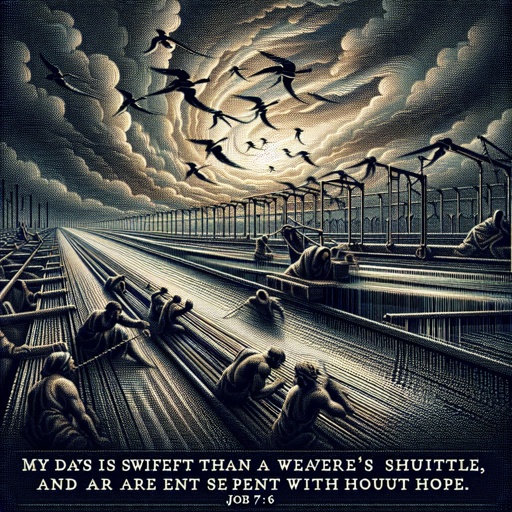
Job 7:6 - "My days are swifter than a weaver's shuttle, and are spent without hope."