What does Job 38:7 mean?
"When the morning stars sang together, and all the sons of God shouted for joy?" - Job 38:7

Job 38:7 in the King James Version reads, “When the morning stars sang together, and all the sons of God shouted for joy?” It belongs to the moment when the LORD answers Job “out of the whirlwind” and begins a long series of questions that turn Job’s attention away from his own anguish and toward the vastness, order, and mystery of God’s works in creation. The verse is not a stand‑alone poetic flourish; it is part of a deliberate argument. Job has spent many chapters protesting the darkness of his suffering and longing to contend with God. When God finally speaks, He does not first explain Job’s pain. Instead, He confronts Job with the reality that the world is larger, older, and more intricately governed than Job can comprehend. The question implied in Job 38:7 is meant to humble Job, not to mock him: were you present at creation, able to witness, advise, or govern it?
The immediate context is the LORD’s description of the founding of the earth as though it were a building set on foundations, measured by a line, secured with a cornerstone. Job 38:4 asks, “Where wast thou when I laid the foundations of the earth?” and the following verses continue with images of architecture and craftsmanship. Then Job 38:7 adds a cosmic chorus: at that laying of the world’s foundations, “the morning stars sang together,” and “all the sons of God shouted for joy.” The effect is to portray creation not merely as an act of power, but as an act that elicited praise. The universe is imagined as participating, in its own way, in celebrating the wisdom and glory of its Maker at the beginning of all things.
In KJV language, “morning stars” functions as symbolic poetry for the heavenly lights, the luminaries associated with the dawn and with the ordering of time itself. The phrase paints a picture of the sky as it first breaks with light, suggesting purity, beginnings, and the beauty of newly established order. To say they “sang together” is not a scientific statement about sound in space, but a poetic way of describing harmony. The created order is presented as if it were a choir, joined in agreement and awe. “Together” emphasizes unity: creation is not chaotic at its origin in this portrayal; it is coordinated, balanced, and responsive to God.
The second half of the verse, “all the sons of God shouted for joy,” draws the reader into the heavenly realm that appears elsewhere in Job. Earlier, Job 1:6 and Job 2:1 speak of “the sons of God” presenting themselves before the LORD, language that in Job’s own narrative context places them among heavenly beings who stand in God’s presence. In Job 38:7, these “sons of God” are pictured as witnesses of creation’s founding, responding not with debate, accusation, or fear, but with joy. The “shout” underscores exuberance and public celebration; the joy is loud, not private. It also creates a contrast with Job’s own cries. Job has shouted in distress and complaint; heaven once shouted in joy at the goodness and rightness of God’s creative act. The juxtaposition invites Job to recognize that his present experience, as real and terrible as it is, does not overturn the fundamental truth that God’s ways are higher than human sight, and that God’s governance of the world includes dimensions Job has not considered.
A major theme in this verse is the limitation of human perspective. God’s questions in Job 38 are not primarily seeking information; they are exposing the gap between the Creator’s knowledge and the creature’s. Job was not there when the “morning stars” sang, nor among the “sons of God” who shouted. That absence matters. It means Job does not have the vantage point to judge the whole structure of providence from the fragment of his own suffering. Job’s demand for an explanation meets God’s revelation of scale: the one who established the cosmos with such wisdom is not careless or ignorant of what He is doing, even when His purposes are hidden.
Another theme is worship as the fitting response to creation. Job 38:7 frames the origin of the world as an event that evokes praise. The earliest scene of the universe, in this poetic depiction, is not silence but song. This suggests that creation is inherently meaningful and oriented toward God, and that joy in God’s works is appropriate even before any human voice exists to articulate it. In the flow of Job, this also implies that God’s answer to Job is not merely intellectual. God is drawing Job toward reverence, toward a posture that can coexist with unanswered questions.
Symbolically, the “morning” imagery can also be heard as the language of newness and dawn after darkness. Job’s experience has been nightlike, full of sorrow and confusion. God’s speech does not immediately remove Job’s pain, but it does bring a kind of dawn by reintroducing Job to the reality of God’s majesty and the ordered goodness that underlies existence. The “singing” and “shouting” do not deny suffering; rather, they place suffering within a universe that, at its foundation, is God‑made and therefore not meaningless.
The significance of Job 38:7, then, is that it situates Job’s personal story inside a cosmic story. The verse affirms that creation is not accidental, that heavenly beings recognized and rejoiced in God’s work, and that God’s wisdom precedes and surpasses human questioning. In the drama of Job, it is one of the lines that helps move Job from insisting on his own case toward surrendering to the reality of God’s greatness. It is not offered as a tidy solution to the problem of pain, but as a profound reorientation: before Job can argue about justice in his particular circumstance, he must reckon with the Creator whose works were celebrated at the dawn of the world, when “the morning stars sang together, and all the sons of God shouted for joy.”
Have questions about Job 38:7?
Dive deeper into this scripture with Bible Chat — an AI-powered tool for exploring God's Word through conversation. Ask questions, get context, and grow in your understanding of the Bible.
Get Our Apps


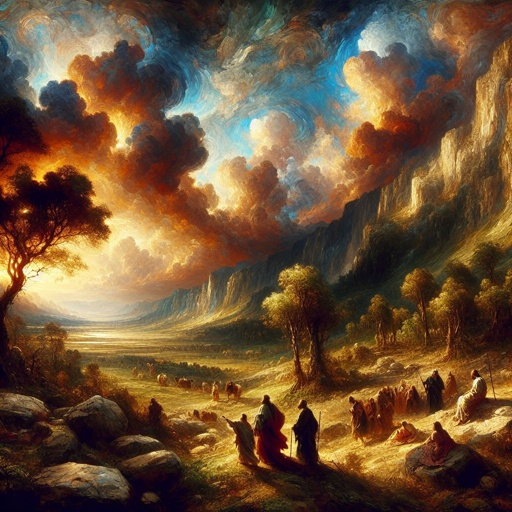
Job 38:7 Artwork

Job 38:7 - "When the morning stars sang together, and all the sons of God shouted for joy?"

"When the morning stars sang together, and all the sons of God shouted for joy?" - Job 38:7

"When the morning stars sang together, and all the sons of God shouted for joy?" - Job 38:7

Job 38:4-7

Job 38:4-7 – "Where were you when I laid the earth’s foundation? Tell me, if you understand."

Job 38:4-7 – "Where were you when I laid the earth’s foundation? Tell me, if you understand."

Job 38

Job 38

Job 38:1 - "Then the LORD answered Job out of the whirlwind, and said,"

Job 38:38 - "When the dust groweth into hardness, and the clods cleave fast together?"

Job 38:36

Job 38:36

Job 38:1

Job 38:36

Job 38:36

Job 38:1

Job 38:14 - "It is turned as clay to the seal; and they stand as a garment."

"Then the LORD answered Job out of the whirlwind, and said," - Job 38:1

Job 38:2 - "Who is this that darkeneth counsel by words without knowledge?"

Job 38:30 - "The waters are hid as with a stone, and the face of the deep is frozen."

"When the dust groweth into hardness, and the clods cleave fast together?" - Job 38:38

Job 38:40 - "When they couch in their dens, and abide in the covert to lie in wait?"

John 7:38

John 7:38
John 7:38

John 7:38

Job 38:28 - "Hath the rain a father? or who hath begotten the drops of dew?"

Job 38:15 - "And from the wicked their light is withholden, and the high arm shall be broken."

Job 38:10 - "And brake up for it my decreed place, and set bars and doors,"

Job 38:26 - "To cause it to rain on the earth, where no man is; on the wilderness, wherein there is no man;"