What does Job 28:16 mean?
"It cannot be valued with the gold of Ophir, with the precious onyx, or the sapphire." - Job 28:16
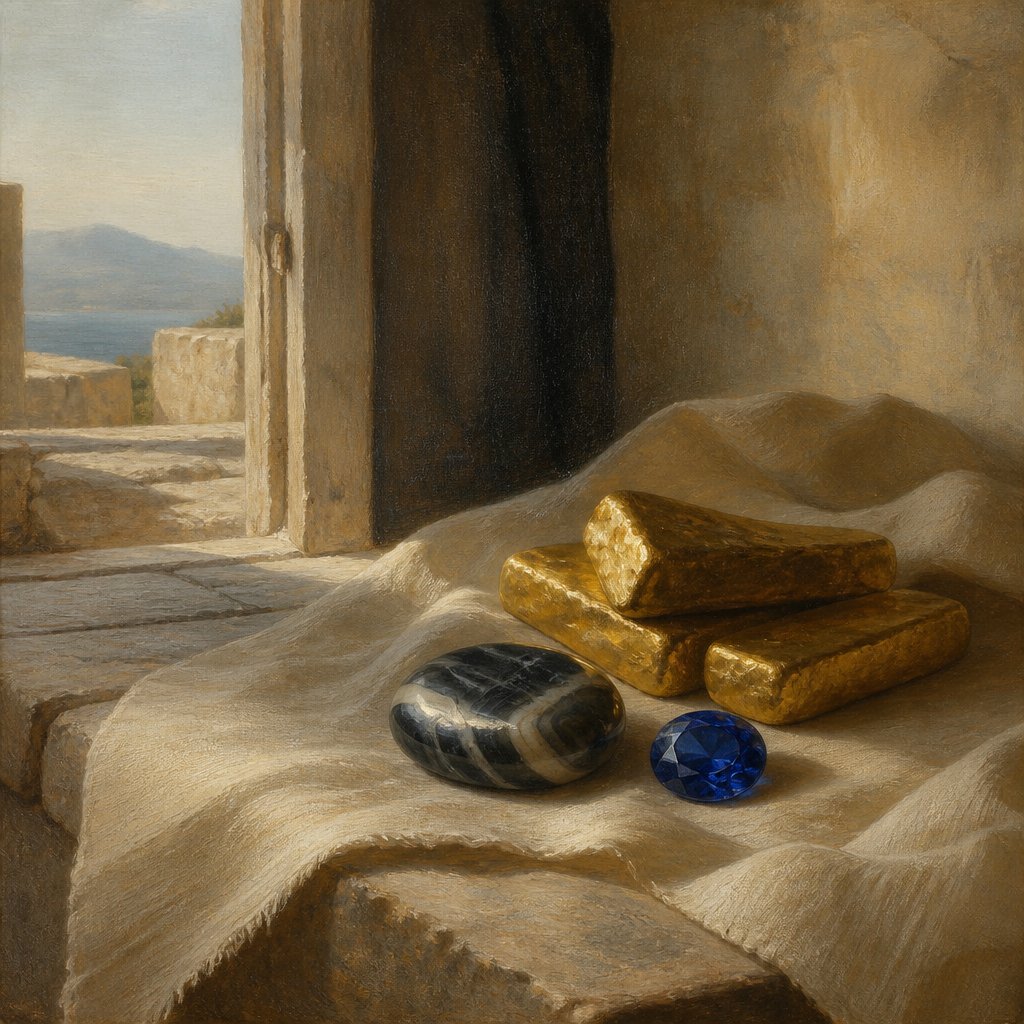
The Bible verse Job 28:16 in the King James Version (KJV) states: "It cannot be valued with the gold of Ophir, with the precious onyx, or the sapphire."
This verse comes from the book of Job in the Old Testament, which tells the story of a man named Job who undergoes immense suffering and loss, yet remains faithful to God. In this particular verse, Job is reflecting on the value of wisdom and understanding, and he emphasizes that these things are more precious than any material wealth.
The context of this verse is important to understand its full meaning. In the preceding verses, Job explores the depths of the earth and the lengths that humans will go to in search of precious resources such as silver, gold, and precious stones. He describes the labor and perseverance that people put into mining for these valuable resources, and he contrasts this with the elusive nature of wisdom and understanding.
In the KJV, the mention of "the gold of Ophir" and "the precious onyx, or the sapphire" serves as a vivid imagery and symbolism of earthly wealth and riches. Ophir was a region known for producing gold, and onyx and sapphire are precious stones that were highly valued in ancient times. Job is making a powerful statement by saying that even these valuable resources cannot compare to the worth of wisdom and understanding.
The themes present in this verse include the contrast between material wealth and spiritual enlightenment, the pursuit of knowledge, and the limitations of human understanding. Job is highlighting the transcendent nature of wisdom, suggesting that it cannot be bought or acquired through material means. This theme reflects the broader message of the book of Job, which grapples with the concept of suffering and the nature of God's wisdom and sovereignty.
The symbolism in this verse is rich and multi-layered. Gold, onyx, and sapphire are all symbols of wealth, beauty, and luxury. In contrast, wisdom and understanding are depicted as intangible yet invaluable treasures. The mention of Ophir, known for its wealth of gold, further emphasizes the idea that even the most precious resources on earth pale in comparison to the worth of wisdom.
Furthermore, the imagery of mining and labor in search of these precious resources serves as a metaphor for the human pursuit of knowledge and understanding. Job is acknowledging the efforts and toil that humans invest in acquiring material wealth, but he ultimately positions wisdom as the ultimate prize that surpasses all earthly treasures.
In a broader theological context, this verse can also be interpreted as a reflection of the wisdom and sovereignty of God. Throughout the book of Job, there is a deep exploration of suffering, human limitations, and the ways in which God's wisdom surpasses human comprehension. Job's acknowledgement of the incomparable value of wisdom can be seen as a testament to the transcendent nature of God's wisdom and the limitations of human understanding.
In conclusion, the Bible verse Job 28:16 in the KJV offers a powerful reflection on the value of wisdom and understanding. Through vivid imagery and symbolism, Job emphasizes the incomparable worth of wisdom in contrast to material wealth. This verse invites readers to consider the transcendent nature of wisdom and the limitations of human understanding, while also pointing to the sovereignty and wisdom of God.
Have questions about Job 28:16?
Dive deeper into this scripture with Bible Chat — an AI-powered tool for exploring God's Word through conversation. Ask questions, get context, and grow in your understanding of the Bible.
Get Our Apps


Job 28:16 Artwork

Job 28:16 - "It cannot be valued with the gold of Ophir, with the precious onyx, or the sapphire."
"It cannot be valued with the gold of Ophir, with the precious onyx, or the sapphire." - Job 28:16

Job 28:3

Job 30:28

Job 30:28

Job 30:28

Job 30:28

Job 28:3

Job 28:3

Job 30:28

Job 28:28 - "And unto man he said, Behold, the fear of the Lord, that is wisdom; and to depart from evil is understanding."

Job 16:1 - "Then Job answered and said,"

Job 28:20 - "Whence then cometh wisdom? and where is the place of understanding?"

Job 28:14 - "The depth saith, It is not in me: and the sea saith, It is not with me."

Job 28:6 - "The stones of it are the place of sapphires: and it hath dust of gold."

"Then Job answered and said," - Job 16:1

Job 28:1 - "Surely there is a vein for the silver, and a place for gold where they fine it."

Job 28:12 - "But where shall wisdom be found? and where is the place of understanding?"

Job 16:16 - "My face is foul with weeping, and on my eyelids is the shadow of death;"

Job 28:25 - "To make the weight for the winds; and he weigheth the waters by measure."

Job 13:28 - "And he, as a rotten thing, consumeth, as a garment that is moth eaten."

Job 28:8 - "The lion's whelps have not trodden it, nor the fierce lion passed by it."

Job 28:2 - "Iron is taken out of the earth, and brass is molten out of the stone."

Job 38:28 - "Hath the rain a father? or who hath begotten the drops of dew?"

Job 28:7 draw a hidden path

Genesis 28-16

Job 28:23 - "God understandeth the way thereof, and he knoweth the place thereof."

Job 28:24 - "For he looketh to the ends of the earth, and seeth under the whole heaven;"

Job 28:13 - "Man knoweth not the price thereof; neither is it found in the land of the living."

Job 36:28 - "Which the clouds do drop and distil upon man abundantly."