What does Isaiah 53:5 mean?
"But he was wounded for our transgressions, he was bruised for our iniquities: the chastisement of our peace was upon him; and with his stripes we are healed." - Isaiah 53:5

Isaiah 53:5 in the King James Version reads, “But he was wounded for our transgressions, he was bruised for our iniquities: the chastisement of our peace was upon him; and with his stripes we are healed.” This sentence stands in the middle of Isaiah’s great “Servant” passage (Isaiah 52:13–53:12), where the prophet speaks of a figure who is outwardly despised and afflicted yet inwardly accomplishing God’s saving purpose. The verse is framed as a confession—an awakened recognition by “we”—that the suffering of this Servant is not meaningless tragedy, nor merely the consequence of his own wrongdoing, but a burden carried on behalf of others. It is a reversal of the natural human judgment found nearby in the same chapter, where the onlookers imagine that the afflicted one is “smitten of God” for his own sake; Isaiah 53:5 insists instead that his pain is vicarious and purposeful.
The themes of substitution and moral exchange dominate the verse. “Wounded for our transgressions” and “bruised for our iniquities” interpret the Servant’s injuries as occurring “for” something beyond himself. In KJV diction, “transgressions” emphasizes willful crossing of God’s boundaries, and “iniquities” points to the crookedness and guilt that lie beneath outward acts. The verse does not treat sin as a light mistake; it speaks of real culpability that demands a reckoning. Yet it also declares that the Servant steps into the place where that reckoning should fall. His suffering is connected to “our” moral debt, implying that the relationship between God and man is restored not by denial of evil, but by a cost borne.
The verse then deepens this idea with the phrase, “the chastisement of our peace was upon him.” “Chastisement” in the KJV carries the sense of corrective punishment or disciplinary judgment, not mere hardship. “Our peace” is more than personal calm; it is the condition of being set right, of having wholeness where there was rupture. The verse portrays peace as something obtained through chastisement—through the settling of what sin has disturbed. Symbolically, peace is pictured as a state that could not exist while guilt remained unresolved; therefore the chastisement that would secure peace is transferred to the Servant. The Servant’s suffering becomes the path by which estrangement is turned into reconciliation.
The closing clause, “and with his stripes we are healed,” uses bodily language as a symbol of spiritual and communal restoration. “Stripes” evokes the marks left by blows, the visible evidence of scourging. In prophetic imagery, sickness and wounds often represent the condition of sin and its consequences—weakness, uncleanness, alienation, and decay. “Healed” therefore points beyond physical recovery to the mending of what sin has damaged: the conscience, the relationship with God, and the moral health of a people. The verse’s paradox is deliberate: the Servant’s injuries become the medicine. The cure is not extracted from the absence of suffering, but from suffering endured in love and obedience. In the logic of the passage, his wounds do not merely inspire others; they accomplish something for them.
The immediate context of Isaiah 53 reinforces these meanings by contrasting appearance with reality. This Servant is not presented as one who naturally attracts honor—he is “despised and rejected of men,” acquainted with grief, and treated as worthless. That setting matters because it shows how easily redemptive suffering can be misunderstood. Isaiah 53:5 functions as the interpretive key that corrects the misreading: what looked like defeat was, in God’s purpose, a bearing of guilt; what looked like punishment for his own sin was chastisement carried for others’ peace; what looked like mere violence becomes the means of healing. The larger passage continues this thread by speaking of the Servant bearing griefs and sorrows, being “brought as a lamb to the slaughter,” and making his soul “an offering for sin,” all of which fit the sacrificial and substitutionary symbolism that Isaiah 53:5 compresses into one sentence.
Symbolically, the verse draws on covenant and sacrificial patterns familiar in the Scriptures: the idea that guilt requires atonement, that blood and suffering are associated with purification, and that an innocent representative can bear the burden of the guilty. Without importing another text’s wording, the KJV’s own vocabulary in Isaiah 53 resonates with those patterns by using terms like “iniquities,” “chastisement,” and “offering for sin” in the surrounding lines. Isaiah 53:5 therefore stands as a theological hinge: it speaks of justice—transgressions and iniquities are not ignored—and of mercy—peace and healing are granted. The Servant becomes the meeting point where judgment is not denied but redirected, and where restoration is not imagined but procured.
In significance, Isaiah 53:5 proclaims that true peace with God and true healing for man come through the Servant’s suffering undertaken on behalf of others. It does not romanticize pain; it assigns pain meaning within redemption. It confronts the depth of human sin (“our transgressions,” “our iniquities”) and answers it with the depth of sacrificial love and divine purpose (“upon him,” “with his stripes”). Read in its own prophetic frame, the verse invites the reader to exchange a surface interpretation of suffering for a deeper confession: that God’s saving work can appear, in the moment, as weakness and shame, yet accomplish peace and healing for those who could not produce it for themselves.
Have questions about Isaiah 53:5?
Dive deeper into this scripture with Bible Chat — an AI-powered tool for exploring God's Word through conversation. Ask questions, get context, and grow in your understanding of the Bible.
Get Our Apps


Isaiah 53:5 Artwork

Isaiah 53:5


Isaiah 53:5 - "But he was wounded for our transgressions, he was bruised for our iniquities: the chastisement of our peace was upon him; and with his stripes we are healed."

"But he was wounded for our transgressions, he was bruised for our iniquities: the chastisement of our peace was upon him; and with his stripes we are healed." - Isaiah 53:5

Isaiah 53:5

Isaiah 53:5

Isaiah 53:5 “But he was pierced for our transgressions, he was crushed for our iniquities; the punishment that brought us peace was on him, and by his wounds we are healed.”

Isaiah 53:5 “But he was pierced for our transgressions, he was crushed for our iniquities; the punishment that brought us peace was on him, and by his wounds we are healed.”

Isaiah 53:5 “But he was pierced for our transgressions, he was crushed for our iniquities; the punishment that brought us peace was on him, and by his wounds we are healed.”

"But he was wounded for our transgressions, he was bruised for our iniquities: the chastisement of our peace was upon him; and with his stripes we are healed." - Isaiah 53:5

Isaiah 53:5 “But he was pierced for our transgressions, he was crushed for our iniquities; the punishment that brought us peace was on him, and by his wounds we are healed.”
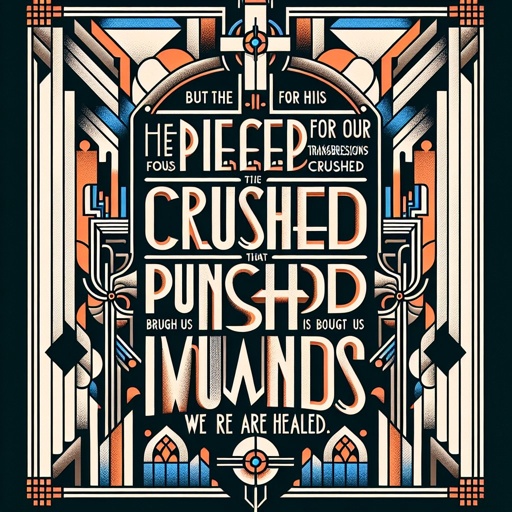
Isaiah 53:5 “But he was pierced for our transgressions, he was crushed for our iniquities; the punishment that brought us peace was on him, and by his wounds we are healed.”
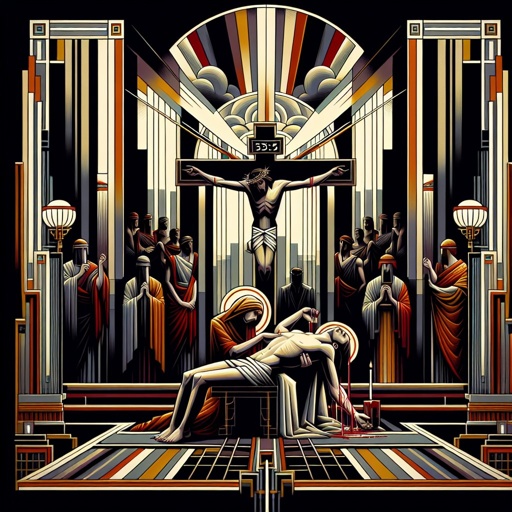
Isaiah 53:5 “But he was pierced for our transgressions, he was crushed for our iniquities; the punishment that brought us peace was on him, and by his wounds we are healed.”

Isaiah 53

Isaiah: 53

Isaiah 53

Isaiah 53

Isaiah 53

isaiah 53 1

Isaiah 53:2

Isaiah 53 3 illustration

Isaiah 53:1 - "Who hath believed our report? and to whom is the arm of the LORD revealed?"

Isaiah 53:2-3 depiction of Jesus Christ

Isaiah 53:4-5 - "Surely he hath borne our griefs, and carried our sorrows: yet we did esteem him stricken, smitten of God, and afflicted. But he was wounded for our transgressions, he was bruised for our iniquities: the chastisement of our peace was upon him; and with his stripes we are healed."

Isaiah 53:9 - "And he made his grave with the wicked, and with the rich in his death; because he had done no violence, neither was any deceit in his mouth."

Isaiah 53:4 - "¶ Surely he hath borne our griefs, and carried our sorrows: yet we did esteem him stricken, smitten of God, and afflicted."

"For he shall grow up before him as a tender plant, and as a root out of a dry ground: he hath no form nor comeliness; and when we shall see him, there is no beauty that we should desire him." - Isaiah 53:2

"For he shall grow up before him as a tender plant, and as a root out of a dry ground: he hath no form nor comeliness; and when we shall see him, there is no beauty that we should desire him." - Isaiah 53:2

Isaiah 53:11 - "He shall see of the travail of his soul, and shall be satisfied: by his knowledge shall my righteous servant justify many; for he shall bear their iniquities."

"Who hath believed our report? and to whom is the arm of the LORD revealed?" - Isaiah 53:1